
WASHINGTON, August 18, 2026
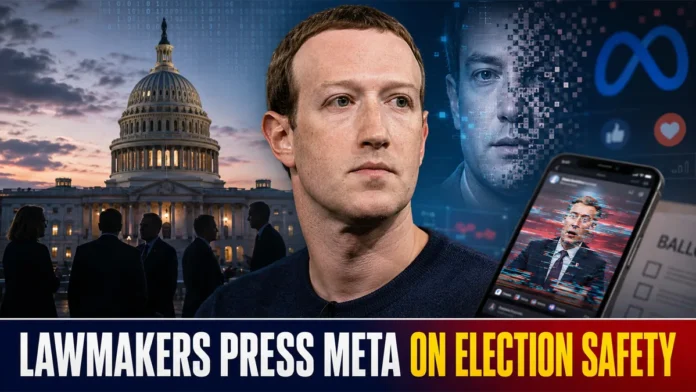
Meta election security measures are facing fresh scrutiny after 19 Democratic members of Congress warned that the company may not be adequately prepared to stop AI-generated deepfakes and political misinformation ahead of the 2026 US midterm elections.
The lawmakers sent a detailed letter to Meta Chairman and CEO Mark Zuckerberg, raising concerns about the company’s decision to end third-party fact-checking in the United States, automate more internal risk assessments and rely on Community Notes to provide context for questionable content.
US Representative Kevin Mullin, a California Democrat whose district includes Meta’s Menlo Park headquarters, led the congressional group. The coalition consists of Mullin and 18 other House members—not US senators.
The lawmakers asked whether Meta can respond effectively to rapidly evolving election threats across Facebook, Instagram, Threads and WhatsApp.
“Generative AI has made it dramatically easier for bad actors to produce deepfakes, cloned voices, and synthetic personas,” the lawmakers wrote in their official letter to Zuckerberg.
Lawmakers Call Meta’s 2026 Election Strategy “Inadequate”
The group said Meta’s current approach may not be sufficient to address the risks facing American voters during the 2026 election cycle.
The lawmakers pointed specifically to three areas of concern: the rollback of professional fact-checking, increased automation of privacy and integrity reviews, and the growing volume of AI-generated content circulating across Meta’s platforms.
They acknowledged Meta’s previous election-security investments, including the company’s election “war rooms” and its earlier work with lawmakers. However, they argued that the company has withdrawn several safeguards at a time when realistic synthetic content is becoming easier and less expensive to produce.
The letter asks Zuckerberg to explain how Meta’s election-integrity staffing and budget in 2026 compare with the resources allocated during the 2020 and 2024 US elections.
End of US Fact-Checking Program Raises Questions
Meta announced in January 2025 that it would discontinue its third-party fact-checking program in the United States. More than 90 independent organizations had participated in the program by reviewing content that could contain false or misleading claims.
The company replaced that system with Community Notes, which allows participating users to add context to posts on Facebook, Instagram and Threads.
The lawmakers argued that the change has shifted responsibility for verifying information onto users who may lack the time, expertise or resources to investigate questionable claims.
They also noted that Community Notes generally adds information to a post instead of necessarily preventing the underlying content from spreading.
The congressional group asked Meta to disclose how much misinformation Community Notes has identified since its introduction and how its performance compares with the discontinued third-party fact-checking program.
Fake “Emily Hart” Influencer Cited as Warning
The letter highlighted “Emily Hart,” a fabricated conservative influencer created using generative AI tools.
According to the lawmakers, a 22-year-old medical student in India created the synthetic persona, which presented itself as an American conservative woman and promoted anti-abortion and anti-immigration views.
The account accumulated millions of views and thousands of subscribers before Instagram removed it for fraudulent activity. Lawmakers cited the case as evidence that one individual can create a convincing political identity and distribute partisan content at scale without requiring the resources of a government or large organization.
The incident also raised questions about how platforms verify accounts that appear to represent real people and whether users can easily determine who controls politically influential pages.
Deepfake Campaign Content Reported in Senate Races
The lawmakers also cited confirmed deepfake incidents connected to 2026 Senate campaigns in Texas and Georgia.
Among the examples was a fabricated video advertisement that appeared to show Texas Senate candidate James Talarico speaking directly to the camera. The letter warned that realistic videos and synthetic audio could falsely portray candidates as making statements they never made.
The lawmakers said AI-generated content could also be used to spread false voting instructions, impersonate public officials or manufacture nonexistent political endorsements.
They asked Meta to explain its policies for handling deepfake videos, cloned voices and accounts that impersonate candidates or elected officials.
Congress Seeks Answers About Paid Political Influencers
The letter includes nine sets of questions covering Meta’s election-security operations and political-content rules.
The lawmakers want Meta to explain:
- Whether paid political influencers must disclose their compensation and funding sources.
- Whether political advertisers must identify misleading images, videos or audio produced with AI.
- How Meta handles non-advertising political deepfakes posted by users or third parties.
- How quickly deceptive content is removed from Facebook, Instagram, Threads and WhatsApp.
- Whether state and local election officials have dedicated reporting channels.
- How Meta verifies Facebook identities and detects malicious automated accounts.
- What disclosures are required for political pages controlled by third parties.
- How Community Notes compares with professional fact-checking.
- How much content Meta has removed under its community standards since January 2025.
Zuckerberg has been asked to submit the company’s responses by Friday, September 18, 2026.
What Meta Says About Its Election Protections
Meta has separately outlined measures it says will help protect the 2026 midterm elections.
The company requires advertisers running election, political or social-issue advertisements to complete an authorization process and include a “paid for by” disclosure. Those advertisements are stored in Meta’s publicly accessible Ad Library.
Meta also requires disclosures in certain cases when AI is used to create or alter political advertisements. The company says it places “AI info” labels on non-advertising content when its systems detect technical signals indicating that an image, video or audio recording was generated or manipulated with AI.
Users are also required to disclose realistic AI-generated video or synthetic audio in certain circumstances.
In addition, Meta plans to block new political, election and social-issue advertisements during the final week of the 2026 campaign. Advertisements that received at least one impression before the restriction begins may continue running. Details of these measures appear in Meta’s 2026 midterm election plan.
The dispute now centers on whether those policies, combined with Community Notes and automated detection systems, can respond quickly enough when convincing deceptive content begins circulating during a fast-moving election campaign.








Comments are closed.