WASHINGTON, Aug. 16, 2026
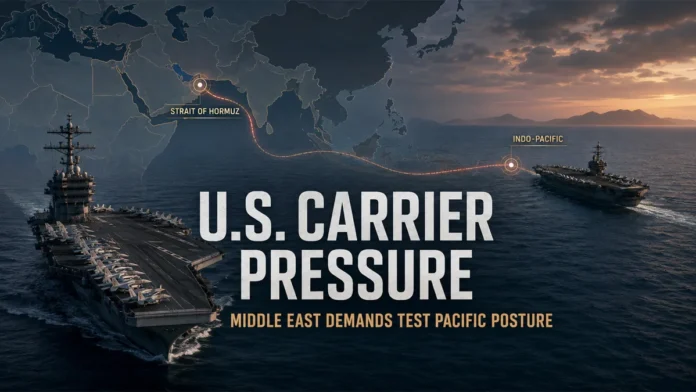
US last aircraft carrier in Asia is reportedly preparing to leave the western Pacific as continuing operations against Iran place mounting pressure on the American Navy’s deployment schedule.
The USS George Washington is expected to move from the Pacific toward the Middle East, where it could eventually replace the USS Abraham Lincoln. The Lincoln’s deployment was extended beyond its original May return schedule to support military operations connected to Iran.
The anticipated movement could temporarily leave the western Pacific without a forward-deployed American aircraft carrier. Although other U.S. warships, submarines and military aircraft will remain in the region, the carrier’s departure could create a highly visible gap at a time when China is expanding its military activity around Taiwan, the South China Sea and waters near Japan.
The U.S. Navy had not publicly confirmed the completion of the reported George Washington transfer as of Aug. 16. The proposed carrier movement should therefore be treated as an expected deployment rather than a completed withdrawal.
Iran Operations Place US Carrier Fleet Under Pressure
The development comes as Adm. Brad Cooper, commander of U.S. Central Command, completed a 10-day tour of the Middle East on Saturday.
Cooper visited Bahrain, Iraq, Israel, Jordan, Saudi Arabia and the United Arab Emirates. He met senior civilian and military leaders and spoke with American personnel stationed across the region.
According to CENTCOM, more than 50,000 U.S. service members are currently operating in the Middle East in support of different military and security missions.
Cooper also visited the USS Abraham Lincoln in the Arabian Sea. The carrier left San Diego in November and reached the Middle East in January.
CENTCOM said the Lincoln Carrier Strike Group has conducted thousands of combat flights supporting regional security operations and the continuing U.S. naval campaign involving Iran. Official CENTCOM statement
USS Abraham Lincoln Stays at Sea Beyond Original Schedule
The Abraham Lincoln was initially expected to return from deployment in May. Its assignment was extended as Washington maintained military pressure on Iran and continued naval operations around the Arabian Sea.
The longer deployment has intensified concerns about pressure on the carrier’s personnel, maintenance requirements and supply network.
Aircraft carriers require extensive logistical support. Thousands of sailors serve aboard a carrier strike group, while aircraft, engines, defensive systems and other equipment must be continuously maintained.
Keeping one carrier deployed beyond its original schedule can also affect the readiness and deployment plans of other ships. Another carrier may need to leave its assigned region earlier than expected to provide relief.
That appears to be the challenge now confronting the USS George Washington.
USS George Washington Could Replace Abraham Lincoln
The USS George Washington has served as a critical part of the American military presence in the western Pacific. Its reported movement toward the Middle East could allow the Abraham Lincoln and its personnel to return home.
However, it may also leave the Pacific without a forward-deployed U.S. carrier until another ship arrives.
The absence is expected to be temporary. Washington could deploy another aircraft carrier within the next several months, depending on operational schedules, maintenance and global security requirements.
The USS Theodore Roosevelt could also reportedly leave San Diego for the Middle East. If that happens, the Navy could soon have as many as four carriers deployed globally, potentially allowing another carrier to return to the Pacific.
No final public timetable has been announced for those movements.
Could China Take Advantage of the Carrier Gap?
The departure of one carrier would not mean that China suddenly gains unrestricted control of the western Pacific.
The United States maintains submarines, destroyers, fighter aircraft, bombers, surveillance systems and military bases throughout the region. It also has defense alliances with Japan and the Philippines and maintains close security relations with several other countries.
However, aircraft carriers carry major strategic and psychological importance. Their presence signals that Washington can quickly conduct large-scale air operations without depending entirely on land bases.
Defense analysts believe China could use the temporary absence of a carrier to increase military signaling and question America’s ability to support its regional allies.
Beijing is unlikely to launch an attack on Taiwan merely because a single American carrier leaves the region. However, it could use the moment to conduct additional exercises, increase patrols or present China as the dominant military power in the western Pacific.
China Increases Military Activity Across the Region
China considers the American military presence in Asia a challenge to its regional influence and its territorial claims.
Beijing claims Taiwan as part of China, while Taiwan operates as a self-governed democracy. Chinese authorities have not ruled out using force to bring the island under their control.
China has also continued to increase its activities in disputed parts of the South China Sea.
Chinese forces conducted military exercises near Scarborough Shoal this month. China and the Philippines both claim the area, which has become a major source of tension between Beijing and Manila.
A Chinese guided-missile destroyer also conducted a live-fire exercise near Okinotorishima, Japan’s southernmost territory, last month.
China conducted naval exercises with Indonesia during the week as it sought to expand defense engagement with Southeast Asian countries.
Those developments are not necessarily a direct response to American carrier movements. However, they show that Beijing continues to strengthen its military presence while monitoring Washington’s ability to maintain forces across multiple regions.
Japan and Philippines Could Watch US Move Closely
Japan and the Philippines are among the American allies most likely to monitor the carrier’s reported departure.
Both countries have territorial disputes with China and rely on security cooperation with Washington as a counterweight to Beijing’s military power.
Aircraft carriers provide psychological reassurance to U.S. allies because they represent a mobile and immediately visible American military capability.
Their absence could strengthen perceptions that Washington is distracted by the Middle East, even if American submarines, aircraft and other warships remain active in the Pacific.
Adm. Frank Bradley, head of U.S. Special Operations Command, met Philippine officials in Manila on Thursday as Washington sought to reaffirm its regional commitments.
Bradley said American special operations forces were prepared to expand joint exercises intended to strengthen the U.S.-Philippines alliance. He was also expected to visit Japan.
Analysts Question Washington’s Priorities
Greg Poling, director of the Southeast Asia Program at the Center for Strategic and International Studies, has argued that Washington’s extended Middle East involvement appears to conflict with its stated effort to prioritize the Pacific.
The Trump administration has repeatedly presented the Indo-Pacific as a central strategic region. However, military operations involving Iran are demanding substantial naval resources.
Poling believes Beijing could benefit politically from any perception that America’s attention is shifting away from Asia.
Bryan Clark, a defense analyst at the Hudson Institute and a former Navy submarine officer, has said China could use the carrier’s absence to persuade countries such as Japan, the Philippines and Indonesia that the United States is no longer the dominant power in the western Pacific.
That would not necessarily reflect the actual balance of military power. Still, perceptions can influence regional diplomacy, defense planning and decisions about security partnerships.
Did the US Underestimate the Iran Conflict?
Clark has also argued that the carrier pressure reflects insufficient preparation for an extended conflict involving Iran.
If military planners had anticipated that operations would last this long, he said, deployment and maintenance schedules could have been adjusted earlier to make additional carriers available.
The U.S. Navy operates 11 aircraft carriers, but not all can be deployed simultaneously. Several are normally undergoing maintenance, repairs, training or preparations for future missions.
Only two or three carriers are commonly deployed at the same time. Increasing that number can provide short-term military flexibility but may produce longer-term readiness problems.
Strategic Challenge for the United States
Washington now faces the difficult task of maintaining military pressure on Iran while demonstrating that its commitment to the Indo-Pacific remains unchanged.
The Middle East requires carriers to support air operations, protect U.S. forces and secure important maritime routes. The Strait of Hormuz is particularly significant because it is one of the world’s most important energy transit corridors.
The Indo-Pacific presents a different challenge. Washington seeks to deter possible Chinese military action, support allies and preserve freedom of navigation across strategically important waters.
The reported movement of the USS George Washington illustrates how a prolonged operation in one region can affect American military planning elsewhere.
The possible Pacific carrier gap may be temporary, and it would not remove the broader U.S. military presence from Asia. Nevertheless, China could use the absence to increase military pressure and advance the message that America’s resources are stretched between competing global crises.