Seoul, August 15, 2026
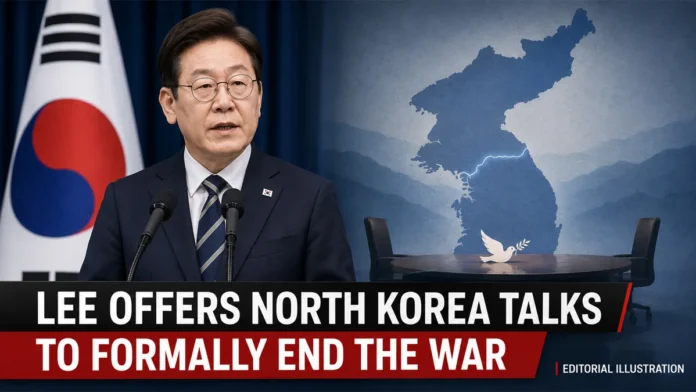
Lee Jae Myung North Korea talks could provide a path toward formally ending the Korean War and curbing the expansion of Pyongyang’s nuclear capabilities, the South Korean president said Saturday as he renewed his call for direct dialogue.
Speaking during South Korea’s 81st Liberation Day ceremony in Seoul, Lee proposed that the two Koreas begin discussions as parties directly involved in the decades-long conflict. He said the talks could help replace the Korean Peninsula’s fragile armistice with a permanent peace arrangement.
Lee also urged Seoul and Pyongyang to abandon the intention of threatening each other and move toward peaceful coexistence, mutual respect and shared growth.
Lee calls for talks to end the Korean War
Lee said South and North Korea should begin direct discussions aimed at formally concluding the war that divided the peninsula more than seven decades ago.
“Let us put down our intentions to threaten each other and begin discussions to end the long-running war as the directly involved parties,” Lee said in his Liberation Day address.
He added that the same negotiating process could be used to consider effective and practical measures to halt further advances in North Korea’s nuclear capabilities.
The proposal does not mean that formal negotiations have begun. North Korea has not yet indicated that it will accept Lee’s offer or participate in discussions.
Why the two Koreas technically remain at war
The Korean War began in 1950 and continued until 1953. Fighting stopped after an armistice agreement was signed, but the conflict was never concluded through a formal peace treaty.
South and North Korea are therefore still technically considered to be at war.
Lee said his administration would begin a diplomatic journey to end that unresolved conflict and transform the peninsula’s “unstable armistice system” into a durable peace regime.
Such a transition would require complex negotiations involving the parties to the conflict and would have significant regional and international security implications.
Proposal delivered on South Korea’s Liberation Day
Lee announced the initiative during a ceremony marking South Korea’s 81st Liberation Day at the Sejong Center for the Performing Arts in Seoul.
Liberation Day commemorates Korea’s freedom from Japanese colonial rule, which lasted from 1910 until 1945.
The anniversary provided Lee with a prominent national platform to outline what he described as a move from general principles to practical action on inter-Korean relations.
In the published text of his Liberation Day address, Lee presented peace as one element of a broader national vision centered on hope, opportunity and balanced development.
South Korea rules out forced unification
Lee reiterated that South Korea respects North Korea’s existing political system and does not intend to pursue unification by absorption.
He also said Seoul would not undertake hostile actions against Pyongyang.
The president argued that the two Koreas must respect each other, reduce unnecessary confrontation and begin dismantling hostility embedded in their perceptions, rules and institutional systems.
Lee said he hoped representatives from both sides would meet face-to-face to pursue peaceful coexistence and mutual development.
His comments were intended to reassure Pyongyang that the proposed dialogue would not serve as a mechanism for regime change or forced unification.
Peaceful coexistence at the center of Lee’s approach
Lee said his government would work to redirect the energy currently devoted to hostility and confrontation toward peaceful coexistence and shared prosperity.
The South Korean president has promoted a gradual engagement policy toward North Korea despite the continued absence of a positive response from Pyongyang.
His administration has repeatedly emphasized that reducing military tension and creating reliable crisis-management channels are necessary to prevent accidental escalation on the peninsula.
Lee said stable peace would require safeguards capable of controlling inter-Korean tensions and preventing a confrontation from developing into a larger crisis.
North Korea’s nuclear program remains the biggest obstacle
North Korea’s expanding nuclear and missile capabilities remain the most difficult challenge facing Lee’s peace initiative.
Rather than expecting immediate denuclearization, Lee’s administration has supported a phased approach. That strategy would initially seek to stop further development of nuclear and missile capabilities before moving toward their reduction and eventual dismantlement.
Lee has argued that practical measures to halt the expansion of North Korea’s nuclear program could be discussed as part of a wider peace process.
In July, he also reaffirmed South Korea’s intention to pursue gradual denuclearization while promoting peaceful coexistence on the peninsula.
However, North Korea has continued to strengthen its nuclear position and has shown little interest in responding to Seoul’s recent reconciliation efforts.
Pyongyang has not responded positively to earlier outreach
Lee’s latest offer is significant because North Korea has remained unresponsive to several conciliatory steps taken by his administration.
Despite that silence, Seoul has pledged to continue pursuing dialogue and peaceful coexistence rather than abandoning diplomatic engagement.
The president said the two sides should begin by reducing hostility in their thinking, rules and institutions. He framed such changes as a starting point for coexistence rather than a concession by either government.
What happens next?
The immediate future of Lee’s proposal depends on whether North Korea responds and what conditions it sets for any negotiations.
Even if Pyongyang agrees to talks, converting the 1953 armistice into a formal peace arrangement would involve difficult security, diplomatic and legal questions. Discussions over North Korea’s nuclear program would be even more complicated.
For now, Lee’s speech represents an invitation to negotiate—not a peace agreement or confirmation of an upcoming summit.
Its practical impact will depend on whether Pyongyang sees value in renewed engagement and whether the parties can establish a negotiating framework acceptable to all sides.