GARDEN CITY, New York — August 15, 2026
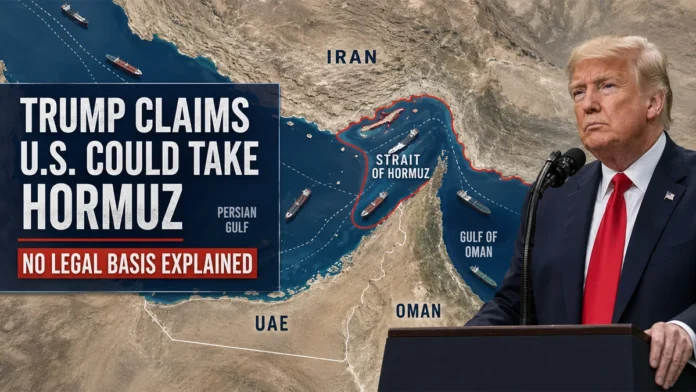
Trump Strait of Hormuz claim has opened a new and potentially explosive front in the debate over the US-Iran conflict after President Donald Trump said he could declare the strategically vital waterway American territory.
Speaking at an event focused on crime and law enforcement in Garden City, New York, Trump said the United States would claim the strait after defeating Iran.
“After defeating Iran, which is being very badly defeated, very soon I will declare the Strait of Hormuz a territory of the United States,” Trump said.
The president did not explain how Washington could acquire the waterway, what legal authority he would invoke or whether the administration intended to pursue any formal territorial process.
A declaration by the president alone would not change the strait’s internationally recognized legal or geographic status.
Why Trump’s Hormuz statement is extraordinary
The Strait of Hormuz lies between Iran to the north and Oman and the United Arab Emirates to the south. It connects the Persian Gulf with the Gulf of Oman and the Arabian Sea.
The surrounding waters fall within the maritime zones of the neighboring coastal states. However, because the channel is used for international navigation, ships from other countries have passage rights under established maritime law.
The United Nations Convention on the Law of the Sea permits transit passage through straits used for international navigation. The United States has not ratified the convention but has historically treated many of its navigational provisions as customary international law.
The United Nations’ overview of maritime law says ships and aircraft of all countries are permitted transit passage through international straits, while neighboring states may regulate limited aspects of navigation.
Nothing in that framework would allow a country to acquire an international strait simply by issuing a unilateral declaration.
Trump claims US controls maritime traffic
Trump presented the declaration as an extension of American military control over shipping in the area. He suggested that the US blockade meant vessels could pass only with Washington’s approval.
However, military enforcement or a naval blockade does not automatically confer sovereignty over a waterway. Control exercised during an armed conflict is legally different from recognized ownership or territorial sovereignty.
Any attempt to permanently alter the status of the Strait of Hormuz would likely face opposition from Iran, Oman and other regional governments, along with countries dependent on the route for energy supplies.
Why the Strait of Hormuz matters to the world
The waterway is one of the most important energy transit points on the planet.
According to the US Energy Information Administration, approximately 20.9 million barrels of petroleum and other liquids passed through the strait each day during the first half of 2025. That represented roughly one-fifth of global petroleum-liquids consumption and about one-quarter of seaborne oil trade.
More than 20% of global liquefied natural gas trade also passed through the route, primarily through exports from Qatar.
China, India, Japan and South Korea are among the major destinations for crude oil transported through Hormuz. Any prolonged restriction can therefore affect energy prices, shipping costs and inflation across Asia and other parts of the world.
Trump claims Iran’s navy and air force were destroyed
During his address, Trump used sweeping military claims to portray Iran as being close to defeat.
The president said Iran no longer had a functioning navy and claimed that all 159 of its ships had been sunk.
“Think about it. They have no navy. It is completely gone,” Trump said, adding that the ships were now “at the bottom of the sea.”
Trump also claimed that Iran had lost all 212 of its aircraft. He did not present evidence for either figure during the speech.
The numbers should therefore be treated as presidential claims rather than independently established battlefield totals. Wartime assessments are frequently disputed, and governments may count naval vessels, patrol boats, aircraft and damaged equipment differently.
The president also alleged that some of the aircraft had been acquired from the United States during Barack Obama’s presidency. He did not provide details supporting that assertion.
Iranian leadership reportedly weakened
Trump said Iranian command structures had also been severely damaged, making future negotiations more difficult.
“They have no leadership,” he said, claiming that several successive levels of senior officials had been removed.
The president portrayed that situation as both a military achievement and a diplomatic problem because, he said, there was no clear authority available for negotiations.
Trump further claimed that Iran retained some missiles and drones but had suffered major damage to its manufacturing capacity, radar installations and intelligence systems.
No supporting intelligence assessment was released with the remarks.
Trump defends military action against Iran
The president used the speech to defend the administration’s military campaign, arguing that force had been necessary to prevent Tehran from obtaining a nuclear weapon.
Trump said the scale of American military success had not been fully acknowledged publicly but claimed Iranian authorities understood the extent of the damage.
His latest comments add to earlier statements in which he portrayed the US operation as having destroyed Iran’s conventional military capabilities.
What happens next?
Trump’s remark does not itself transfer the Strait of Hormuz to the United States. Any formal attempt to claim sovereignty would trigger major legal, diplomatic and security challenges.
It could also increase uncertainty in global energy markets, particularly if the statement leads shipping companies to expect additional military restrictions or confrontation around the waterway.
For now, the status of the strait remains unchanged: it is an international shipping channel situated between Iran and Oman, with navigational rights governed by maritime law.
The larger question is whether Trump’s statement was political rhetoric intended to emphasize US military power or the first indication of a policy the administration will attempt to pursue.