MUMBAI, August 14, 2026
The Indian stock market ended the week on a subdued note Friday as weakness in metal, information technology and financial shares outweighed gains in consumer durables, private banks and select real estate stocks.
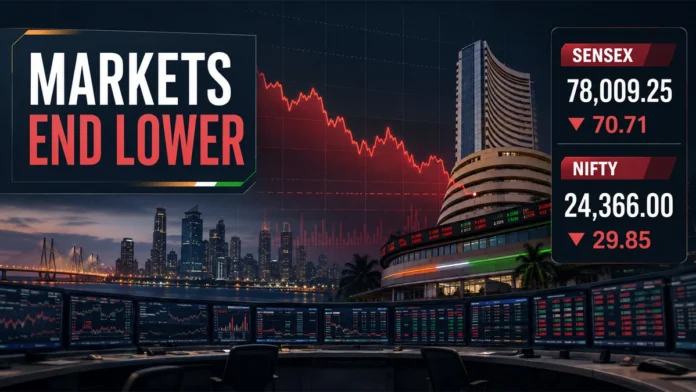
The 30-share BSE Sensex declined 70.71 points, or approximately 0.09%, to close at 78,009.25. The broader NSE Nifty 50 fell 29.85 points, or about 0.12%, to settle at 24,366.00, according to closing-market data available through the BSE and NSE.
Benchmark indices traded within a relatively narrow range during the session as elevated crude oil prices and mixed global cues kept investors cautious. Oil prices remained close to $87 per barrel, raising concerns about inflation and the potential impact of higher import costs on India’s economy.
Although the headline indices recorded only modest declines, selling pressure was visible across several major sectors.
Why did the Indian stock market close lower?
Investors adopted a cautious approach amid uncertainty surrounding global markets, crude oil prices and geopolitical developments. The lack of a strong positive domestic trigger also prevented the indices from establishing a sustained recovery.
Metal stocks experienced the sharpest selling pressure. Information technology, consumer goods and cement shares also weakened during the session. Financial services stocks contributed to the decline, while oil and gas, pharmaceuticals and health care companies finished mostly lower.
The broader weakness indicated that investors were reducing exposure across multiple sectors instead of concentrating their selling in a limited group of stocks.
However, the relatively small declines in the Sensex and Nifty showed that buying in selected sectors prevented a deeper fall.
Metal, IT and financial stocks lead declines
Metal companies emerged as the weakest sectoral performers Friday. The decline came as investors assessed uncertain global demand and mixed signals from international commodity markets.
Information technology stocks also remained under pressure. The sector continues to face questions surrounding global technology spending, demand from major overseas markets and the growing effect of artificial intelligence on traditional outsourcing businesses.
Financial shares weakened as well, placing additional pressure on the benchmark indices. Oil and gas, pharmaceutical and health care stocks joined the decline.
Among individual counters highlighted during the session, Jio Financial Services fell approximately 3%, while Asian Paints lost about 2%.
Selling in heavyweight stocks limited the market’s ability to recover, even as some pockets of domestic consumption remained resilient.
Consumer durables outperform the broader market
Consumer durable stocks were among the session’s strongest performers. Buying interest in the sector helped offset part of the pressure created by metal, technology and financial shares.
Private banking and real estate stocks also displayed relative strength. However, their gains were not sufficient to push the benchmark indices into positive territory.
The contrasting performances reflected selective buying rather than broad-based investor confidence. Traders continued to favor companies and industries with comparatively resilient domestic demand while remaining cautious about sectors exposed to global economic conditions.
Crude oil prices remain a concern
Oil prices near $87 per barrel continued to influence market sentiment. India imports most of the crude oil it consumes, meaning sustained increases in global prices can affect inflation, government finances, corporate operating costs and the rupee.
Higher oil prices can also increase expenses for transportation, aviation, paints, chemicals and other industries that use petroleum or petroleum-linked products.
The market nevertheless remained range-bound, suggesting that investors were monitoring the situation without engaging in panic selling.
How did global markets perform?
International markets produced mixed signals during the Asian trading session.
Japan’s Nikkei 225 futures gained approximately 0.7%, while the Topix advanced 0.6%. In contrast, Australia’s S&P/ASX 200 declined 0.9%.
Hong Kong’s Hang Seng Index fell 0.9%, while the Shanghai Composite slipped 0.2%. European futures were comparatively positive, with Euro Stoxx 50 futures rising approximately 0.3%.
S&P 500 futures showed little movement during the referenced trading period, indicating a cautious start for US markets.
What should investors watch next?
Investors are expected to monitor crude oil prices, global market movements, foreign institutional investment and upcoming domestic economic data when trading resumes.
Corporate earnings, currency movements and geopolitical developments could also determine whether the Sensex and Nifty break out of their recent trading ranges.
Friday’s decline was modest, but the weakness across several major sectors showed that risk appetite remained restrained at the end of the week.
Market Closing Snapshot
| Index | Closing Level | Change |
|---|---|---|
| BSE Sensex | 78,009.25 | Down 70.71 points |
| NSE Nifty 50 | 24,366.00 | Down 29.85 points |
| Brent crude | Around $87 per barrel | Broadly stable |
| Stronger sectors | Consumer durables, private banks, realty | Positive |
| Weaker sectors | Metals, IT, financials, cement | Negative |