NEW DELHI, August 14, 2026
Maruti Baleno facelift 2026 is expected to make its India debut on September 5, bringing the premium hatchback its first substantial visual and feature update since the second-generation model arrived in 2022.
Maruti Suzuki’s NEXA division has teased an event for September 5 and 6 using the silhouette of a hatchback resembling the Baleno. Although detailed specifications have not yet been released, the updated model is widely expected to be presented on September 5.
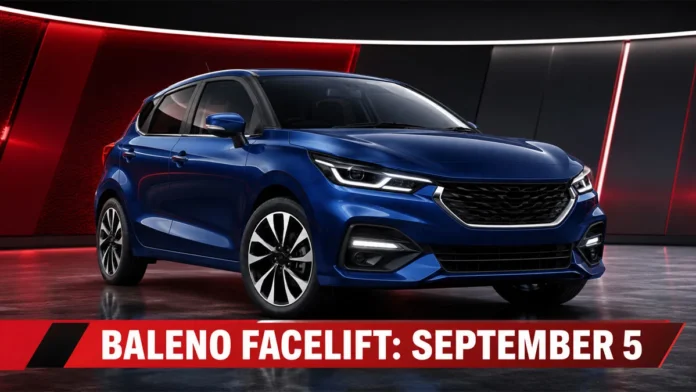
Camouflaged test vehicles indicate that the most noticeable changes will be concentrated around the front fascia. The cabin could receive revised upholstery, new trim finishes and additional convenience features, while the existing petrol and CNG powertrains are likely to continue.
All equipment and technical details remain subject to official confirmation at the unveiling.
Redesigned grille and front bumper expected
The Baleno facelift is expected to receive a redesigned front grille with a thinner and more prominent horizontal element. A chrome-finished bar could extend across the grille and visually connect the two headlamp units.
The shape of the headlamps is unlikely to change substantially. Maruti may retain the current model’s distinctive boomerang-style LED daytime running lights, helping the facelift remain immediately recognizable as a Baleno.
A redesigned front bumper is also expected. Camouflaged prototypes appeared to have a cleaner lower section, while the fog lamps available on some variants of the outgoing model were not visible on the test vehicles.
However, the final bumper configuration and variant-specific lighting equipment will become clear only after Maruti Suzuki reveals the production model.
Side profile likely to remain familiar
Major structural changes are not expected along the sides. The Baleno facelift is likely to retain the existing car’s overall silhouette, pull-style door handles and prominent shoulder line.
Newly designed alloy wheels could provide the main visual difference. The outgoing model offers 16-inch precision-cut alloy wheels on higher variants, and a refreshed design may be introduced for the facelift.
Changes to the vehicle’s dimensions are also unlikely because this is a mid-cycle update rather than a new-generation model.
Updated rear bumper, familiar taillights
At the rear, Maruti Suzuki could introduce a revised bumper with minor styling changes. The wraparound LED combination lamps are expected to retain their current basic shape, although revised internal lighting elements remain possible.
The roof-mounted spoiler, high-mounted brake light, rear windshield wiper and washer are expected to be carried over.
Overall, Maruti appears likely to focus on carefully updating the Baleno’s exterior rather than radically changing its established design.
What could change inside the cabin?
The current dashboard architecture is expected to continue in the Maruti Baleno facelift 2026.
That means the car could retain its freestanding infotainment display, trapezoidal air-conditioning vents and three-spoke steering wheel. Higher variants of the existing Baleno use a 9-inch SmartPlay Pro+ touchscreen with wireless Android Auto and Apple CarPlay.
Maruti Suzuki may refresh the interior through new seat upholstery, revised door trims and different dashboard finishes. A new cabin color combination could also help distinguish the facelift from the outgoing version.
The company has not confirmed whether the infotainment screen will be upgraded or enlarged.
Sunroof and ambient lighting could join feature list
A single-pane electric sunroof is among the most anticipated additions. The feature is already available on several competing premium hatchbacks and compact vehicles, making it a potentially important upgrade for the Baleno.
Ambient cabin lighting is another feature reportedly under consideration. If introduced, it could be reserved for higher trims.
Existing equipment likely to continue includes:
- Automatic climate control
- Rear air-conditioning vents
- Electrically adjustable and folding outside mirrors
- Auto-dimming inside rearview mirror
- Head-up display
- A 360-degree camera
- Cruise control
- Wireless smartphone connectivity
- Six-speaker audio system
- Connected-car technology
- Rear USB Type-A and Type-C charging ports
The outgoing model also offers six airbags as standard, electronic stability control, hill-hold assistance, ISOFIX child-seat anchorages and rear parking sensors. Maruti Suzuki has not yet confirmed the facelift’s variant-wise safety package.
Will the Baleno facelift retain its current engine?
The familiar 1.2-liter, four-cylinder, naturally aspirated K-Series petrol engine is expected to continue.
In the outgoing Baleno, this engine produces approximately 89.7 PS, commonly rounded to 90 hp, and 113 Nm of torque. Transmission choices comprise a five-speed manual and a five-speed automated manual transmission.
The current official Baleno brochure lists the following specifications:
| Powertrain | Maximum output | Maximum torque | Transmission |
|---|---|---|---|
| 1.2-liter petrol | 89.7 PS | 113 Nm | 5-speed manual/5-speed AMT |
| 1.2-liter CNG mode | 77.5 PS | 98.5 Nm | 5-speed manual |
A major mechanical change is not presently expected. Maruti Suzuki is more likely to concentrate on exterior styling, cabin quality and additional features.
Reports suggesting a turbo-petrol or hybrid option remain unconfirmed and should not be treated as final specifications.
CNG version expected to continue
The factory-fitted S-CNG version is expected to remain part of the facelifted Baleno range.
In CNG mode, the current engine develops 77.5 PS and 98.5 Nm and is available only with a five-speed manual gearbox. The outgoing CNG model has a certified efficiency figure of 30.61 kilometers per kilogram.
Maruti has not disclosed whether the updated version will receive a revised CNG-tank arrangement or changes to its luggage capacity.
Expected Maruti Baleno facelift price
Pricing will be announced at the official launch.
The current Baleno is priced from approximately ₹5.99 lakh, with higher variants extending beyond ₹9 lakh on an ex-showroom basis. A moderate increase is possible because of the revised design and expected feature additions.
The final increase will depend on whether equipment such as a sunroof, ambient lighting or an upgraded infotainment system is introduced and how those features are distributed across variants.
Buyers should wait for the official variant-wise price list before making comparisons, as ex-showroom prices do not include registration, insurance and other on-road costs.
Competition in India’s premium hatchback market
The Maruti Baleno facelift will continue to compete with the Tata Altroz, Hyundai i20 and Toyota Glanza.
The Altroz offers multiple powertrain choices, while the i20 emphasizes design, technology and its performance-oriented N Line range. The Toyota Glanza shares its underlying platform and mechanical package with the Baleno but uses Toyota-specific styling and branding.
A sharper exterior and additional equipment could help Maruti Suzuki strengthen the Baleno’s position without changing the efficient petrol-and-CNG formula that has supported its popularity.
The production design, confirmed equipment, bookings, deliveries, fuel-efficiency figures and complete prices are expected to be disclosed around the September presentation.