BOGOTÁ, August 12, 2026 —
The Colombia Earthquake 2026 death toll has risen to 188, while at least 1,677 people have been injured, according to the latest consolidated figures attributed to the Colombian Association of Capital Cities, known as Asocapitales, as rescue and damage-assessment operations continue across the country’s heavily affected western region.
The 7.4-magnitude earthquake struck western Colombia on Monday morning, causing widespread damage to homes, public infrastructure and transportation facilities and leaving some of the country’s largest cities dealing with extensive destruction.
Cali and Pereira have reported the heaviest human toll in the latest Asocapitales assessment. Cali accounted for 95 deaths and 997 injuries, while Pereira reported 79 deaths and 278 injured people.
The figures remain subject to revision as emergency teams continue searching affected areas and local authorities update their assessments.
Colombia’s geological authority recorded the main earthquake near San José del Palmar in the Chocó department at 7:34 a.m. local time on August 10.
Colombia Earthquake Death Toll Reaches 188
The scale of the disaster has become clearer as rescue teams gain access to damaged neighborhoods and municipalities.
According to Asocapitales’ latest tally cited in the supplied information, 188 people had been confirmed dead and 1,677 injured.
Cali, one of Colombia’s largest cities and the capital of Valle del Cauca, has recorded the highest number of casualties in that assessment.
The city reported 95 deaths, while nearly 1,000 people were injured.
Pereira has also suffered severe losses, with 79 fatalities and 278 injuries reported.
Earlier official Asocapitales updates had already warned that casualty numbers were preliminary and could change as damage and needs assessments progressed across affected cities.
The continuing revisions underscore the fluid nature of the emergency, particularly as authorities attempt to obtain information from locations where communications and transportation links have been disrupted.
Where Did the 7.4-Magnitude Colombia Earthquake Strike?
The earthquake struck western Colombia, with the epicentral area located near San José del Palmar in Chocó.
The Colombian Geological Service lists the main shock at 7:34 a.m. local time on Monday, August 10, 2026.
The tremor was powerful enough to cause damage across several western Colombian cities and was felt well beyond the immediate epicentral region.
The source material places the earthquake’s depth at approximately 96 kilometers, while early seismic assessments have varied somewhat as agencies refine their measurements.
The relatively deep earthquake nevertheless caused widespread structural damage, particularly in populated cities where buildings, houses and public facilities were affected.
Chocó, Valle del Cauca and Risaralda are among the areas facing significant consequences from the disaster.
Cali Reports 95 Deaths and Nearly 1,000 Injuries
Cali has emerged as one of the hardest-hit urban centers.
According to the latest Asocapitales figures in the report, 95 people have died in Cali and 997 have been injured.
The high casualty figure reflects the scale of destruction in Colombia’s third-largest city, where emergency personnel have been working through damaged buildings and neighborhoods.
Rescue teams and volunteers have been searching collapsed structures for survivors while medical facilities deal with large numbers of injured people.
The disaster has also created logistical challenges, with damaged roads, structures and essential services complicating efforts to reach everyone requiring assistance.
Authorities remain focused on rescue operations while engineers assess buildings that may have suffered structural damage but have not collapsed.
Residents have been urged to exercise caution around damaged structures because aftershocks can increase the risk of additional collapses.
Pereira Also Suffers Heavy Losses
The city of Pereira, in Colombia’s coffee-growing region, has also recorded a devastating toll.
Asocapitales reported 79 deaths and 278 injuries there.
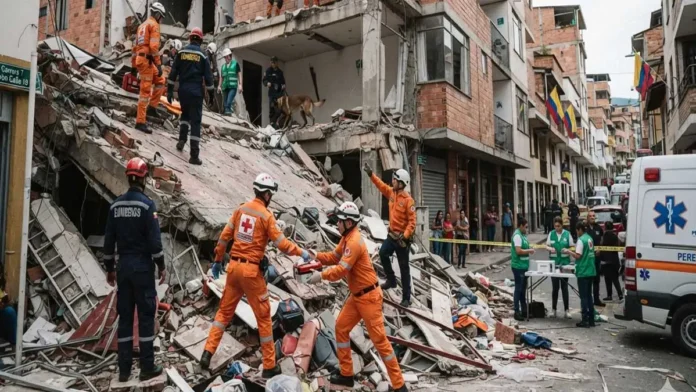
Emergency crews have been using heavy equipment to move concrete and debris from collapsed structures while rescuers search for people who may remain trapped.
The scale of the destruction has required assistance from local authorities, emergency services and national agencies.
Pereira was identified in earlier official Asocapitales assessments as one of several provincial capitals under the highest alert level after the earthquake.
The city remains a major focus of Colombia’s national rescue effort.
More Than 1,500 Homes Reportedly Damaged
President Abelardo de la Espriella earlier said that approximately 1,575 homes had been damaged by the earthquake, according to the information provided.
Housing damage has left many families facing uncertainty over whether they can safely return home.
Some structures have sustained visible damage, while others require engineering inspections before residents can be permitted to re-enter.
The destruction creates a second major challenge after immediate search-and-rescue operations: providing shelter, food, clean water, medical care and other essential assistance to displaced families.
Local governments are continuing to assess damage and identify the communities with the most urgent needs.
Asocapitales said it was maintaining direct contact with affected departmental capitals while coordinating with mayors and municipal teams.
Airport Infrastructure Hit by Earthquake
Transportation infrastructure has also been affected.
According to the information released following the disaster, infrastructure at six airports suffered damage, forcing the temporary suspension of commercial flight operations at affected facilities.
Airport disruption can significantly complicate disaster relief because aircraft are often crucial for moving rescue personnel, medicine, food and specialized equipment into areas where roads have been damaged.
Authorities have therefore been carrying out safety inspections before allowing normal operations to resume.
The situation at individual airports may change as engineering teams complete assessments, meaning passengers traveling within or through affected regions should verify flight information directly with airlines and airport authorities.
Colombia Declares National Disaster
Faced with rapidly rising casualties and extensive infrastructure damage, the Colombian government declared a national disaster on Monday.
The measure allows national authorities to mobilize resources and coordinate emergency operations across multiple regions.
Search-and-rescue work remains the immediate priority.
Emergency services have been deployed to damaged cities while local governments assess collapsed buildings, hospitals, schools, roads, water networks and telecommunications infrastructure.
Colombia’s national government is also coordinating with regional and municipal authorities to determine where additional equipment and personnel are needed most.
Asocapitales Coordinates With Affected Cities
Asocapitales said it remains in constant contact with the capitals of affected departments.
The organization is working with mayors and their teams to monitor conditions, determine the extent of damage and identify the most urgent humanitarian requirements.
These assessments are critical because earthquake damage can vary substantially even between nearby communities.
One municipality may require search-and-rescue equipment, while another may urgently need temporary shelter, drinking water, medical supplies or engineering teams.
The continuing flow of information from local administrations is also likely to result in further revisions to casualty and damage figures.
Earlier official Asocapitales reporting explicitly described its casualty figures as preliminary while damage and needs assessments continued.
Rescue Teams Search Through Collapsed Buildings
Emergency personnel are continuing to search damaged structures for possible survivors.
Images from affected Colombian cities have shown firefighters, rescue workers and volunteers working through large piles of concrete, twisted metal and other debris.
In some areas, heavy machinery has been required to remove large pieces of collapsed structures.
Rescue work after a major earthquake is especially dangerous because damaged buildings can remain unstable, while aftershocks may cause additional sections to collapse without warning.
Teams must therefore balance the need to reach trapped people quickly with the safety of rescue personnel and survivors.
The first days following an earthquake are particularly critical, and rescue operations are continuing across multiple urban areas.
Aftershock Risk Remains a Concern
The main earthquake has been followed by additional seismic activity.
The Colombian Geological Service has continued recording earthquakes around San José del Palmar, including events after the main shock. Its seismic listings show subsequent tremors in the same area.
Aftershocks are common following major earthquakes and can continue for days, weeks or even longer.
Most are weaker than the original event, but they can still cause further damage to structures already weakened by the main earthquake.
Residents in affected areas should therefore continue following instructions from Colombian emergency and geological authorities.
International Leaders Express Solidarity With Colombia
The scale of the tragedy has prompted expressions of support from governments and international leaders.
French President Emmanuel Macron expressed condolences to the Colombian people and solidarity with victims, injured residents, grieving families and emergency teams responding to the disaster.
Macron said Colombia could count on France’s friendship and support during the difficult period.
His message also recognized rescue workers and others helping people affected by the earthquake.
Ukrainian President Volodymyr Zelenskyy likewise expressed solidarity with Colombia and appealed for support for communities affected by the disaster.
Expressions of international solidarity are expected to be followed by discussions over humanitarian assistance as Colombian authorities determine what additional support may be required.
Humanitarian Needs Could Grow as Damage Assessments Continue
Beyond the immediate death and injury toll, the earthquake has created significant humanitarian challenges.
Thousands of people whose homes have been damaged may require temporary accommodation, while interruptions to electricity, water, transportation and healthcare services can complicate daily life.
Authorities must also determine whether damaged schools, hospitals and public buildings remain safe.
Emergency relief is therefore likely to focus on several priorities simultaneously: rescue operations, medical treatment, shelter, clean water, food distribution, restoration of communications and assessment of critical infrastructure.
The difficulty is greater in remote parts of western Colombia, where geographic conditions can slow the movement of emergency personnel and equipment.
Why Western Colombia Faces Significant Earthquake Risk
Colombia lies in a tectonically active part of South America, where several major geological systems interact.
Its western regions are particularly exposed to seismic activity associated with the complex movement of tectonic plates along the Pacific margin.
That means earthquakes are not unusual in the country, although destructive events of this magnitude are far less common.
The latest disaster demonstrates how a powerful earthquake can affect not only homes but also airports, roads, hospitals, communications networks and other critical infrastructure across a wide geographic area.
This creates cascading challenges for emergency responders because damaged infrastructure can make rescue operations harder precisely when those systems are most urgently needed.
Death Toll Could Change as Search Operations Continue
The reported 188 deaths and 1,677 injuries represent a snapshot of an evolving disaster rather than a final toll.
Earlier official figures were significantly lower and were repeatedly revised as information reached national authorities. Asocapitales itself cautioned that its preliminary figures were subject to updating.
Search operations remain underway, and rescue teams are still assessing damaged locations.
For that reason, the number of deaths, injuries, missing people and damaged structures may change as new information is confirmed.
Accurate identification of victims can also take time during a disaster affecting several cities simultaneously.
Colombia Faces Long Road From Rescue to Recovery
The immediate priority remains finding survivors and treating the injured, but Colombia will soon face an extensive recovery effort.
Thousands of damaged homes will need to be inspected, repaired or rebuilt.
Airport infrastructure and other transportation systems will require restoration, while schools, hospitals and public buildings must be assessed for structural safety.
Families displaced by the earthquake may need temporary accommodation for weeks or months.
The financial cost of rebuilding is also likely to become clearer only after comprehensive damage assessments are completed.
For now, emergency teams remain concentrated on the most urgent task: saving lives.
The Colombia Earthquake 2026 has already become one of the country’s most serious recent natural disasters, with Cali and Pereira suffering particularly heavy casualties.
As rescue operations continue and authorities receive information from affected communities, the full scale of the earthquake’s human and economic impact is still emerging.