TEHRAN, August 10, 2026
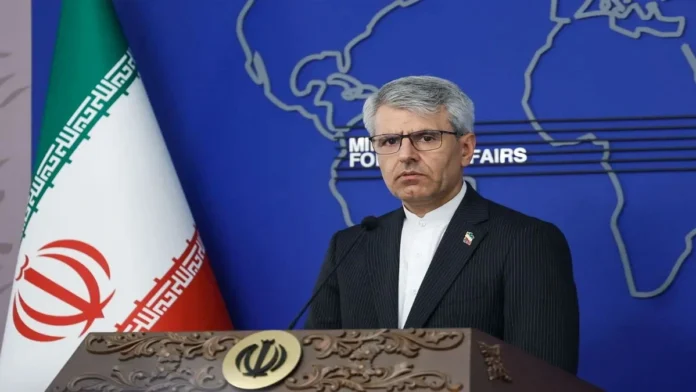
Strait of Hormuz reopening will not move forward while the United States maintains its naval blockade against Iran, Iranian Foreign Ministry spokesman Esmaeil Baghaei said Monday, setting out Tehran’s central condition for restoring normal maritime access through one of the world’s most consequential energy routes.
Speaking during his weekly press briefing in Tehran, Baghaei said restrictions in the waterway followed the military confrontation involving Iran, the United States and Israel. He argued that the conditions required for a full reopening would remain absent until Washington changed what Tehran describes as destructive military and maritime actions.
Baghaei’s statement came as Iran and neighboring Oman continued separate negotiations over a proposed corridor for commercial vessels. Iranian officials emphasized that an agreement with Muscat could facilitate limited or managed transit but would not, by itself, amount to a complete reopening of the Strait of Hormuz.
Iranian Foreign Minister Seyed Abbas Araghchi separately said that Tehran was not engaged in direct negotiations with Washington. According to Araghchi, intermediaries were still exploring possible ways to restart diplomacy, but Iran would not return to formal talks unless the United States stopped what Tehran considers violations of an earlier memorandum and addressed their consequences.
Key Developments in the Strait of Hormuz Dispute
| Issue | Latest stated position |
|---|---|
| Iran’s condition for reopening | Tehran says the U.S. naval blockade must end and Washington must change its military posture |
| Direct Iran-US negotiations | No direct talks are currently underway, according to Araghchi |
| Role of mediators | Intermediaries are seeking a formula for restarting negotiations |
| Iran-Oman maritime corridor | Negotiations are described as being in their final stages |
| Effect of an Oman agreement | Iran says it would not automatically reopen the entire Strait of Hormuz |
| Current maritime conditions | Commercial traffic remains restricted and operational conditions are contested |
| US position | Washington says its measures target Iranian revenue and protect freedom of navigation |
Iran Links Hormuz Reopening to End of US Blockade
Baghaei said Tehran would not regard conditions in the Strait of Hormuz as normalized while the United States continued enforcing restrictions against Iranian ports, maritime activities and commercial networks.
“As long as the U.S. naval blockade continues, the necessary conditions for reopening the Strait of Hormuz will not exist,” Baghaei said. He called on Washington to stop and revise its actions before the two sides could discuss further steps.
The statement represents Iran’s latest public position in a rapidly changing maritime dispute. It does not necessarily mean that every vessel has been physically prevented from entering or leaving the waterway. Limited traffic and specially arranged passages may still occur, while the definition of a full “reopening” remains politically and operationally contested.
An earlier Iranian Foreign Ministry statement in June said shipping traffic was taking place under arrangements connected to a memorandum reached that month. Tehran’s latest statements, however, indicate that it no longer considers the broader conditions required for unrestricted and secure international navigation to be in place.
That distinction is important: limited vessel movement is not the same as normalized commercial transit. A full reopening would ordinarily require predictable navigation rules, acceptable security conditions, commercially available insurance and confidence among shipping companies that vessels can cross without detention, attack, sanctions exposure or additional payment demands.
Why Iran Says the Waterway Was Restricted
Iran has attributed the disruption to what it calls military aggression by the United States and Israel. Tehran maintains that the resulting security situation, combined with U.S. maritime enforcement measures, made normal shipping conditions impossible.
The Iranian government’s characterization of the confrontation and the legality of the U.S. measures are disputed by Washington. The United States has presented its actions as part of a broader campaign to restrict Iranian state revenue, enforce sanctions and protect commercial navigation.
A July statement from the U.S. State Department said American measures supported U.S. Navy enforcement of restrictions involving Iranian ports and coastline. The U.S. Treasury Department has also described its pressure campaign as directly targeting Iran’s primary revenue streams.
Washington has accused Iranian authorities of attempting to impose unauthorized tolls, obtain sensitive vessel information and direct ships through Iranian-designated routes. Iran, in contrast, argues that American military and economic pressure is responsible for the continued disruption.
The competing narratives show that the dispute is not limited to the physical movement of ships. It also involves sanctions enforcement, maritime jurisdiction, security guarantees, revenue collection and the interpretation of international navigation rights.
No Direct Iran-US Negotiations Underway
Araghchi said Sunday that Iran and the United States were not holding direct negotiations.
“There are currently no negotiations between us and the United States,” the foreign minister said while speaking to reporters at the Iranian Foreign Ministry’s Center for Political and International Studies.
He added that mediators were continuing to search for a way to resume diplomacy. However, he said Iran would not return to negotiations until the United States stopped violating an earlier memorandum and compensated for what Tehran considers the resulting damage.
Araghchi did not announce a date, location or agreed framework for renewed talks. His remarks therefore suggest that diplomatic channels have not been completely abandoned, but that no formal negotiating process has been restored.
Iran has repeatedly maintained that it remains open to diplomacy under conditions it considers fair and reciprocal. At the same time, Iranian officials have rejected negotiations conducted under military or economic pressure.
The United States has continued combining maritime enforcement with financial restrictions targeting Iranian oil sales, shipping networks and access to foreign currency. That approach has widened the gap between the two sides over what must happen before negotiations can restart.
Iran and Oman Near Maritime Corridor Agreement
Despite the broader deadlock, Iran and Oman have continued technical negotiations on a proposed shipping corridor.
Baghaei described the discussions as a bilateral matter involving the two countries that border the Strait of Hormuz. According to an official Iranian Foreign Ministry statement, the talks have addressed the corridor’s geographical, legal, technical, environmental and security dimensions.
Iranian officials said the geographical parameters had largely been agreed upon and that a joint statement was undergoing final review and drafting. The discussions have reportedly continued for approximately two months.
Oman has frequently played a mediating role in regional disputes and maintains working relations with both Iran and Western governments. Its location on the southern side of the Strait also makes Muscat essential to any practical arrangement for managed commercial passage.
The proposed corridor could provide ships with a defined route and agreed operational procedures. It may also help lower the risk of misunderstandings between vessels, coastal authorities and military forces operating in the area.
However, the details released so far do not indicate that the proposed route would restore unrestricted traffic throughout the entire waterway.
Why the Oman Corridor Would Not Fully Reopen Hormuz
Araghchi stressed that an agreement with Oman on a new maritime route should not be interpreted as a decision to reopen the Strait of Hormuz without conditions.
The two arrangements address different issues. A bilateral corridor could define where participating vessels travel and establish procedures for their passage. A complete reopening would require the broader removal of military, legal and commercial barriers affecting international shipping.
In practical terms, an Iran-Oman corridor may:
- Establish a clearly defined route for participating commercial vessels.
- Create communication and notification procedures for ships using the corridor.
- Reduce the risk of accidental encounters or navigational misunderstandings.
- Allow limited cargo movement while broader political negotiations remain stalled.
The corridor would not automatically:
- End the U.S. naval blockade or sanctions enforcement.
- Restore unrestricted passage for every commercial vessel.
- Resolve Iran-US disputes over maritime authority.
- Remove war-risk insurance premiums or security concerns.
- Constitute a diplomatic settlement between Tehran and Washington.
Iran’s position is that a corridor agreement can exist alongside continued restrictions in other parts of the waterway. Tehran therefore views the Oman negotiations as a technical and regional arrangement, not as a substitute for a wider political agreement.
Why the Strait of Hormuz Matters to Global Energy Markets
The Strait of Hormuz connects the Persian Gulf with the Gulf of Oman and the Arabian Sea. It provides the principal maritime出口 route for major oil and liquefied natural gas producers across the Gulf region.
Before the current disruption, approximately 20.7 million barrels per day of crude oil and petroleum liquids moved through the strait during the fourth quarter of 2025. The estimated volume fell to 14.6 million barrels per day in the first quarter of 2026, according to the U.S. Energy Information Administration.
The agency has cautioned that vessel-tracking data became especially unreliable after the escalation in late February, meaning that 2026 transit estimates remain subject to revision.
Only limited pipeline capacity is available to bypass the strait. Saudi Arabia and the United Arab Emirates operate alternative infrastructure, but those routes cannot fully replace the volumes that ordinarily travel by sea through Hormuz.
Extended disruption can affect:
- International crude oil and LNG supplies
- Tanker availability and freight charges
- War-risk insurance premiums
- Energy prices in major importing economies
- Refinery supply planning
- Government fuel-subsidy costs
- Inflation and transportation expenses
Asian economies are particularly exposed because a substantial share of Gulf energy exports traditionally moves toward markets in Asia.
US and Iranian Positions Remain Far Apart
Washington and Tehran agree that navigation through Hormuz has global importance, but they disagree sharply over who is responsible for the disruption and what conditions should govern commercial passage.
The U.S. Treasury Department says its campaign is designed to restrict revenue available to the Iranian government and prevent what it describes as coercive demands on commercial vessels. It has warned shipping companies and financial institutions about sanctions exposure connected to payments demanded for passage.
Iran says the U.S. military presence and blockade are the principal obstacles to safe navigation. Tehran argues that Washington cannot simultaneously impose maritime restrictions and demand that Iran treat the waterway as fully open.
These positions leave diplomacy trapped in a circular dispute. Iran wants the pressure reduced before negotiations resume, while the United States treats pressure as leverage intended to produce concessions from Tehran.
What Could Happen Next?
The immediate development to watch is the potential completion of the Iran-Oman shipping corridor agreement. A finalized arrangement could permit more structured commercial movement without resolving the wider Iran-US confrontation.
The second issue is whether mediators can establish an indirect negotiating channel acceptable to both sides. Oman may remain central to those efforts, although neither Tehran nor Washington has announced a new formal process.
The third factor is enforcement. Even if Iran and Oman finalize the corridor, shipping companies will assess whether the arrangement is compatible with U.S. sanctions, naval procedures and insurance requirements.
A sustainable reopening would likely require parallel progress in several areas: maritime security, sanctions enforcement, the disputed memorandum, commercial insurance and political communication. Agreement on only one component may improve limited transit without restoring normal conditions throughout the strait.