TEHRAN | August 8, 2026
Saudi Arabia-Turkey-Pakistan Defense Pact Draws Iran’s Rebuke as Tehran Questions Riyadh’s Security Strategy
Saudi Arabia Turkey Pakistan Defense Pact: Iran has sharply questioned the newly signed trilateral defense agreement between Saudi Arabia, Turkey and Pakistan, arguing that even a formal collective-security arrangement cannot guarantee Riyadh’s long-term safety unless the kingdom changes its regional policies.
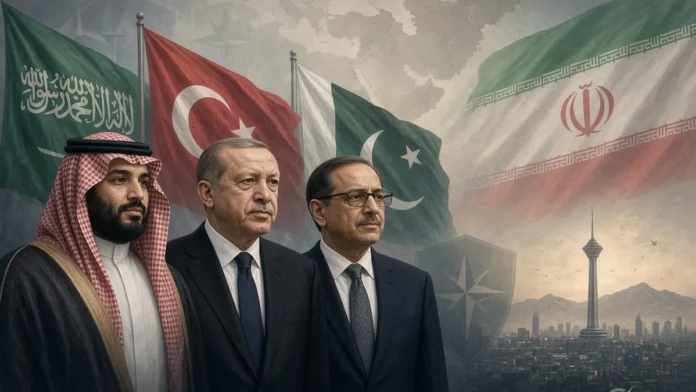
Ebrahim Rezaei, a member of the Iranian Parliament’s National Security and Foreign Policy Commission, criticized the agreement shortly after Saudi Crown Prince Mohammed bin Salman, Turkish President Recep Tayyip Erdogan and Pakistani Prime Minister Shehbaz Sharif signed the Makkah Joint Defense Agreement in Saudi Arabia on Friday.
The pact contains a far-reaching collective-defense provision under which an armed attack against any one of the three countries would be treated as an attack against all three. The arrangement significantly deepens security cooperation among three of the region’s most influential military powers.
What Did Iran Say About the New Defense Pact?
Rezaei took to social media platform X to dismiss the agreement’s ability to provide lasting security to Saudi Arabia.
He argued that a defense agreement with Turkey and Pakistan would not by itself protect the kingdom, just as Riyadh’s decades-long security relationship with Washington had not eliminated threats facing Saudi Arabia.
Rezaei urged Saudi leaders to reconsider their regional policies rather than relying on outside powers for security. His remarks amounted to one of Tehran’s clearest public criticisms of the agreement since it was announced.
His language was particularly pointed, accusing Riyadh of seeking security from other countries rather than addressing what Iran considers the underlying causes of regional tensions.
What Is the Makkah Joint Defense Agreement?
Saudi Arabia, Turkey and Pakistan signed the agreement in Makkah on August 7, following talks involving the leaders of all three countries.
At the heart of the deal is a collective-defense commitment: an armed attack on one member will be considered an attack on all three.
The pact also calls for broader cooperation across defense and security fields, with the three countries seeking to improve joint deterrence and their ability to respond to external threats.
It builds on Saudi Arabia and Pakistan’s earlier Strategic Mutual Defense Agreement, signed in September 2025, which already established a similar bilateral commitment between Riyadh and Islamabad. Turkey’s inclusion dramatically expands the strategic weight of the new framework.
‘Attack on One Is Attack on All’
The collective-defense clause has attracted particular attention because of its resemblance to the principle underpinning NATO’s Article 5, although the new trilateral agreement should not automatically be treated as equivalent to NATO.
Pakistan is a nuclear-armed state, while Turkey is already a NATO member and possesses one of the alliance’s largest armed forces. Saudi Arabia, meanwhile, has substantial financial resources, strategic energy infrastructure and considerable political influence across the Middle East.
Together, those capabilities give the agreement greater geopolitical significance than a conventional defense cooperation memorandum.
However, officials from the participating countries have stressed that the agreement is defensive rather than offensive and is not directed against a particular country. Saudi Arabia has also rejected suggestions that the pact represents the creation of a new military axis or a sectarian or religious bloc.
Is This an ‘Islamic NATO’?
The pact has already prompted comparisons with an “Islamic NATO” because of its collective-defense clause and the military strength of the three participating Muslim-majority countries.
That label, however, is a political and media characterization rather than the official name or stated objective of the agreement.
Unlike NATO, the Makkah pact does not currently have a comparable multinational command structure, large permanent bureaucracy or publicly defined integrated military planning mechanism.
For that reason, describing it as a NATO-style collective-security arrangement is more precise than presenting it as a fully established alternative to NATO.
Why Was the Agreement Signed Now?
The timing is crucial.
The agreement comes amid severe security instability across the Middle East, including the wider conflict involving Iran, disruptions to regional shipping and renewed attacks involving Iran-aligned armed groups.
The escalating crisis has affected shipping around both the Strait of Hormuz and the Red Sea-Bab el-Mandeb corridor, two routes of enormous importance to global energy supplies and trade.
The environment has encouraged several Middle Eastern governments to reassess how heavily they should depend on traditional security arrangements and whether stronger regional defense partnerships are necessary.
Why Is Saudi Arabia Expanding Its Defense Partnerships?
Saudi Arabia has faced repeated missile and drone threats during the region’s recent conflicts.
In late July, Saudi authorities said their air defenses intercepted drones launched from Iraq that attempted to strike oil facilities in the kingdom’s Eastern Province and Riyadh. Riyadh blamed Iran-backed armed groups in Iraq, although those groups disputed Saudi accusations.
Saudi Arabia later said it carried out strikes, coordinated with the U.S. military, against Iran-backed groups in Iraq that it accused of involvement in attacks targeting Saudi energy infrastructure.
At the same time, renewed attacks involving the Houthis in Yemen have increased concerns over Saudi-linked shipping and regional maritime security.
Against this backdrop, Riyadh has sought to diversify its security partnerships rather than rely exclusively on its longstanding relationship with the United States.
What Does Pakistan Bring to the Pact?
Pakistan contributes considerable military experience and, most significantly, is a nuclear-armed state.
Islamabad and Riyadh have maintained defense ties for decades, including military training and security cooperation.
Their relationship was further formalized in September 2025 through the bilateral Strategic Mutual Defense Agreement, which stated that aggression against one country would be treated as aggression against both.
The new trilateral pact extends that collective-security concept to Turkey.
There is, however, no publicly confirmed provision in the Makkah agreement establishing nuclear sharing or explicitly extending Pakistan’s nuclear deterrent to Saudi Arabia or Turkey.
Why Turkey’s Participation Matters
Turkey’s participation adds another powerful dimension.
Ankara is a longstanding NATO member with a large military and a rapidly expanding domestic defense industry, particularly in drones, missiles, naval platforms and other advanced military technologies.
Turkey and Pakistan also have extensive bilateral defense cooperation, while Ankara has steadily expanded its political, economic and defense relationships with Gulf states.
Adding Turkey therefore combines Saudi financial and geopolitical influence, Pakistani military capabilities and Turkish defense-industrial strength under a collective-defense framework.
What Is the Agreement Based On?
Statements accompanying the signing emphasized the three countries’ longstanding political ties, strategic interests and security cooperation.
The agreement is also presented by its signatories as an attempt to strengthen regional self-reliance and collective deterrence at a time when the Middle East is undergoing major strategic shifts.
Saudi officials have insisted that the agreement does not undermine the kingdom’s existing security relationships with Gulf, Arab or international partners.
What Could the Pact Mean for Iran?
For Iran, the emergence of a powerful three-country defense arrangement involving Saudi Arabia is strategically sensitive.
Tehran has had a complex relationship with all three countries. It shares borders with both Turkey and Pakistan, while its decades-long rivalry with Saudi Arabia has involved competing regional interests despite diplomatic efforts in recent years to stabilize relations.
Iran’s criticism therefore highlights a central question surrounding the new pact: whether it will function primarily as a deterrent and regional stability mechanism or eventually contribute to harder geopolitical blocs across the Middle East.
For now, Saudi Arabia, Turkey and Pakistan insist their agreement is not aimed at Iran or any other particular state.
Could the Pact Reshape Middle East Security?
Potentially—but its long-term importance will depend on implementation.
The agreement’s collective-defense language is significant, but key questions remain unanswered, including how the three countries would respond militarily to an actual attack, what mechanisms will be established for joint decision-making, and how their commitments would interact with existing alliances such as Turkey’s NATO membership.
What is already clear is that the Saudi Arabia Turkey Pakistan Defense Pact adds a new layer to an increasingly complex Middle Eastern security landscape.
Iran’s rapid criticism shows that neighboring powers are closely watching not simply what the three countries signed in Makkah, but how far they intend to turn those commitments into practical military cooperation.