Beijing | July 29, 2026
China Unveils World’s Largest Fusion Magnet, Marking Major Step Toward an ‘Artificial Sun’
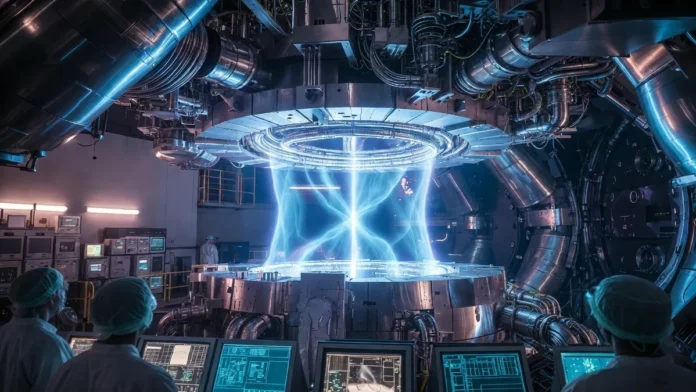
China has achieved a significant milestone in its pursuit of nuclear fusion energy by successfully developing and testing the world’s largest superconducting fusion magnet, a massive 582-ton D-shaped component designed for its next-generation fusion reactor.
The breakthrough is seen as a major step toward China’s long-term goal of generating large-scale, carbon-free fusion energy by 2030 through its “artificial sun” program. Scientists believe nuclear fusion could one day provide virtually unlimited clean electricity by replicating the same process that powers the Sun.
According to the Chinese Academy of Sciences (CAS), fusion research is aimed at developing a sustainable energy source that produces no direct carbon emissions and significantly less long-lived radioactive waste than conventional nuclear fission reactors.
What Makes the 582-Ton Fusion Magnet So Important?
The newly developed superconducting magnet is one of the most critical components of a fusion reactor. Measuring 21 meters in length, 12 meters in width, and weighing 582 tons, the D-shaped magnet generates an extremely powerful magnetic field capable of containing plasma heated to nearly 100 million degrees Celsius.
Because plasma at such temperatures cannot touch the walls of a reactor, powerful superconducting magnets are required to suspend and stabilize it inside a magnetic field. Maintaining this confinement allows hydrogen isotopes to fuse, releasing enormous amounts of energy—the same process that naturally occurs inside the Sun.
Scientists say successful magnetic confinement is one of the biggest technological challenges in achieving commercial fusion power.
China Targets Commercial Fusion Progress by 2030
China plans to complete its Burning Plasma Experimental Reactor (BPER) by the end of 2027, after which the project will move into advanced experimental operations.
The newly tested superconducting magnet is expected to play a central role in the reactor by maintaining the stable magnetic environment required for sustained fusion reactions.
Although commercial fusion power remains under development worldwide, China’s latest achievement is viewed as another step toward demonstrating technologies that could eventually support large-scale clean electricity generation.
How Does an ‘Artificial Sun’ Work?
Unlike today’s nuclear power plants, which generate electricity through nuclear fission by splitting heavy atoms such as uranium, fusion reactors produce energy by combining light hydrogen isotopes into heavier helium atoms.
This fusion reaction releases enormous amounts of energy while producing no direct carbon emissions.
The process is identical to the mechanism powering the Sun, where intense heat and pressure continuously fuse hydrogen nuclei, generating the light and heat that reach Earth.
Scientists around the world have spent decades trying to recreate these conditions in controlled laboratory environments.
India Is Also Part of Global Fusion Research
China’s project operates alongside the world’s largest international fusion collaboration, the ITER Organization, which is building the International Thermonuclear Experimental Reactor (ITER) in southern France.
The ITER project includes the European Union, India, China, Japan, South Korea, Russia, and the United States.
India has made a significant contribution by manufacturing the Cryostat, the world’s largest stainless-steel vacuum chamber, which protects and supports the ITER reactor during fusion experiments.
Information about India’s contribution to ITER is available through the Institute for Plasma Research (IPR India), the country’s domestic agency for the project.
Why China’s Achievement Is Drawing Global Attention
While ITER is primarily designed to demonstrate the scientific and engineering feasibility of fusion energy, China’s newly completed superconducting magnet is reported to have a volume approximately 1.3 times larger than its comparable ITER counterpart.
The achievement highlights China’s growing investment in advanced fusion technologies and strengthens its position in the global race to develop commercially viable fusion power.
Experts caution, however, that despite rapid technological progress, commercial fusion electricity generation has not yet been achieved anywhere in the world, and substantial engineering challenges remain before fusion becomes a practical energy source.
Key Highlights
- China has successfully developed and tested the world’s largest 582-ton superconducting fusion magnet.
- The D-shaped magnet measures 21 meters long and 12 meters wide.
- It is designed to confine plasma at temperatures approaching 100 million°C.
- China aims to complete its Burning Plasma Experimental Reactor by late 2027.
- The project supports China’s long-term ambition of producing large-scale carbon-free fusion energy.
- India is a key partner in the international ITER fusion project and supplied the reactor’s massive Cryostat.
- Scientists say commercial fusion energy remains under development, but the latest milestone represents important progress.