Washington, D.C., United States | July 25, 2026
Trump AI Science Strategy
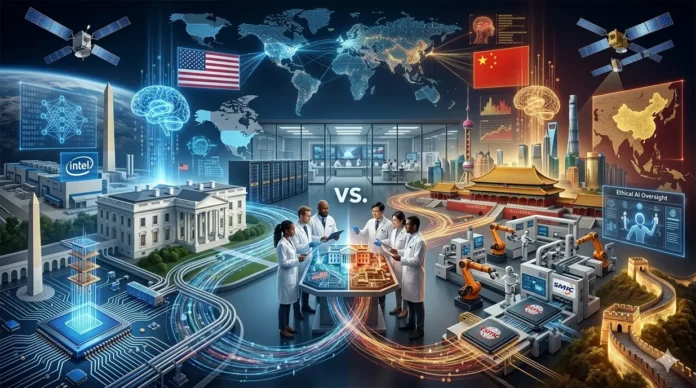
The Trump administration has defended sweeping changes to the United States’ scientific research system, arguing that the country must accelerate innovation in artificial intelligence (AI), quantum computing, advanced manufacturing, fusion energy, and space technology to maintain its technological leadership over China.
The policy shift, unveiled during a hearing before the House Committee on Science, Space, and Technology, outlines what administration officials describe as a “new golden age of American science.” The strategy is also expected to influence collaboration with key technology partners, including India.
White House Presents Vision for a ‘New Golden Age of Science’
Appearing before lawmakers, Michael Kratsios, Director of the White House Office of Science and Technology Policy (OSTP), said the United States could no longer assume its leadership in science and technology would remain unchallenged.
“In a rapidly changing world, our economic leadership and technological dominance cannot be taken for granted. The United States is no longer the world’s only industrial and scientific superpower,” Kratsios told the committee.
He argued that a renewed national strategy and structural reforms are necessary to strengthen America’s scientific competitiveness over the coming decades.
AI-Centered Research Reform at the Core
Kratsios outlined a series of proposed reforms aimed at modernizing federally funded scientific research.
According to the administration, key priorities include:
- Making federal research funding more flexible.
- Expanding support for researchers across scientific disciplines.
- Strengthening links between scientific discovery and advanced manufacturing.
- Integrating artificial intelligence into future scientific research.
The White House said AI will become a foundational tool for accelerating innovation across multiple sectors.
Genesis Mission to Receive More Than $5 Billion
A central component of the administration’s strategy is the Genesis Mission, which Kratsios described as one of the government’s most significant AI initiatives for scientific research.
He told lawmakers that more than 15 federal agencies have committed over $5 billion toward AI-powered scientific research.
Participating agencies include:
- Department of Energy
- Department of Agriculture
- Department of Health and Human Services
- NASA
- National Institute of Standards and Technology (NIST)
- Other federal research organizations
The investment is intended to accelerate breakthroughs in science while strengthening America’s long-term innovation ecosystem.
China Remains Central to the Strategy
Republican lawmakers repeatedly framed the initiative as essential for preserving America’s technological advantage over China.
Committee Chairman Brian Babin warned that the Chinese Communist Party has made artificial intelligence a national strategic priority and continues investing heavily in emerging technologies.
He also alleged that China has sought to obtain advanced scientific research through American universities and research laboratories.
Kratsios said Washington must clearly define its national priorities and maintain leadership in strategic technologies including:
- Artificial Intelligence
- Quantum Computing
- Fusion Energy
- Space Technology
- Advanced Semiconductor Manufacturing
Democrats Raise Concerns Over Research Funding
Democratic lawmakers questioned whether the administration’s policies could weaken the very research ecosystem they are intended to strengthen.
Ranking Member Zoe Lofgren argued that reductions in graduate admissions, uncertainty surrounding research funding, and proposed changes to grant policies could undermine America’s scientific leadership while China continues increasing its investment in research and recruiting global talent.
Several Democratic members also criticized:
- Proposed reductions in National Science Foundation (NSF) funding.
- Political influence over research grants.
- The restructuring or removal of scientific advisory panels.
White House Defends Scientific Standards
Kratsios rejected suggestions that the White House interferes in individual grant decisions made by the National Science Foundation.
Instead, he said the administration is committed to what it calls “gold standard science,” emphasizing that federally funded research should be:
- Transparent
- Reproducible
- Scientifically rigorous
- Reliable
He said maintaining high research standards would strengthen public confidence in federally funded science.
Semiconductors and Open-Source AI Also in Focus
Lawmakers also discussed concerns over:
- China’s semiconductor supply chains.
- Biotechnology competition.
- Open-source AI development.
Kratsios said the administration supports a diverse AI ecosystem that includes both open-source and closed-source AI models, while continuing to invest in domestic semiconductor manufacturing and AI infrastructure.
Potential Impact on Global Technology Partnerships
The administration’s renewed focus on AI and advanced technologies is expected to influence international research cooperation with strategic partners such as India, particularly in areas including:
- Artificial intelligence
- Semiconductor manufacturing
- Quantum technologies
- Space research
- Advanced manufacturing
Analysts say future bilateral collaborations may increasingly align with these strategic priorities as both countries expand cooperation in emerging technologies.
Key Highlights
- The Trump administration has defended major reforms to the US scientific research system.
- AI, quantum computing, fusion energy, advanced manufacturing, and space technology have been identified as national priorities.
- The White House announced that more than $5 billion has been committed for AI-driven scientific research through the Genesis Mission.
- Republican lawmakers said the strategy is essential to maintaining US technological leadership over China.
- Democratic lawmakers questioned proposed research funding changes and warned they could weaken America’s scientific ecosystem.
- The administration pledged continued investment in AI infrastructure, semiconductor manufacturing, and high scientific standards.