Washington, D.C. | July 15, 2026
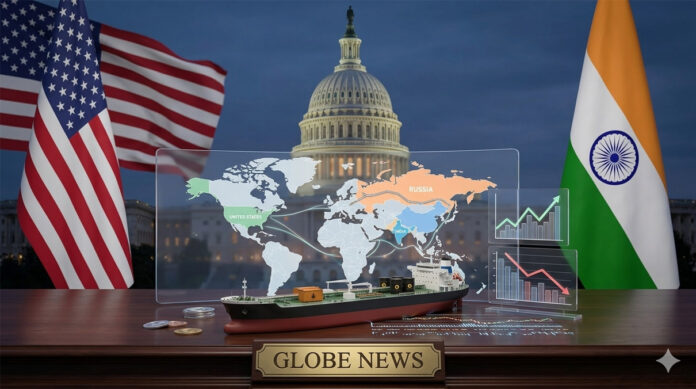
WASHINGTON: US Russia Sanctions Bill has moved to the center of Washington’s foreign policy debate after a bipartisan group of US senators introduced legislation that could authorize steep tariffs on countries continuing to purchase Russian energy. India has been named among five countries that may face import tariffs under the proposed measure if they continue importing Russian crude oil.
The legislation, formally introduced on Capitol Hill on Tuesday, seeks to significantly increase economic pressure on Moscow over the ongoing war in Ukraine. Besides targeting Russia’s energy exports, the bill also proposes expanded sanctions against Russia’s financial institutions, defense sector, influential business figures, and President Vladimir Putin.
The proposal has attracted international attention because it includes a mechanism allowing tariffs of up to 500% on imports from countries that continue purchasing Russian oil, although lawmakers clarified that the final tariff rates would be determined by the Office of the United States Trade Representative (USTR) rather than being fixed in the legislation itself.
India Among Five Countries Identified
According to Democratic Senator Richard Blumenthal, one of the bill’s lead sponsors, the legislation identifies India, China, Slovakia, Hungary, and Azerbaijan as the primary countries continuing to purchase significant volumes of Russian crude oil.
The proposed bill also extends its scope to countries importing Russian natural gas. However, it includes exemptions for nations that obtain less than 15% of their total natural gas supply from Russia and are actively reducing those imports. This provision is expected to shield most European allies from potential penalties.
Blumenthal said the legislation is intended to discourage major buyers of Russian oil and gas from maintaining their current energy trade with Moscow.
Bipartisan Support for the Russia Sanctions Bill
The legislation enjoys support from lawmakers in both major political parties.
It was introduced by Democratic Senators Richard Blumenthal and Jeanne Shaheen, alongside Republican Senators Roger Wicker, Katie Britt, and more than a dozen bipartisan co-sponsors.
Lawmakers described the proposal as a continuation of the work led by late Senator Lindsey Graham, who spent nearly two years developing the framework for stronger sanctions against Russia. Several senators referred to the legislation as the “Lindsey Graham Russia Accountability Bill” in recognition of his role in shaping the proposal.
More Than Tariffs: Broad Economic Measures Against Russia
Supporters emphasized that the bill goes well beyond trade tariffs.
If enacted, it would authorize sweeping sanctions covering:
- Russia’s banking and financial system
- Energy companies
- Defense manufacturers
- Major Russian oligarchs
- President Vladimir Putin
- Russia’s broader industrial sector
The legislation also targets Russia’s so-called “shadow fleet”—oil tankers allegedly used to transport Russian crude while bypassing existing international sanctions.
Senator James Risch, Chairman of the Senate Foreign Relations Committee, said this provision was added to strengthen enforcement against sanctions evasion.
Tariff Rates Yet to Be Determined
Although the legislation has frequently been associated with a 500% tariff, lawmakers clarified that the bill does not automatically impose that specific rate.
Instead, it authorizes the US administration to establish tariff levels above zero, with the US Trade Representative responsible for determining the actual percentage within the limits established by the legislation.
Blumenthal declined to specify the eventual tariff level but said it should be significant enough to discourage countries from continuing large-scale purchases of Russian oil and gas.
Presidential Waiver Authority Included
The proposed legislation also grants the President of the United States authority to temporarily waive tariffs under specific national security or diplomatic circumstances.
Should the administration later reduce or remove tariffs, it would be required to notify Congress, providing lawmakers with oversight over future implementation.
Supporters said this flexibility would allow the White House to respond to changing geopolitical developments while maintaining pressure on Russia.
Bill Narrowed After White House Consultation
Lawmakers acknowledged that the latest version of the bill is substantially narrower than earlier drafts.
Previous proposals reportedly covered as many as 63 countries engaged in trade with Russia. Following discussions with the Trump administration, the current draft focuses primarily on five major oil-importing countries and five significant buyers of Russian natural gas.
Blumenthal said the administration provided written support for the revised legislation after recommending a more targeted approach.
Tributes Paid to Senator Lindsey Graham
During the bill’s introduction, several senators paid tribute to the late Senator Lindsey Graham, describing the legislation as one of his most significant policy initiatives.
Senator Roger Wicker said Graham had devoted years to developing stronger measures against Russia and called the legislation a lasting part of his legacy.
Senator Ted Cruz added that Graham had personally discussed the proposal with President Donald Trump before his passing and urged Congress to pass the bill with broad bipartisan support.
What the Proposal Means for India
India has significantly increased imports of discounted Russian crude oil since 2022, making Russia one of its largest energy suppliers.
The Indian government has consistently maintained that these purchases are guided by energy security, economic stability, and the interests of Indian consumers.
New Delhi has also argued that diversified energy sourcing contributes to global market stability and helps moderate international oil prices.
If the legislation ultimately becomes law and tariffs are imposed, it could complicate aspects of US-India trade relations. However, any impact would depend on the final tariff rates, the implementation strategy adopted by the US administration, and potential diplomatic negotiations.
Legislative Process Still Underway
The proposal has not yet become law.
Before taking effect, the bill must:
- Pass the US Senate.
- Receive approval from the House of Representatives.
- Be signed into law by President Donald Trump.
A White House official previously indicated that the Trump administration supports the legislation and that it could authorize the President to impose tariffs of up to 500% on imports from countries continuing to engage with Russia’s energy sector.
Several senators expressed optimism that the Senate could begin considering the bill before the end of August, depending on legislative priorities and bipartisan support.