Lucknow, Uttar Pradesh | July 15, 2026
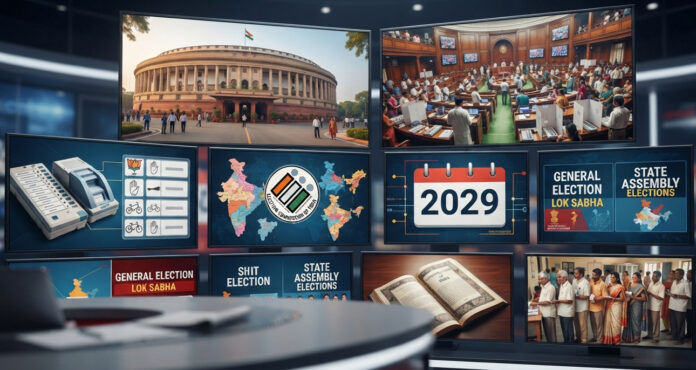
One Nation One Election Bill could pave the way for simultaneous Lok Sabha and State Assembly elections in 2029, according to Joint Parliamentary Committee (JPC) Chairman and BJP MP P.P. Chaudhary. Speaking during the committee’s three-day visit to Lucknow, Chaudhary said preparations are underway to implement the proposed electoral reform, subject to Parliament approving the required legislation and constitutional amendments.
The proposal is currently under examination by the Joint Parliamentary Committee, which is consulting political parties, constitutional experts, the Election Commission, legal scholars, and other stakeholders before finalizing its recommendations.
JPC Chairman Says 2029 Is the Target
During an interaction with the media, Chaudhary said the government aims to synchronize Lok Sabha and State Assembly elections by 2029.
According to him, holding frequent elections places an administrative and financial burden on the country, and many citizens have expressed support for conducting elections simultaneously.
He argued that reducing repeated election cycles would improve governance and allow governments to focus more consistently on development initiatives.
Public Consultations Underway
Chaudhary said the Joint Parliamentary Committee has been receiving feedback from across the country.
According to him, the committee has interacted with:
- Political parties
- Constitutional experts
- Election Commission officials
- Legal experts
- Civil society representatives
- Other stakeholders
He stated that the committee intends to prepare its recommendations after considering a broad range of views.
Reference to India’s Earlier Election Model
Defending the proposal, Chaudhary noted that India successfully conducted simultaneous parliamentary and state assembly elections between 1952 and 1967.
He said that if such elections were possible during the early decades after Independence, they should be even more feasible today given advances in election management, logistics, and electronic voting infrastructure.
He also rejected concerns that insufficient Electronic Voting Machines (EVMs) or infrastructure would hinder implementation.
Response to Opposition’s Concerns
Responding to criticism that simultaneous elections could affect India’s federal structure, Chaudhary said synchronizing election schedules would not alter the constitutional powers of states.
According to him, the experience of simultaneous elections in the 1950s and 1960s demonstrates that the electoral model can function within India’s federal framework.
He also alleged that opposition parties oppose the proposal for political reasons rather than constitutional concerns, claiming they do not want the initiative to be credited to Prime Minister Narendra Modi.
These remarks reflect Chaudhary’s political assessment and not the stated positions of opposition parties.
Government Exploring Legal Options
Chaudhary said the government is prepared to move forward with the necessary legal framework if Parliament approves the proposal.
He suggested that in states governed by the BJP where assembly terms do not align with the proposed national election schedule, state governments could choose to recommend the dissolution of their legislative assemblies to synchronize elections with the Lok Sabha.
He also said that additional legislation could be introduced if required to facilitate implementation.
Early Collapse of State Governments Under Review
Addressing questions about situations where a state government falls before completing its term, Chaudhary said the committee is examining possible constitutional mechanisms.
Among the options being discussed is providing an opportunity to form an alternative government before calling fresh elections, thereby avoiding unscheduled polls wherever constitutionally feasible.
He emphasized that discussions are still underway and that the committee has not finalized its recommendations.
Committee Says It Will Build Broad Consensus
According to Chaudhary, the Joint Parliamentary Committee aims to submit recommendations based on broad consultation rather than unilateral decision-making.
He said the committee’s objective is to examine constitutional, legal, administrative, and practical aspects before presenting its final report.
The proposed legislation would require parliamentary approval and, if necessary, constitutional amendments before any nationwide implementation.
Objective Is Electoral Reform
Chaudhary said the government’s objective is not merely to reduce the number of elections but to improve governance, administrative efficiency, transparency, and accountability.
He added that any electoral reforms should remain consistent with the Constitution and serve the broader national interest.
At present, the proposal remains under parliamentary review, and no final decision has been taken regarding its implementation.