New Delhi | July 15, 2026
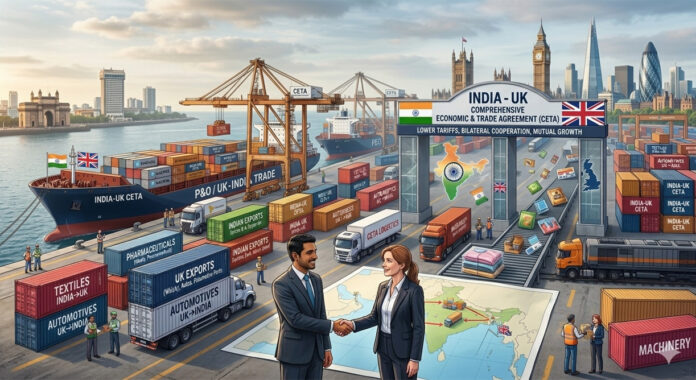
India UK CETA, the landmark Comprehensive Economic and Trade Agreement (CETA) between India and the United Kingdom, officially comes into force today, marking one of India’s most significant free trade agreements in recent years. The agreement is expected to strengthen bilateral trade, attract investment, expand employment opportunities, and improve market access for businesses in both countries.
The Indian government describes the agreement as a transformative step that will benefit farmers, workers, MSMEs, exporters, startups, women entrepreneurs, and the services sector. It is the sixth major free trade agreement implemented during Prime Minister Narendra Modi’s tenure, following similar agreements with Mauritius, the United Arab Emirates (UAE), Australia, the European Free Trade Association (EFTA), and Oman.
99% of Indian Exports to Enter the UK Duty-Free
One of the most significant provisions of the India UK CETA is duty-free access for approximately 99% of Indian exports to the British market.
According to the Ministry of Commerce, the agreement removes or substantially reduces tariffs on thousands of Indian products, allowing exporters to compete more effectively in one of the world’s largest consumer markets.
The agreement is expected to particularly benefit sectors such as:
- Ready-made garments and textiles
- Footwear
- Carpets
- Processed foods
- Grains
- Fruits and vegetables
- Spices
- Marine and seafood products
- Meat and processed food
- Automobiles and auto components
- Machinery
- Electronics
- Ceramics
- Glass
- Cement
- Stone products
Lower tariff barriers are also expected to improve the global competitiveness of Indian manufacturers.
More Than a Tariff Reduction Agreement
Commerce Secretary Rajesh Agrawal described the agreement as a milestone in India’s trade policy, emphasizing that it extends well beyond tariff reductions.
The Comprehensive Economic and Trade Agreement (CETA) consists of 30 chapters covering a wide range of economic areas, including:
- Trade in goods
- Trade in services
- Digital trade
- Investment
- Government procurement
- Intellectual property
- MSME cooperation
- Labor standards
- Environmental cooperation
The agreement also seeks to reduce non-tariff barriers, simplify customs procedures, and promote easier market access for businesses.
UK Firms Gain Access to Indian Government Tenders
For the first time, eligible British companies will be able to participate in approximately 40,000 high-value Indian government procurement contracts, opening new opportunities in sectors such as:
- Transportation
- Green energy
- Infrastructure
- Public services
Officials believe increased competition could improve project quality while encouraging technology transfer and investment.
Scotch Whisky Tariffs to Be Reduced
Consumers may also notice lower prices on several imported premium products over time.
Among the most notable tariff reductions is Scotch whisky, where India’s current 150% import duty will be reduced in stages.
The tariff structure will change as follows:
- Reduced to 75% in the initial phase.
- Gradually lowered to 40% over the next ten years.
The phased approach aims to balance consumer benefits with the interests of India’s domestic alcoholic beverage industry.
Automobile Sector Sees Historic Tariff Cuts
The agreement marks the first time India has offered such significant tariff concessions on fully built British passenger vehicles and trucks under a free trade agreement.
Under the agreement:
- Import duty on fully built British cars will decline from 110% to 10% in phases.
- Petrol and diesel vehicles become eligible for concessions immediately.
- Electric, hybrid, and hydrogen-powered vehicles will receive tariff benefits beginning in the sixth year, allowing India’s domestic EV industry an initial protection period.
- Up to 378,000 British passenger vehicles may be imported at concessional duty rates during the first 15 years.
- Import duty on trucks will fall from 44% to 8.8% by the fifth year.
Social Security Relief for Indian Professionals
The agreement also introduces a Double Contribution Convention, providing significant relief to Indian professionals working temporarily in the United Kingdom.
Under this arrangement:
- Indian employees sent to the UK for temporary assignments will not be required to contribute to the UK’s social security system for up to five years.
- Their employers will also receive the same exemption.
The provision is expected to reduce costs for Indian IT companies and other firms with overseas operations.
Products Excluded From the Agreement
Despite its broad scope, several sensitive products remain outside the agreement.
India has excluded tariff concessions on:
- Apples
- Walnuts
- Whey products
- Certain seeds
- Gold bullion
- Smartphones
Similarly, the United Kingdom has excluded:
- Rice
- Sugar
- Selected meat products
These exclusions are intended to protect sensitive domestic industries in both countries.
What Could Become Cheaper?
As tariff reductions are implemented, Indian consumers may gradually see lower prices on several imported British products, including:
- Scotch whisky
- Salmon
- Lamb
- Machinery
- Electronic goods
- Premium chocolates
- Soft drinks
- Cosmetics
- Soaps
- Perfumes
- Shaving creams
- Nail polish
The actual price reductions will depend on importers, distributors, taxes, logistics costs, and market competition.
A Major Milestone in India-UK Economic Relations
The implementation of the India UK CETA represents a significant step in strengthening bilateral economic ties.
By expanding market access, encouraging investment, lowering trade barriers, and improving mobility for professionals, the agreement is expected to deepen commercial cooperation between the world’s fifth and sixth-largest economies while creating new opportunities for businesses and consumers in both countries.