MUMBAI, India | August 22, 2026
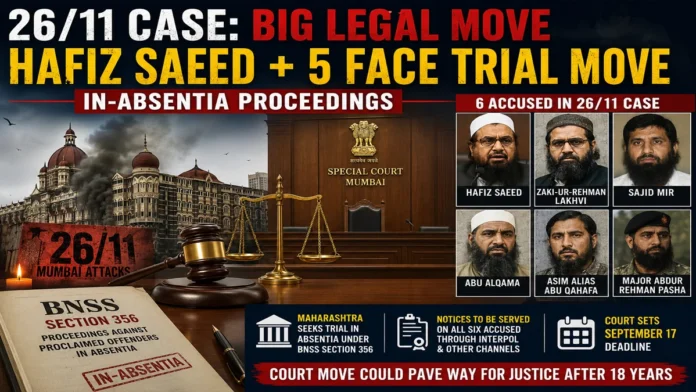
The 26/11 Mumbai attacks case has entered a significant new legal phase, with Maharashtra seeking to prosecute six Pakistan-based accused — including Lashkar-e-Taiba founder Hafiz Saeed and senior LeT figure Zaki-ur-Rehman Lakhvi — in their absence.
The Maharashtra government approached a special court in Mumbai on Friday seeking permission to move ahead under the Bharatiya Nagarik Suraksha Sanhita, or BNSS, which allows courts in specified circumstances to try proclaimed offenders who remain absconding.
The six accused named in the proceedings are Hafiz Saeed, Zaki-ur-Rehman Lakhvi, Sajid Mir, Abu Alqama, Asim alias Abu Qahafa and Major Abdur Rehman Pasha.
A Mumbai sessions court has given the prosecution until September 17 to complete the process of serving formal legal notices on the six accused in Pakistan through appropriate international channels, including Interpol.
The development could pave the way for one of the most consequential uses of India’s new trial-in-absentia provision in a major terrorism case.
Maharashtra Seeks Trial Without Physical Presence of Accused
For years, prosecution of several alleged planners and handlers of the November 2008 attacks has remained stalled because the accused are outside India and have not appeared before the Mumbai court.
The new legal strategy seeks to overcome that obstacle.
Under Section 356 of the BNSS, a court can proceed against a proclaimed offender who has absconded to evade trial and whose immediate arrest is not considered likely.
The court must record reasons in writing before proceeding.
The law treats prolonged absconding in such circumstances as a waiver of the accused person’s right to be physically present during the trial, while retaining procedural safeguards.
If statutory requirements are completed, the court can hear evidence, conduct the trial and pronounce judgment even when the proclaimed offender is not physically present.
Court Sets September 17 Deadline
The prosecution has now been given time until September 17 to complete another important procedural step.
Formal notices must be served or attempted to be served on the six accused through prescribed channels.
Special Public Prosecutor Ujjwal Nikam has said the authorities are pursuing the legal process against the Pakistan-based accused after earlier proclamation orders were issued.
The notices are significant because trial in absentia cannot simply begin automatically.
Indian law requires several procedural conditions to be fulfilled before a court can proceed against an accused person who is not present.
Who Are the Six Accused?
The six Pakistan-based accused named in the latest proceedings are:
Hafiz Saeed — Founder of Lashkar-e-Taiba and a figure Indian authorities have long accused of involvement in planning and supporting the Mumbai attacks.
Zaki-ur-Rehman Lakhvi — Senior LeT commander accused by Indian authorities of playing an operational role in the conspiracy.
Sajid Mir — LeT figure accused of involvement in planning and directing parts of the attack.
Abu Alqama — Accused by investigators of involvement in the wider conspiracy.
Asim alias Abu Qahafa — Named by investigators in connection with the attack planning and training network.
Major Abdur Rehman Pasha — Accused of involvement in the wider conspiracy surrounding the attacks.
The allegations against the six remain subject to judicial adjudication in the proceedings now being pursued.
What Does ‘Trial in Absentia’ Mean?
A trial in absentia is a criminal trial conducted even though the accused person is not physically present before the court.
India’s newer criminal procedure framework introduced a specific mechanism for proclaimed offenders who deliberately remain beyond the reach of the judicial process.
Section 356 of the BNSS allows a court to move forward if it determines that:
- The person has been declared a proclaimed offender
- The accused has absconded to evade trial
- There is no immediate prospect of arrest
- Required procedural steps have been followed
- Proceeding without the accused is necessary in the interests of justice
The court must also comply with safeguards relating to warrants, public notices and legal representation.
Why the New BNSS Provision Matters
The provision was introduced to address cases in which criminal trials remain stalled for years because an accused person deliberately stays outside the jurisdiction.
The government has said the purpose is to prevent justice from being indefinitely delayed simply because a proclaimed offender cannot be brought before the court.
The 26/11 proceedings could become an important test of how the provision functions in a high-profile terrorism case involving accused persons based overseas.
Any judgment, however, would still have to follow normal standards of evidence and judicial scrutiny.
26/11 Attacks Killed 166 People
The coordinated Mumbai attacks began on November 26, 2008.
Ten armed attackers targeted multiple locations across the city, including:
- Chhatrapati Shivaji Terminus
- Taj Mahal Palace Hotel
- Oberoi-Trident Hotel
- Nariman House
- Leopold Cafe
- Other locations across south Mumbai
The attacks continued for nearly three days.
166 people were killed, including Indian citizens, security personnel and foreign nationals, while hundreds were injured.
Nine attackers were killed during security operations.
Ajmal Kasab, the only attacker captured alive, was prosecuted in India, convicted and later executed in 2012.
Evidence From Earlier 26/11 Proceedings Could Be Important
The prosecution is expected to rely heavily on evidence already collected during the long-running Mumbai attack investigation.
That material includes electronic communications, witness testimony, intelligence inputs and evidence presented during earlier proceedings.
Testimony connected to David Coleman Headley, who admitted involvement in reconnaissance linked to the attack conspiracy, has also played an important role in investigations into the wider network behind 26/11.
Indian authorities have consistently maintained that the attack was planned and directed by Lashkar-e-Taiba operatives based in Pakistan.
Hafiz Saeed Has Long Been Wanted by India
India has pursued Hafiz Saeed for years over his alleged role in terrorism.
The Government of India designated him as an individual terrorist under the Unlawful Activities (Prevention) Act.
Indian authorities have also cited his alleged involvement in the 26/11 attack and other terror cases.
International sanctions and restrictions have also been imposed on several LeT-linked figures.
The latest Mumbai court proceedings create a new judicial route for India to pursue a legal finding even if the accused remain outside the country.
India Says Fight Against Terrorism Will Continue
The Ministry of External Affairs has reiterated India’s position that it will continue taking necessary action against terrorism.
New Delhi has repeatedly called on Pakistan to take effective action against individuals accused of involvement in cross-border terrorism.
The Mumbai attacks remain one of the most sensitive issues in India-Pakistan relations.
Indian officials have argued that lack of accountability for alleged planners and handlers in Pakistan has prolonged the search for justice for victims and their families.
Could a Conviction Lead to Extradition?
An in-absentia judgment would not automatically bring an accused person to India.
Extradition and physical custody depend on several additional factors, including the location of the accused, international law, bilateral arrangements and cooperation from foreign governments.
However, a judicial finding could strengthen India’s legal and diplomatic case when seeking international action against a fugitive.
It could also support requests involving Interpol and other law-enforcement mechanisms.
Legal Safeguards Still Apply
Trial in absentia does not mean the court can bypass ordinary standards of criminal justice.
Section 356 contains procedural safeguards before the court can proceed.
The accused may also be represented through legal counsel under applicable provisions.
Ultimately, any conviction would have to be based on evidence tested before the court.
That distinction is especially important in a case involving accused persons who are not physically present to respond directly to the allegations.
Why This Development Is Significant
For nearly 18 years, India’s prosecution of Pakistan-based accused in the Mumbai attacks has faced a fundamental problem: several key suspects have remained outside Indian custody.
The BNSS mechanism creates a potential path for the Indian judicial system to move forward despite their absence.
If the trial proceeds, it could set an important precedent for future terrorism and organized-crime cases involving fugitives located abroad.
It could also provide victims’ families with a new judicial process after years of delay.
What Happens Next?
The immediate focus is the September 17 deadline.
Authorities must complete the required steps relating to legal notices and report back to the Mumbai court.
The court will then determine whether the statutory requirements for proceeding in absentia have been satisfied.
Only after those requirements are fulfilled can the case advance toward substantive trial proceedings against the six Pakistan-based accused.
For now, the development does not amount to a conviction or judicial finding of guilt.
It marks the beginning of a potentially historic attempt to use India’s new criminal-procedure framework to bring the unresolved overseas portion of the 26/11 Mumbai attacks case back before an Indian court.