India , Yemen, Somalia | August 22, 2026
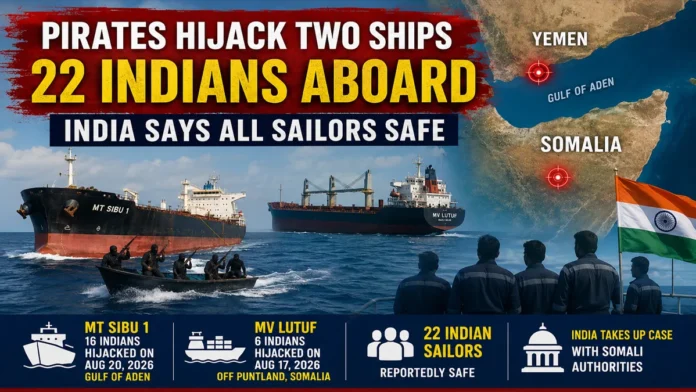
22 Indian sailors aboard hijacked ships off Yemen and Somalia are reportedly safe as India intensifies efforts with regional authorities following two separate armed piracy incidents in some of the world’s most dangerous maritime waters.
The Indian High Commission in Kenya, which is concurrently accredited to Somalia, has taken up the matter with the concerned Somali authorities and said New Delhi attaches the highest importance to the safety and welfare of Indian seafarers.
The two incidents involve the Eritrea-flagged oil-products tanker MT Sibu 1 and the Cameroon-flagged cargo vessel MV Lutuf.
Together, the vessels are carrying 22 Indian nationals among their crews.
The hijackings have renewed concerns over piracy in waters around the Gulf of Aden and Somalia, a strategically critical maritime corridor connecting the Indian Ocean with the Red Sea.
16 Indians Aboard MT Sibu 1
The more recent incident involves MT Sibu 1, an Eritrea-flagged oil-products tanker.
The vessel was hijacked in the Gulf of Aden on August 20, approximately 30 nautical miles off the Yemeni coast.
The tanker has a crew of 20, including 16 Indian nationals.
According to information available to Indian authorities, armed men boarded the vessel and took control of it.
The tanker had issued a distress call after being approached and was subsequently forced to alter course.
Indian authorities are monitoring developments surrounding the ship and its crew.
Six Indians Aboard MV Lutuf
The second incident occurred earlier, on August 17, off Somalia’s Puntland coast.
The Cameroon-flagged MV Lutuf has a crew of 10, including six Indian nationals.
Armed pirates boarded the vessel and seized control.
The incident occurred in waters off Puntland, an area that has historically experienced significant piracy activity.
With six Indians aboard MV Lutuf and 16 aboard MT Sibu 1, the two hijackings involve a total of 22 Indian seafarers.
All Indian Sailors Reportedly Safe
The most important development for the families of the crew members is that the Indian sailors are currently reported to be safe.
India’s High Commission in Nairobi said the Mission has taken up the issue with the concerned authorities in Somalia.
The government is continuing to monitor the situation.
External Affairs Ministry spokesperson Randhir Jaiswal has also reiterated that the safety and welfare of Indian seafarers remain a high priority for the government.
Given the volatile security environment around Somalia, Yemen and the Gulf of Aden, authorities are maintaining close contact with relevant stakeholders.
India Raises Matter With Somali Authorities
India’s diplomatic mission in Kenya plays an important role because it is also accredited to Somalia.
The Mission has contacted Somali authorities regarding the hijacked vessels and the Indian nationals aboard them.
Indian government agencies are also coordinating with shipping companies and other parties involved.
The immediate priority is the safety of the crew.
Maritime hostage incidents can be particularly complex because vessels may move between territorial and international waters and negotiations can involve shipowners, governments, naval forces and local authorities.
Gulf of Aden Remains Critical Global Shipping Route
The Gulf of Aden is one of the world’s most strategically important maritime corridors.
Ships travelling between Asia and Europe commonly use the route to reach the Red Sea and the Suez Canal.
Cargo moving through these waters includes:
- Crude oil
- Petroleum products
- Containers
- Food
- Industrial materials
- Consumer goods
Any significant deterioration in maritime security can therefore affect global trade and shipping costs.
The area has already faced severe disruption in recent years because of regional conflicts and attacks on commercial vessels.
The renewed threat from piracy adds another layer of risk.
Somalia Piracy Threat Returns to Focus
Somalia became synonymous with maritime piracy during the late 2000s and early 2010s.
At its peak, pirates operating from the Somali coast seized commercial ships and held crew members hostage for ransom.
International naval deployments, improved security measures aboard merchant vessels and stronger coordination eventually produced a dramatic decline in successful attacks.
However, piracy never disappeared completely.
Recent incidents have raised concerns that armed groups may again be taking advantage of instability and security gaps in the region.
The hijacking of two vessels carrying Indian nationals within days of each other highlights the continuing risk.
Why Indian Seafarers Are Particularly Important
India is one of the world’s major suppliers of trained merchant seafarers.
Thousands of Indian captains, engineers, officers and crew members work aboard international cargo ships, tankers and other commercial vessels.
Many serve on ships registered in foreign countries.
As a result, maritime crises far from India’s coastline can directly affect Indian citizens.
New Delhi has repeatedly intervened in previous incidents involving piracy, armed attacks, regional conflict and distressed merchant ships to help protect Indian crew members.
Indian Navy Has Experience in Anti-Piracy Missions
The Indian Navy has extensive experience in anti-piracy operations in the western Indian Ocean and Gulf of Aden.
Indian warships have conducted escort missions, responded to distress calls and rescued merchant crews in previous operations.
India has also participated in wider international efforts to secure shipping routes in the region.
The resurgence of piracy poses a particularly difficult challenge because merchant traffic must cover vast areas of open sea.
Naval forces cannot be physically present near every commercial ship at all times.
Early distress alerts, vessel tracking, intelligence sharing and coordination with regional authorities therefore remain critical.
Maritime Workers Face Multiple Risks
Piracy is no longer the only danger facing seafarers in the region.
Commercial vessels operating around the Red Sea, Gulf of Aden, Yemen and the wider Middle East face a complicated security environment involving:
- Piracy
- Armed robbery
- Regional military conflict
- Drone and missile threats
- Disruption to shipping routes
- Rising insurance costs
- Longer alternative voyages
These risks can significantly affect crews who may spend weeks or months at sea.
For Indian authorities, protecting seafarers has therefore become an increasingly important element of foreign and maritime policy.
What Happens Next?
Authorities will now focus on maintaining information about the condition and location of the two vessels and their crews.
India is expected to remain in contact with:
- Somali authorities
- Shipping companies
- Vessel operators
- Diplomatic missions
- Maritime-security agencies
Because piracy incidents can evolve quickly, official information may change as authorities establish contact with vessels and those controlling them.
The government has so far emphasized that all 22 Indian crew members are reportedly safe.
Families Await Further Updates
For the families of the Indian sailors, confirmation of their safety provides some relief, but the hijackings remain unresolved.
Until the vessels and crews are fully released from pirate control, authorities are likely to continue treating the incidents as an active maritime-security situation.
Officials have not publicly disclosed detailed operational measures being taken to secure the ships.
That caution is common in hostage or piracy situations, where disclosure of sensitive information can complicate efforts to protect crews.
Two Hijackings Raise Fresh Maritime Security Alarm
The seizure of MT Sibu 1 and MV Lutuf demonstrates how quickly piracy can again threaten international shipping in strategically important waters.
For India, the immediate concern is straightforward: bringing all 22 Indian sailors aboard the hijacked ships safely out of the crisis.
For the global shipping industry, however, the incidents raise a broader question.
If piracy continues to increase around Somalia and the Gulf of Aden while regional military tensions remain high, one of the world’s most important shipping corridors could face yet another serious security challenge.
For now, India says its diplomatic mission is actively engaged with the concerned authorities and that all Indian seafarers are reportedly safe.