
NEW DELHI, August 13, 2026
India Remains World Bank’s Largest Borrower; Latest Data Reveals Top 10 Countries
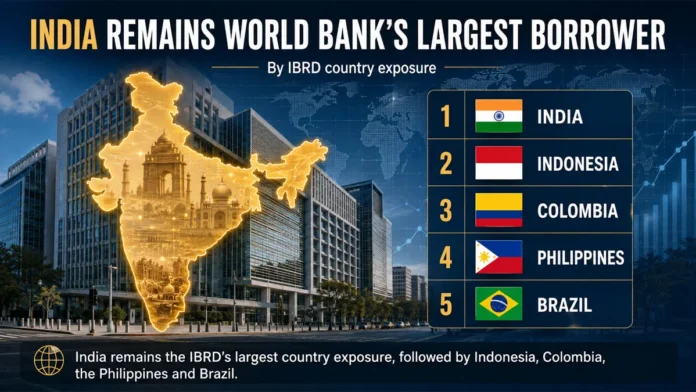
World Bank’s largest borrower by International Bank for Reconstruction and Development exposure remains India, the institution’s latest official data and investor disclosures show. Indonesia holds second place, while Colombia, the Philippines and Brazil complete the top five.
The World Bank’s country-exposure dataset was most recently updated on July 23, 2026, with figures covering the quarter ended March 31, 2026. A World Bank investor presentation published in July also identifies India as the IBRD’s largest country exposure.
However, the figures must be interpreted carefully. The ranking measures the IBRD’s financial exposure to borrowing countries. It does not represent a country’s total national debt or its combined borrowing from all international institutions.
Latest World Bank borrower ranking
The latest official disclosure confirms the following ranking of the five largest IBRD country exposures:
| Rank | Country | Latest position |
|---|---|---|
| 1 | India | Largest IBRD country exposure |
| 2 | Indonesia | Second-largest exposure |
| 3 | Colombia | Third-largest exposure |
| 4 | Philippines | Fourth-largest exposure |
| 5 | Brazil | Fifth-largest exposure |
The most recent official disclosure does not provide a complete, easily comparable June 2026 top-10 numerical table. Therefore, the remaining positions below use the latest fully published country-exposure table, dated September 30, 2025.
| Rank | Country | IBRD exposure* |
|---|---|---|
| 1 | India | $22.9 billion |
| 2 | Indonesia | $21.5 billion |
| 3 | Colombia | $17.8 billion |
| 4 | Philippines | $15.9 billion |
| 5 | Brazil | $15.0 billion |
| 6 | China | $14.1 billion |
| 7 | Türkiye | $13.9 billion |
| 8 | Mexico | $13.9 billion |
| 9 | Argentina | $12.7 billion |
| 10 | Egypt | $12.3 billion |
*Figures in the complete table are as of September 30, 2025. The World Bank’s newer March 2026 data and July investor presentation continue to identify India, Indonesia, Colombia, the Philippines and Brazil as the five largest exposures.
What do the latest 2026 figures show?
The IBRD’s overall net loans outstanding increased to $287.66 billion as of June 30, 2026, compared with $280.04 billion one year earlier.
Its total assets reached approximately $403.51 billion, while total borrowings stood at $309.25 billion. The institution reported an equity-to-loans ratio of 21.6%, unchanged from the previous fiscal year.
During fiscal 2026, the IBRD recorded $50.18 billion in net commitments, up from $40.89 billion in fiscal 2025.
The fiscal 2026 commitments included:
- $22.08 billion in investment-project financing
- $17.86 billion in development-policy financing
- $10.24 billion in Program-for-Results financing
These figures demonstrate an expansion in the IBRD’s global lending operations during the financial year ending June 30, 2026.
Why is India ranked first?
India’s position reflects the scale of its development partnership with the World Bank. IBRD financing in the country supports transportation, highways, employment, skills, public health, water management, energy, education and disaster-resilience programs.
World Bank data show that India had received approximately $142.75 billion in cumulative IBRD and IDA commitments across 718 projects as of June 30, 2026. This is a historical commitment figure and should not be confused with the amount India currently owes.
Among the projects approved for India during 2026 were:
- $1.5 billion for private-sector job creation
- $830 million for upgrading industrial training institutes and employability
- $245 million for disaster recovery and resilience in Himachal Pradesh
- $225 million for the Rajasthan Highway Modernization Project
These approvals have strengthened India’s position as one of the World Bank’s most significant development partners.
Does India owe the World Bank $142.75 billion today?
No. The $142.75 billion figure represents cumulative commitments approved for India across hundreds of projects over several decades.
It is not India’s current unpaid loan balance.
Outstanding exposure is calculated after considering disbursements, repayments, cancellations, guarantees and other financial adjustments. That is why cumulative commitments are much higher than the current exposure used for the borrower ranking.
Does this mean India is the world’s most indebted country?
No. India is the World Bank’s largest borrower only under the specific measure of IBRD country exposure.
The ranking does not compare:
- Total government debt
- Domestic borrowing
- Private corporate debt
- Loans from other multilateral institutions
- Bilateral government loans
- Bonds issued in domestic or international markets
Several advanced economies have substantially larger overall public-debt burdens. Most of them, however, do not use IBRD development financing in the same manner as middle-income countries.
The accurate description is that India is the IBRD’s largest country borrower by exposure, not that India has the highest total debt in the world.
What is IBRD exposure?
IBRD exposure broadly covers outstanding loans, guarantees and certain financial commitments to a borrowing country. It may also incorporate adjustments for guarantees and other credit-enhancement arrangements that reduce the bank’s risk.
The IBRD extends market-based development loans primarily to middle-income and creditworthy lower-income countries. Along with the International Development Association, it forms the part of the World Bank Group commonly called the World Bank.
IDA operates differently. It provides grants and concessional credits mainly to lower-income countries. Consequently, its leading borrowers are different from those in the IBRD ranking.
Why India’s top position is not necessarily a warning sign
A large World Bank exposure is not automatically evidence of financial distress. It can reflect the size of a country, the number of development projects underway and its eligibility to secure long-term institutional financing.
Such borrowing can help fund infrastructure and essential public services. Its benefits, however, depend on project quality, execution, transparency and the economic or social returns generated by the investment.
The latest data confirm India’s leading position in the IBRD portfolio, but the figure must be assessed alongside the country’s economic output, repayment capacity and broader public-debt profile.
The latest figures are available through the World Bank’s IBRD financial results, country-exposure dataset and India financial profile.