SEOUL, SOUTH KOREA | AUGUST 23, 2026 —
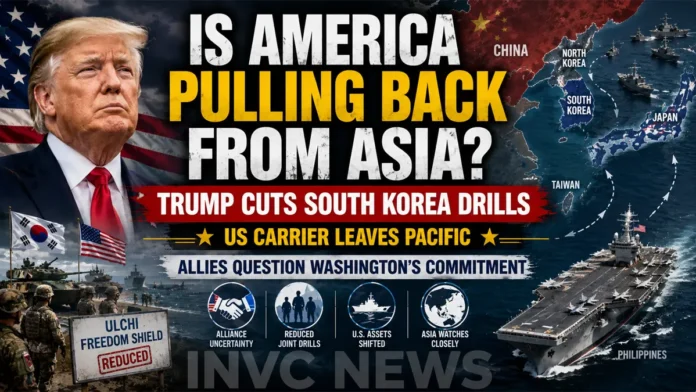
US Retreat From Asia has become a growing strategic question after President Donald Trump sharply reduced major military exercises with South Korea just as Washington shifted one of its most visible military assets from the Indo-Pacific to the Middle East.
The decision to shorten the annual Ulchi Freedom Shield exercise came suddenly and surprised officials in Seoul.
The exercise, originally scheduled to run for 11 days, was reduced to five days, while several live-training activities were cut, canceled or converted into simulations.
Trump defended the move by arguing that the drills were costly and unnecessarily provocative toward North Korea. He also highlighted his relationship with North Korean leader Kim Jong Un and criticized Seoul over its refusal to support Washington’s Iran campaign.
On its own, a shorter military exercise would not necessarily suggest a major strategic retreat.
But the decision came alongside another highly symbolic development: the USS George Washington aircraft carrier, normally based in Japan, was moved from the Pacific to the Middle East to relieve the heavily deployed USS Abraham Lincoln.
For the moment, that leaves the Indo-Pacific without a deployed U.S. aircraft carrier.
Together, the two developments are raising a larger question across Asia:
Is Washington still prioritizing the Indo-Pacific — or are wars and commitments elsewhere beginning to pull American power away from the region?
Trump Cuts Ulchi Freedom Shield From 11 Days to Five
Ulchi Freedom Shield is one of the most important annual exercises conducted by the United States and South Korea.
The drills are designed to test how both militaries would respond to a major security crisis on the Korean Peninsula.
They include command-and-control exercises, computer simulations and field training involving thousands of troops.
This year’s exercise began on August 17 and had originally been scheduled to continue until August 27.
Following Trump’s directive, however, the allies concluded the main exercise on August 21.
Some associated field-training activities were also reduced.
The Pentagon said essential training objectives would still be met, despite the shortened schedule.
For South Korea, however, the sudden nature of the order created uncertainty.
The U.S.-South Korea military relationship depends heavily on regular combined exercises because the two forces would need to operate together during any major conflict involving North Korea.
Trump Says the Drills Send a ‘Hostile’ Message
Trump has long questioned large-scale U.S. military exercises overseas.
During his first presidency, he suspended major exercises with South Korea after his 2018 summit with Kim Jong Un.
His latest decision reflects a similar belief that reducing military pressure could help reopen diplomacy with Pyongyang.
Trump has described the exercises as costly and argued that they can send an unnecessarily hostile signal.
He has also repeatedly emphasized that he maintains a strong personal relationship with Kim.
That approach sharply contrasts with the traditional U.S. position that regular military exercises are necessary to maintain deterrence against North Korea.
North Korea Has Not Rewarded the Move
If Trump hoped that reducing the drills would immediately improve relations with Pyongyang, the early reaction has been discouraging.
North Korea has continued to criticize the joint exercises despite the reduction.
Kim Yo Jong, the influential sister of Kim Jong Un, dismissed the scaling back as insufficient to demonstrate a fundamental change in U.S. policy.
Pyongyang has also continued missile activity.
North Korea launched around 10 short-range ballistic missiles toward its eastern waters on August 20, only days after Trump announced the reduction.
That raises an uncomfortable question for Washington:
If the United States reduces military pressure but North Korea continues weapons development and missile launches, what does Washington gain strategically?
South Korea Welcomes Dialogue — But Worries About Reliability
South Korean President Lee Jae Myung has long supported reducing tensions with North Korea.
His government favors diplomacy and has called for renewed dialogue between Washington and Pyongyang.
In that sense, reducing military exercises is not automatically inconsistent with Seoul’s own policy.
But the way the decision was made has caused concern.
Trump announced the reduction with little advance warning, leaving officials in Seoul scrambling to understand how significantly the exercise would be changed.
President Lee has since reaffirmed that the alliance with the United States remains central to South Korean security.
At the same time, the episode has strengthened debate about whether Seoul needs greater ability to defend itself independently.
Also Read
South Korea and US Reaffirm North Korea Denuclearization Goal Amid Rising Nuclear Threats
That earlier cooperation illustrates the contradiction now confronting Seoul: the alliance remains deeply institutionalized, yet Washington’s political signals can change rapidly.
USS George Washington Leaves the Pacific
The military-exercise decision is only one part of the concern.
The U.S. Navy has also redeployed the USS George Washington from Asia to the Middle East.
The carrier reached the U.S. Central Command area this week, where it is expected to relieve the USS Abraham Lincoln.
Lincoln had remained at sea far beyond a normal deployment as the United States maintained pressure on Iran.
The move was operationally understandable.
Washington needed another carrier to sustain Middle East operations without keeping Lincoln deployed indefinitely.
But strategically, it created an important symbol.
For the first time in years, the western Pacific is temporarily without a forward-deployed U.S. aircraft carrier.
Why the Carrier Gap Matters
Aircraft carriers are not the only measure of American military power.
The United States continues to maintain:
- Tens of thousands of troops in Japan and South Korea
- Air bases across the region
- Submarines and surface warships
- Marines in Japan
- Defense facilities in Guam
- Access agreements with the Philippines
- Extensive intelligence and surveillance capabilities
So the absence of one aircraft carrier does not mean America has militarily abandoned Asia.
But carriers are powerful symbols of deterrence.
Their presence demonstrates that Washington can rapidly project air power across large maritime regions.
Removing the only regional carrier while China is increasing pressure around Taiwan, Japan and the Philippines inevitably attracts attention.
Iran War Is Stretching US Military Resources
The deeper issue is not necessarily that Washington has decided Asia is unimportant.
It may instead be that the United States is struggling to maintain simultaneous commitments in multiple theaters.
The Iran conflict has required significant naval, air and missile-defense resources.
Europe continues to require attention because of the Russia-Ukraine war.
The Middle East remains unstable.
At the same time, Washington wants to deter China in the Indo-Pacific.
Maintaining enough forces for all of these missions is becoming increasingly difficult.
Also Read
US Rules Out Asia Retreat as Pentagon Demands Stronger Defense Spending From Regional Allies
That earlier Pentagon message is crucial to understanding the current debate.
U.S. officials insist America is not leaving Asia.
Instead, they argue that allies must carry a larger share of the defense burden.
Pentagon Says America Is ‘Not Disengaging’
Under Secretary of Defense for Policy Elbridge Colby has explicitly rejected suggestions that the United States is retreating from Asia.
During a recent visit to Manila, Colby said Washington remained committed to maintaining a favorable balance of power in the Indo-Pacific.
His argument is that America wants stronger alliances, not weaker ones.
But the model is changing.
Asian partners are increasingly expected to spend more on defense, acquire more capable weapons and assume greater responsibility for their own security.
That is very different from a complete withdrawal.
Yet allies may still worry about whether Washington will be physically present during a crisis.
Philippines Says US Commitment Remains ‘Ironclad’
Not every U.S. ally is publicly alarmed.
The Philippines has sought to reassure observers that the American military relationship remains strong.
Philippine military spokesperson Roy Vincent Trinidad said Manila does not expect any slowdown in military cooperation with Washington despite the shift of U.S. assets to the Middle East.
The Philippines continues to host major exercises with U.S. forces.
Washington also maintains access to several Philippine military facilities under the Enhanced Defense Cooperation Agreement.
The alliance has become increasingly important as tensions with China rise in the South China Sea.
So far, Manila says there is no evidence that the United States is reducing those commitments.
Japan May Be More Nervous
Japan has more reason to watch the developments closely.
The U.S.-Japan alliance is fundamental to Tokyo’s security strategy.
Japan also hosts the largest concentration of American forces in the region.
Yet Tokyo faces rapidly growing security pressures from:
- China
- North Korea
- Russia
- Missile threats
- Maritime disputes
- Taiwan-related instability
If Japan begins to doubt that American forces will always be available, pressure to strengthen its own military capability will increase.
That process has already begun.
Also Read
Japan is investing heavily in long-range missiles, advanced air defense, unmanned systems and counterstrike capabilities.
Those changes were already underway.
But uncertainty over U.S. reliability could accelerate them.
Australia and Japan Are Deepening Defense Cooperation
Washington’s allies are also increasingly cooperating directly with one another.
Australia and Japan recently announced plans for Japanese forces to use Australian ranges to test advanced weapons, including hypersonic systems.
That kind of agreement would have been unusual only a decade ago.
Today it reflects a broader shift toward a networked Indo-Pacific security system.
Also Read
Australia-Japan Defense Ties Deepen as Canberra Could Host Japanese Hypersonic Missile Tests
The message is increasingly clear:
Asian allies are not necessarily abandoning America.
But they are building additional options in case U.S. support becomes less predictable.
China Is Watching the US Debate Closely
Beijing has every reason to pay attention.
China has spent years arguing that the United States is an outside power whose commitment to Asia is temporary.
Chinese officials frequently tell neighboring countries that geography is permanent while American strategic attention can shift.
Any sign of reduced U.S. military presence strengthens that narrative.
The carrier redeployment and reduced South Korean exercises therefore give Beijing a political talking point even if neither represents a permanent American withdrawal.
China can argue that U.S. resources are increasingly consumed by conflicts elsewhere.
Taiwan Is Another Major Test
The issue becomes especially sensitive around Taiwan.
China has increased coast guard, naval and military activity around the island.
A major Taiwan crisis would require enormous U.S. military resources.
Carriers, submarines, bombers, missile defenses, logistics networks and regional bases could all become important.
If American assets are already committed heavily in the Middle East, allies may question how quickly Washington could respond to simultaneous crises.
That concern is one reason strategic planners increasingly focus on what the U.S. military calls force availability.
Having powerful weapons is not enough.
They must be available in the right theater at the right time.
South China Sea Adds Another Pressure Point
The Philippines is also facing regular confrontations with China in the South China Sea.
American and Japanese forces joined Philippine forces for maritime exercises in July.
Those drills reflected Washington’s continued engagement.
But regional countries are watching whether this operational tempo continues if Middle East commitments remain heavy.
For Manila, the U.S. alliance remains extremely important because China possesses a much larger navy and coast guard.
A visible reduction in American maritime presence could alter Beijing’s calculations.
North Korea’s Growing Arsenal Makes Drill Cuts Risky
The Korean Peninsula creates a different challenge.
North Korea has continued to expand its missile and nuclear programs.
It has also strengthened ties with Russia.
Regular joint exercises allow U.S. and South Korean commanders to practice how they would respond to a crisis.
Cutting exercises repeatedly could eventually affect readiness.
Military officials can compensate through simulations and smaller drills.
But large combined exercises test communication, logistics and command structures in ways that smaller events cannot fully reproduce.
Could Trump Meet Kim Jong Un Again?
There is another possible explanation for Trump’s decision.
He may be preparing for another diplomatic initiative with Kim.
Trump met Kim three times during his first term.
Those meetings created historic imagery but failed to produce a lasting nuclear agreement.
Trump has continued to speak positively about his personal relationship with the North Korean leader.
Reducing exercises could be intended to create conditions for another meeting.
If talks ultimately reduce North Korea’s nuclear threat, the strategy could look very different in hindsight.
If Pyongyang simply accepts the concession while continuing weapons development, critics will argue that deterrence was weakened without receiving anything meaningful in return.
America Is Sending Mixed Signals
This is the central problem.
Washington is simultaneously saying several things:
The United States is committed to Asia.
Allies must spend more on their own defense.
Some military exercises can be reduced.
Major assets can be moved to other theaters when necessary.
The U.S. remains prepared to deter China.
Each statement can be individually defensible.
Together, however, they create uncertainty.
And in deterrence, uncertainty matters.
Is America Actually Retreating From Asia?
At this stage, the evidence does not support saying the United States has abandoned or formally withdrawn from Asia.
American troops remain deployed throughout the region.
Alliance treaties remain intact.
Exercises with the Philippines continue.
Washington continues to sell weapons, conduct military planning and maintain major bases.
The more accurate conclusion is that the shape of American engagement is changing.
Washington wants allies to carry more of the burden.
The U.S. military is also being stretched by global commitments.
And Trump appears more willing than previous presidents to change alliance practices quickly if he believes they are too expensive or interfere with diplomacy.
That unpredictability is what worries allies.
Asian Nations May Spend More on Their Own Defense
One likely consequence is increased defense spending.
Japan is already moving rapidly in that direction.
Australia is strengthening long-range capabilities.
South Korea is debating greater military autonomy.
The Philippines is modernizing its armed forces.
These developments can strengthen deterrence.
But they also carry risks.
If countries conclude they cannot depend on Washington, some may seek much more powerful independent capabilities.
In Northeast Asia, that could eventually revive debates about nuclear weapons.
Could a More Self-Reliant Asia Actually Help Washington?
The Trump administration would argue that this is partly the point.
For decades, Washington has complained that some allies relied too heavily on U.S. military protection.
Stronger regional partners could make the alliance system more sustainable.
A Japan with more capable missiles, a stronger Philippine military and a more self-reliant South Korea could reduce pressure on American forces.
The difficult question is how to encourage allied self-reliance without simultaneously convincing those allies that America may not show up when needed.
That balance will determine whether the new approach strengthens or weakens U.S. influence.
Why This Matters for India
India is not a U.S. treaty ally.
But any major shift in American strategy in Asia would still matter enormously for New Delhi.
India shares concerns about regional stability, maritime trade routes and China’s growing strategic influence.
The Indo-Pacific also affects Indian trade, energy flows and security planning.
A stronger China combined with a less predictable American presence could encourage Asian countries to deepen partnerships with India, Japan, Australia and other regional powers.
That could give frameworks such as the Quad even greater strategic importance.
The Real Question Is Reliability, Not Withdrawal
The debate over a US Retreat From Asia may therefore be framed too simply if it asks only whether American troops are leaving.
They are not.
The more important issue is whether Asian governments believe U.S. commitments will remain predictable when another global crisis erupts.
The South Korea exercise decision matters because it was sudden.
The carrier redeployment matters because it demonstrates competing global demands.
The Middle East matters because it is consuming military resources originally expected to support American power elsewhere.
And China matters because Beijing is watching every sign of strain.
For now, America remains the most powerful external military actor in the Indo-Pacific.
But allies are increasingly asking a different question:
Will that power always be available when they need it most?
If Washington cannot provide a convincing answer, Asia may gradually begin building a security order designed not around American withdrawal — but around the possibility that U.S. support can no longer be taken for granted.