By Team INVC | INVC NEWS
NEW DELHI, India | September 15, 2026 —
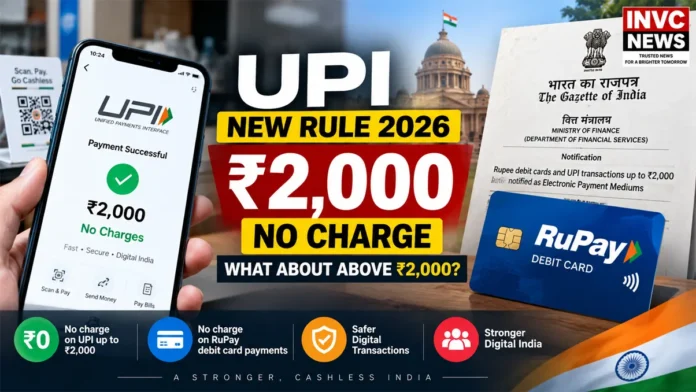
UPI charges new rule 2026 has brought an important change to India’s digital-payments framework, with the Central Government formally protecting Unified Payments Interface transactions of up to ₹2,000 from any direct or indirect charge by banks or payment-system providers.
The Finance Ministry’s Department of Financial Services issued Gazette Notification S.O. 5067(E) on September 14 under Section 10A of the Payment and Settlement Systems Act, 2007.
The notification also protects payments made through RuPay-powered debit cards from such charges.
However, the ₹2,000 threshold has created an obvious question for millions of users: Will UPI payments above ₹2,000 now attract a fee?
The short answer is: not automatically.
The notification protects UPI transactions up to ₹2,000, but the government has not announced a new consumer charge merely because a UPI transaction exceeds ₹2,000. Reports indicate that the revised framework could allow policymakers to consider charges such as Merchant Discount Rate, or MDR, on certain higher-value transactions in the future.
What Does the New UPI Notification Say?
The government has formally specified two electronic modes of payment under Section 10A:
RuPay-powered debit cards, and UPI transactions up to ₹2,000.
For payments covered by these categories, no bank or payment-system provider can directly or indirectly impose a charge on the person making or receiving the payment.
This gives explicit statutory protection to small-value UPI payments under the revised framework.
For ordinary users making everyday payments at shops, restaurants, grocery stores or other establishments, UPI transactions up to ₹2,000 therefore remain protected from such charges.
Does This Mean UPI Above ₹2,000 Will Be Charged?
No. A transaction exceeding ₹2,000 does not suddenly become chargeable simply because of this notification.
This is the most important point for UPI users.
The government has not announced a universal transaction fee on every UPI payment above ₹2,000. Nor has it announced that someone sending ₹5,000 through UPI must now pay an additional fee.
Instead, the new framework removes the blanket statutory protection that previously covered UPI more broadly and explicitly protects transactions up to ₹2,000. That potentially gives the government greater flexibility to establish a different charging framework for higher-value payments later.
Any future MDR or other charging mechanism would require its own applicable framework or directions.
Therefore, users should avoid social-media claims suggesting that a ₹2,001 UPI payment automatically attracts a charge under the September 14 notification.
What About Person-to-Person UPI Transfers?
There is also an important distinction between a consumer fee and Merchant Discount Rate.
MDR generally refers to a charge associated with merchant payments and the payment-processing ecosystem. It should not automatically be interpreted as a fee charged to an individual simply for transferring money to another person.
Current reporting indicates that person-to-person UPI transfers remain unaffected by the debate surrounding a possible MDR framework for higher-value merchant transactions.
That distinction will become especially important if the government subsequently announces additional rules.
RuPay Debit Cards Get No-Charge Protection
The Gazette notification separately specifies debit cards powered by RuPay.
Unlike the UPI provision, the wording specifying RuPay debit cards does not attach the same ₹2,000 threshold to RuPay in the notification itself.
The Gazette lists “Debit Card powered by RuPay” as one specified mode and “Unified Payments Interface (UPI) transactions upto Rs. 2,000” as the other.
That distinction matters and should not be blurred by describing the notification as though both categories carry an identical ₹2,000 cap.
Why Has the Government Changed the Framework?
India’s UPI ecosystem has grown into one of the world’s largest digital-payment networks.
Keeping such a vast infrastructure operating requires banks, payment companies and other ecosystem participants to invest in technology, cybersecurity, fraud prevention, servers and transaction processing.
The government has previously supported the ecosystem through incentive schemes rather than allowing MDR on qualifying UPI transactions. A Finance Ministry response to Parliament said the government provided approximately ₹8,730 crore in incentive support between FY2021-22 and FY2024-25.
The debate has therefore increasingly focused on how India can maintain free or inexpensive everyday digital payments while ensuring that the infrastructure supporting enormous transaction volumes remains financially sustainable.
What UPI Users Should Know Right Now
For consumers, the immediate position is straightforward.
UPI transactions of up to ₹2,000 have explicit no-charge protection under the September 14 notification.
RuPay-powered debit card payments are also specified as protected electronic payment modes.
Most importantly, the government has not announced that every UPI transaction above ₹2,000 will now carry a fee.
Users should therefore distinguish between what the Gazette actually establishes today and what policymakers may decide about higher-value transactions in the future.
Any subsequent announcement concerning MDR or charges above ₹2,000 could have major consequences for India’s digital-payments ecosystem.
Until then, claims that users must start paying simply because their UPI transaction crosses ₹2,000 go beyond what the current notification says.