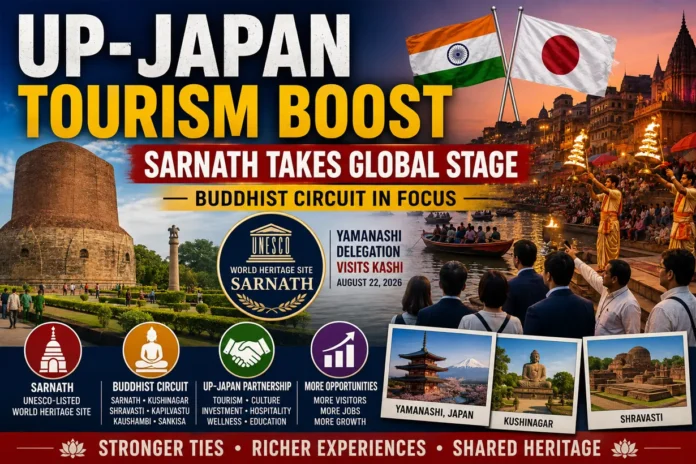
VARANASI, India | August 22, 2026
The UP-Japan tourism pact is set to give fresh momentum to Buddhist, spiritual and cultural tourism in Uttar Pradesh as a high-level delegation from Japan’s Yamanashi Prefecture arrives in Varanasi, with newly UNESCO-listed Sarnath emerging as a centerpiece of the growing partnership.
Uttar Pradesh and Yamanashi have expanded their cooperation through new agreements covering tourism and broader economic engagement, building on months of discussions between the Indian state and the Japanese prefecture.
The tourism partnership is focused on increasing visitor exchanges, promoting Buddhist destinations, strengthening cultural ties and creating new opportunities in hospitality and wellness tourism.
The timing is particularly significant because Sarnath was added to UNESCO’s World Heritage List in July 2026, strengthening its international visibility as one of Buddhism’s most important pilgrimage destinations.
Japanese Delegation Heads to Sarnath
The Japanese delegation visiting Varanasi is scheduled to experience some of Uttar Pradesh’s most important spiritual and cultural attractions.
A major stop is Sarnath, where Gautama Buddha is traditionally believed to have delivered his first sermon after attaining enlightenment.
The ancient Buddhist site has long attracted pilgrims from Japan, Thailand, Sri Lanka, South Korea and other countries with significant Buddhist communities.
Its new UNESCO World Heritage status gives Uttar Pradesh an additional opportunity to position Sarnath as a major international pilgrimage and heritage-tourism destination.
The Japanese visitors are also expected to experience the famous Ganga Aarti in Varanasi, providing another showcase of the region’s living spiritual traditions.
Sarnath Became India’s 45th World Heritage Site
UNESCO formally inscribed the Ancient Buddhist Site of Sarnath on its World Heritage List on July 25, 2026 during the 48th session of the World Heritage Committee.
The inscription made Sarnath India’s 45th World Heritage Site.
The World Heritage property includes the archaeological remains connected with the development of Buddhism at Sarnath.
The site contains important stupas, monasteries and other archaeological remains documenting centuries of Buddhist religious activity.
For Uttar Pradesh tourism, UNESCO recognition could significantly strengthen Sarnath’s international profile.
Buddhist Circuit at Heart of UP-Japan Tourism Cooperation
The tourism partnership extends well beyond Sarnath.
Uttar Pradesh is home to several major destinations associated with the life and teachings of Gautama Buddha, including:
- Sarnath
- Kushinagar
- Shravasti
- Kapilvastu
- Kaushambi
- Sankisa
Together, these destinations form a major part of India’s Buddhist tourism circuit.
For Japanese travelers, the circuit holds particular religious and cultural significance.
Officials from Uttar Pradesh and Yamanashi have therefore identified Buddhist tourism as a natural area for long-term cooperation.
Tourism MoU Targets More Visitors
The tourism agreement aims to encourage stronger visitor flows between Uttar Pradesh and Yamanashi.
Potential areas of cooperation include joint tourism promotion, exchange programs, collaboration between tour operators and greater engagement between hospitality businesses.
The two sides are also looking beyond traditional pilgrimage travel.
Wellness tourism, experiential travel, cuisine, handicrafts and cultural tourism are increasingly being viewed as complementary attractions capable of encouraging visitors to stay longer.
That could help spread tourism spending beyond a small number of monuments and religious sites.
Varanasi Could Benefit From Japanese Tourist Growth
Varanasi is likely to play a critical role in the tourism strategy.
The city already attracts large numbers of domestic and foreign tourists because of the Ganga, its temples, historic neighborhoods and spiritual traditions.
Sarnath’s location near Varanasi creates an important advantage.
International visitors can combine a Buddhist heritage experience at Sarnath with the religious and cultural attractions of Kashi.
Improved promotion in Japan could therefore increase demand for combined Varanasi-Sarnath itineraries.
Hotels, tour operators, transport providers, restaurants, guides and local artisans could benefit if international visitor numbers rise.
Kushinagar Also Important for Japanese Buddhist Travelers
Kushinagar represents another major opportunity.
Buddhist tradition identifies Kushinagar as the place where Gautama Buddha attained Mahaparinirvana.
The city also has an international airport, improving its potential as a gateway for overseas Buddhist pilgrims.
Better air connectivity combined with coordinated international promotion could make it easier to package Sarnath, Kushinagar and other Buddhist destinations into multi-day itineraries.
Uttar Pradesh has been working to improve connectivity and tourism infrastructure across these sites.
Japan and Uttar Pradesh Deepen Wider Partnership
Tourism is only one part of the expanding relationship between Uttar Pradesh and Yamanashi.
The two sides have also been building cooperation in areas including:
- Green hydrogen
- Manufacturing
- Skills and vocational education
- Technology
- Healthcare
- MSMEs
- Investment
- Cultural exchanges
During the current engagement, Uttar Pradesh has also sought to attract Japanese companies and strengthen institutional links with Yamanashi.
The broader partnership could indirectly benefit tourism if new business travel, educational exchanges and investment increase movement between Japan and Uttar Pradesh.
Japanese Interest in Uttar Pradesh Has Been Growing
The current visit follows sustained engagement between the two regions.
Earlier discussions identified Uttar Pradesh’s Buddhist Circuit as a major area for Japanese tourism and hospitality investment.
Officials have also explored opportunities for familiarization trips involving tour operators and stronger promotional activities aimed at international Buddhist travelers.
This is important because tourism growth increasingly depends not only on having attractive destinations but also on international marketing, convenient transportation, high-quality accommodation and professionally designed travel packages.
UNESCO Status Could Transform Sarnath Tourism
Sarnath’s UNESCO inscription could prove especially valuable.
World Heritage status gives destinations greater international recognition, but it can also bring increased responsibility.
Rising visitor numbers must be balanced with conservation of archaeological remains, responsible development and protection of the site’s spiritual character.
For Sarnath, the challenge will be to expand tourism without allowing commercialization or overcrowding to undermine the qualities that earned the site global recognition.
Sustainable visitor management will therefore be critical as international promotion increases.
Local Handicrafts and Cuisine Could Also Gain
The partnership could create benefits beyond hotels and tourism companies.
Uttar Pradesh has a rich ecosystem of traditional crafts, textiles, cuisine and cultural products.
Varanasi in particular is internationally known for Banarasi silk, handicrafts and religious products.
Japanese visitors interested in cultural and experiential travel could create additional demand for locally produced goods.
Integrating craftspeople, local guides and small tourism businesses into international itineraries could help distribute tourism revenue more widely.
From Taj Mahal to Kashi
The Yamanashi delegation’s Uttar Pradesh visit has showcased the diversity of the state’s tourism offering.
Japanese representatives have visited Agra, experienced local culture and engaged with officials and business representatives before moving toward Varanasi.
The itinerary reflects Uttar Pradesh’s attempt to promote itself as more than a single-destination tourism market.
Agra provides globally recognized Mughal heritage.
Varanasi offers spirituality and living culture.
Sarnath provides Buddhist heritage.
Together, these destinations create a powerful international tourism circuit.
India-Japan People-to-People Ties Could Strengthen
Tourism has increasingly become an important part of India-Japan relations.
While strategic, economic and technological cooperation dominates bilateral diplomacy, tourism and cultural exchanges can deepen connections between ordinary citizens.
Buddhism provides a particularly strong cultural bridge.
For Japan, visiting the places associated with Buddha’s life offers a direct connection with the historical origins of a tradition deeply embedded in Japanese society.
For India, expanding Buddhist tourism offers an opportunity to strengthen cultural diplomacy while generating employment and investment.
UP-Japan Tourism Pact Opens New Opportunity
The UP-Japan tourism pact therefore has implications far beyond a single delegation visit.
If joint promotion translates into sustained growth in Japanese arrivals, Uttar Pradesh could strengthen its position as one of Asia’s important Buddhist pilgrimage destinations.
The recent UNESCO recognition of Sarnath provides additional momentum at exactly the right time.
With Sarnath, Varanasi, Kushinagar, Shravasti and other Buddhist sites increasingly connected through better infrastructure and international outreach, Uttar Pradesh has an opportunity to build a tourism circuit capable of attracting pilgrims, heritage travelers and cultural tourists from across the world.
The next challenge will be converting diplomatic agreements into measurable increases in visitors, investment, hospitality capacity and local economic opportunities.
For now, the arrival of the Yamanashi delegation in Kashi sends a clear signal: Buddhist and spiritual tourism is becoming an increasingly important pillar of the Uttar Pradesh-Japan partnership.