By Team INVC | INVC NEWS
WASHINGTON, United States | September 15, 2026 —
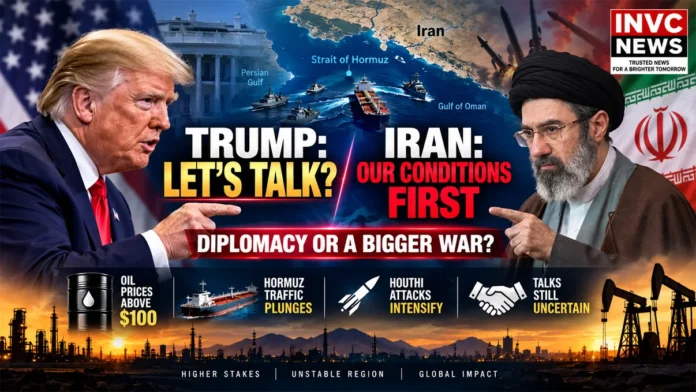
The Trump Iran talks story took a dramatic turn Tuesday after U.S. President Donald Trump opened the door to negotiations with Tehran, only for Iran to push back and insist that talks cannot begin until its conditions are met.
The diplomatic clash comes at an explosive moment for the Middle East.
Yemen’s Houthis have launched fresh missile and drone attacks on Saudi Arabia, Gulf states have postponed planned negotiations with Iran over the Strait of Hormuz, oil prices remain above $100 a barrel, and shipping through one of the world’s most important energy corridors has plunged.
Against that backdrop, Trump’s latest remarks represent a potentially important shift.
After weeks of questioning whether Iran was ready for an agreement, the U.S. president said Washington was open to the “concept” of engaging with Tehran.
But Iran did not respond with an immediate yes.
Instead, Tehran effectively replied: not on Washington’s terms.
Trump Says Iran Wants a Deal ‘Quickly and Badly’
Trump claimed Iran was eager to reach an agreement with the United States.
He said he would decide whether Washington should engage, while making clear that he was open to the concept of negotiations.
The language matters.
It stops short of announcing formal peace talks, but it represents a diplomatic opening at a time when the wider conflict is threatening oil supplies, shipping routes and regional stability.
Trump’s position has fluctuated during the conflict as Washington has tried to combine military pressure with the possibility of a negotiated settlement.
Now the door appears open again.
Iran’s Answer: No Talks Until Our Conditions Are Met
Tehran quickly complicated that narrative.
Mohsen Rezaei, secretary of Iran’s Supreme National Security Council, said Iran would not enter negotiations until its conditions were satisfied.
His response highlighted the enormous gap that remains between Trump’s willingness to consider engagement and Tehran’s willingness to actually sit down at the negotiating table.
That distinction is crucial.
The United States and Iran have not announced a new round of formal negotiations.
Instead, both sides are publicly positioning themselves over what would have to happen before meaningful diplomacy could restart.
The Real Drama Is Unfolding Around Strait of Hormuz
The diplomatic battle is inseparable from the Strait of Hormuz.
The waterway is one of the most strategically important shipping routes on Earth because a major share of global oil and liquefied natural gas trade normally passes through it.
Shipping traffic has now collapsed compared with normal pre-war levels.
Kpler data cited by Reuters showed only four commodity vessels crossed Hormuz on Monday, down from 10 the previous day.
Before the war, average daily traffic was roughly 125 vessels.
That extraordinary decline shows why the Trump-Iran confrontation is no longer only a military or diplomatic story.
It has become a global energy story.
Gulf-Iran Talks Hit the Brakes
Oman had been preparing to host Iran and Gulf Arab states for discussions focused on restoring commercial navigation through Hormuz.
Those talks have now been postponed.
The delay removes, at least temporarily, one of the most important diplomatic channels for easing pressure on the waterway.
It also comes as relations between Saudi Arabia and Iran face another serious test.
Houthis Open Another Dangerous Front
While Washington and Tehran trade messages over negotiations, the conflict around Yemen is intensifying.
Iran-aligned Houthi forces launched missiles and drones toward a Saudi military airbase in Khamis Mushait.
Saudi authorities said 13 civilians were injured.
The Houthis have also expanded their territorial position along Yemen’s western Red Sea coast, increasing fears surrounding another critical maritime chokepoint: Bab el-Mandeb.
That creates an extraordinary strategic problem.
Pressure is now building around both Hormuz and the Red Sea routes that connect Middle Eastern energy supplies with global markets.
Saudi Oil Lifeline Comes Under Pressure
Saudi Arabia’s East-West pipeline has emerged as another major point of concern.
The roughly 1,200-kilometer pipeline provides the kingdom with an alternative route for moving oil when Hormuz becomes difficult or dangerous to navigate.
Its disruption therefore carries far greater significance when Hormuz traffic is already severely constrained.
Markets immediately understand the risk.
Brent crude has been trading around $107 a barrel, keeping inflation fears alive from India to the United States.
Why India Should Watch This Very Closely
For India, this is not a distant geopolitical confrontation.
India depends heavily on imported crude oil.
A prolonged period of oil above $100 can increase the country’s import bill, pressure the rupee and raise costs across transportation, aviation, manufacturing and other sectors.
Higher energy prices can eventually work their way into consumer inflation.
That connection was visible on Dalal Street Tuesday, where expensive crude helped limit the broader market despite sharp gains in several major technology stocks.
The Middle East crisis therefore connects directly with Indian household finances and markets.
Trump Faces a Difficult Choice
The latest developments leave Trump facing a difficult strategic equation.
Escalating military involvement could deepen America’s exposure to a widening regional war.
Pulling back without an agreement could allow Iran and its regional allies to claim that military pressure forced Washington to reconsider its approach.
Diplomacy offers another route—but only if Washington and Tehran can agree on the conditions for negotiations.
For now, they cannot.
Iran Has Leverage, but So Does Washington
Iran’s ability to influence the security environment around Hormuz gives Tehran substantial bargaining power.
However, the United States retains enormous military, financial and sanctions leverage.
That creates the central contradiction behind any potential talks.
Both sides have reasons to negotiate.
Both also want the other side to make the first meaningful concession.
Neither wants to appear desperate.
Is a Trump-Iran Deal Really Getting Closer?
Not yet.
Trump’s willingness to entertain negotiations is significant, but it should not be confused with a breakthrough.
Iran’s response makes that clear.
No new comprehensive agreement has been announced. No confirmed negotiating timetable exists. Gulf-Iran discussions over Hormuz have been postponed.
Meanwhile, missiles are still flying, shipping remains severely disrupted and oil remains expensive.
Yet the fact that the word “negotiating” has returned to Trump’s public language matters.
In a conflict where every military escalation can move oil prices and global markets, even the possibility of diplomacy can become a major development.
For now, however, Washington has opened the door—and Tehran is standing on the other side demanding its price for walking through it.