WASHINGTON, August 18, 2026
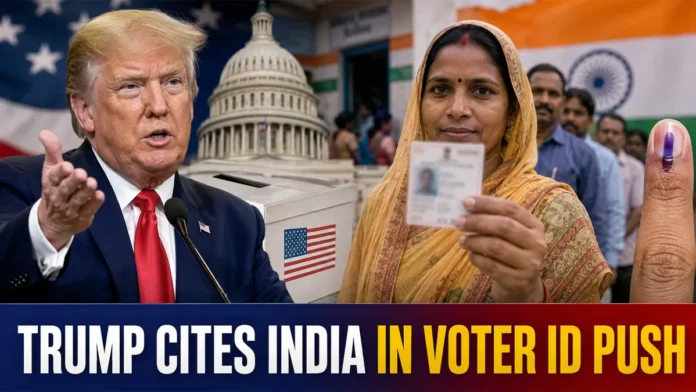
Trump India voter ID remarks have intensified the debate over US election laws after President Donald Trump cited India’s identification requirements and limited use of postal ballots to demand passage of the SAVE America Act.
In a Truth Social post on Monday, Trump said India’s Chief Election Commissioner Gyanesh Kumar recently questioned how the United States could conduct elections without a nationwide photo-identification requirement.
“Earlier this month, India’s Chief Election Commissioner, Gyanesh Kumar, asked our Administration—How can you have Elections in the U.S. without a valid Photo ID?” Trump wrote.
Trump then pointed to the size of India’s 2024 general election, saying 646 million votes were cast and fewer than 1% were submitted by mail.
“We need to pass THE SAVE AMERICA ACT, now!” he added.
How Accurate Are Trump’s Claims About India’s Election?
Official Indian data broadly supports Trump’s figures concerning the number of votes cast and the limited use of postal ballots.
India recorded 646,420,869 votes during the 2024 Lok Sabha election. Of those, 642,139,275 were cast through electronic voting machines and 4,281,594 were postal ballots, according to official election data released by the Indian government.
Postal ballots therefore represented approximately 0.66% of all votes cast, supporting Trump’s statement that fewer than 1% of Indian votes were submitted by mail.
However, India had approximately 979.75 million registered electors in 2024. The figure of 646 million cited by Trump refers to votes cast, not the country’s entire registered electorate.
India also requires voters appearing at polling stations to establish their identity before voting. The standard document is the Elector Photo Identity Card, commonly called EPIC or voter ID.
Voters who cannot produce an EPIC card may use one of several approved alternative photo documents. These include an Aadhaar card, passport, driver’s license, PAN card, pension document with a photograph, disability identification card or certain government-issued service cards.
The Election Commission of India’s 2024 instructions allowed 12 categories of alternative identification.
Therefore, Indian voters generally must prove their identity at polling stations, but they are not restricted to a single voter-ID document.
US Ambassador Sergio Gor Backs Trump’s Demand
US Ambassador to India Sergio Gor publicly supported Trump’s comparison and urged Congress to approve the legislation.
“President Donald J. Trump is absolutely right,” Gor wrote in a social media post. “646 MILLION voters, every single one required an ID in India’s last election. Congress should pass THE SAVE AMERICA ACT!”
Gor’s statement amplified the administration’s argument that a large democracy can require identification without preventing hundreds of millions of people from participating in an election.
India’s election procedures and the proposed American legislation are not identical, however. Election administration in the United States is decentralized, with individual states setting many registration, identification and voting procedures.
What Is the SAVE America Act?
The SAVE America Act, formally known as the Safeguard American Voter Eligibility Act, proposes major changes to registration and identification rules for federal elections.
The legislation would require applicants to provide documentary proof of US citizenship before registering to vote in federal elections. It would also establish a photo-identification requirement for casting a federal ballot.
Documents that could be accepted as proof of citizenship include:
- A valid US passport.
- Certain government-issued identification showing US citizenship or a US birthplace.
- A military identification card accompanied by a service record showing birth in the United States.
- A government-issued photo ID presented with a birth certificate, naturalization certificate or another approved citizenship record.
The legislation would direct states to identify and remove noncitizens from federal voter rolls. It would allow election officials to use information obtained from state agencies, the Social Security Administration and the Department of Homeland Security.
The proposal also contains identification requirements affecting mailed ballots. Trump has separately advocated limiting mail voting primarily to people who are ill, have a disability, are serving in the military or are traveling.
House Passed the Bill by a Narrow Margin
The Republican-controlled House passed the 2026 version of the SAVE America Act on February 11 by a vote of 218-213.
One Democrat joined Republicans in supporting the measure. The bill was then sent to the Senate, where it faces substantial opposition and would generally need 60 votes to overcome a filibuster.
An earlier SAVE Act passed the House in April 2025 by a vote of 220-208 but did not advance through the Senate.
The latest House-approved measure combines documentary proof-of-citizenship requirements with a federal voter-identification mandate. The House Administration Committee confirmed the February 2026 vote.
Republicans Say the Bill Would Strengthen Election Security
Republican supporters argue that citizenship documentation and identification requirements would strengthen public confidence in elections and help ensure that only US citizens participate in federal voting.
Voting by noncitizens in federal elections is already prohibited under US law and can result in criminal penalties.
Republicans contend that the existing prohibition is insufficient without a standardized system for verifying citizenship before a person is added to a federal voter roll.
The Trump administration has repeatedly characterized the proposal as a basic election-security measure similar to identification systems used in several other democracies.
Democrats Warn Eligible Voters Could Be Blocked
Democrats and voting-rights advocates argue that the legislation could prevent eligible citizens from registering or casting ballots.
They say low-income Americans, older voters, rural residents, married women whose current names differ from those on their birth certificates and people without passports could face particular difficulty satisfying the documentation requirements.
Opponents also argue that documented instances of noncitizens voting in federal elections are rare and do not justify imposing new requirements on millions of eligible voters.
Senate Democratic Leader Chuck Schumer has declared the proposal “dead on arrival” in the Senate and said Democrats would block it. His July 27 Senate remarks confirmed continued opposition to the bill.
India Comparison Adds New Dimension to US Debate
Trump’s reference to India gives his voter-ID campaign an international comparison as the United States approaches the November 2026 midterm elections.
Nevertheless, important differences remain. India has a centrally administered election system, a national electoral roll framework and government-issued voter cards. US elections are largely administered by state and local authorities under a combination of state and federal laws.
The political dispute is therefore not simply about whether voters should prove their identity. It also concerns which documents should be accepted, who must obtain them, how mail voting should operate and whether a national mandate would place an unreasonable burden on eligible citizens.
With the House measure stalled in the Senate, Trump’s latest intervention is likely to increase pressure on Republican leaders to bring the legislation back into the national debate before the midterm elections.