By Team INVC | INVC NEWS
WASHINGTON, United States | September 14, 2026 —
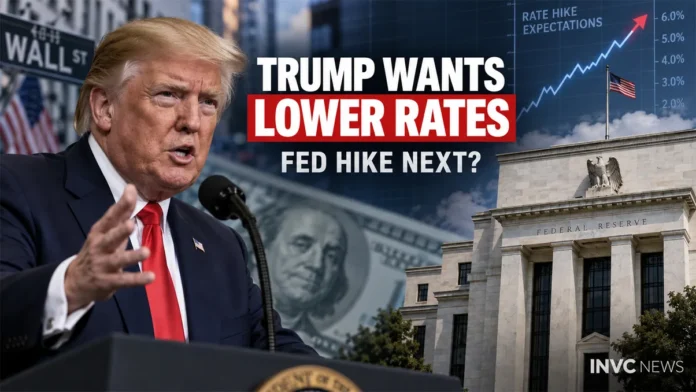
Trump demands world’s lowest US interest rate just days before the Federal Reserve’s September policy decision, setting up a sharp confrontation between the White House’s push for cheaper borrowing and growing market expectations that the central bank could raise rates instead.
US President Donald Trump said the United States should have the lowest interest rate of any country in the world as he intensified pressure on the Federal Reserve ahead of its September 15–16 meeting.
The demand comes at a difficult moment for policymakers.
Inflation accelerated again in August, oil prices remain elevated and several major Wall Street institutions now expect the Fed to tighten monetary policy rather than deliver the lower rates Trump wants.
The current federal funds target range stands at 3.50% to 3.75%.
Goldman Sachs and JPMorgan have moved toward forecasts for a 25-basis-point rate increase at the September meeting, while financial markets have also sharply increased the probability of a hike.
That creates one of the most politically sensitive Fed decisions of 2026.
Trump Wants US Interest Rates Below Every Other Country
Speaking during his visit to Ireland, Trump made his position clear.
The president argued that the United States should benefit from the lowest borrowing costs in the world because of the size and strength of the American economy.
His message was direct: the US should not allow other countries to borrow more cheaply.
Trump has repeatedly argued that high interest rates hurt economic growth, housing, investment and federal finances.
This time, however, his demand arrives just as inflation data is pushing markets in the opposite direction.
That contradiction has dramatically increased attention on the upcoming Fed decision.
Fed Faces Growing Pressure to Raise Rates
US inflation strengthened in August, adding to concerns that price pressures have not cooled enough.
Consumer prices rose 0.4% in August from the previous month, while core prices, which exclude food and energy, increased 0.3%.
Higher energy costs have complicated the inflation outlook further.
Oil prices have remained elevated amid continued Middle East tensions and disruption risks affecting global energy supplies.
The combination of stubborn inflation and strong economic data has forced investors to reconsider earlier expectations that the Federal Reserve might keep rates unchanged.
Markets are now assigning a high probability to another increase.
Goldman Sachs and JPMorgan Expect September Hike
Two of Wall Street’s biggest institutions have strengthened the case for a rate rise.
Goldman Sachs now expects the Federal Reserve to increase its policy rate by 25 basis points at the September meeting.
JPMorgan has also moved toward a September hike and sees the possibility of additional tightening later this year.
Market pricing has shifted rapidly alongside those forecasts.
Traders now see roughly an 87% probability of a September rate increase, highlighting how significantly expectations have changed in recent days.
A quarter-point hike would lift borrowing costs further for businesses and consumers at a time when mortgage rates and other forms of credit are already expensive.
Trump and Fed Heading in Opposite Directions
The political tension surrounding the meeting is unusually sharp.
Trump wants dramatically lower rates.
Markets increasingly expect higher ones.
Federal Reserve policymakers, meanwhile, must decide policy based on inflation, employment, growth and financial conditions rather than presidential preferences.
Fed Chair Kevin Warsh therefore faces a difficult test.
A rate increase could strengthen the central bank’s inflation-fighting credentials but would likely trigger fresh criticism from Trump.
Holding rates steady could ease immediate political pressure, yet policymakers would then have to explain why persistent inflation does not require tighter policy.
A rate cut would represent an even bigger surprise given current market expectations.
What Higher US Rates Could Mean for Stocks
A Fed rate increase can affect Wall Street in several ways.
Higher rates raise borrowing costs for companies and reduce the relative attractiveness of future corporate earnings.
Growth and technology stocks often become particularly sensitive because investors value many of those companies based on profits expected years into the future.
However, the effect is not automatic.
Markets may respond positively if investors believe tighter policy will bring inflation under control without triggering a recession.
The Fed’s language after the decision could therefore matter almost as much as the rate move itself.
Investors will closely examine whether policymakers signal additional hikes or describe September as a one-off adjustment.
What It Could Mean for the US Dollar
Higher interest rates can support the US dollar because dollar-denominated assets may offer investors better returns.
The dollar has already strengthened ahead of this week’s major central-bank meetings.
However, currency markets are also watching the Bank of Japan and other global central banks.
If several central banks raise rates at the same time, the dollar’s reaction may become more complicated.
Trump has previously expressed concern that currency movements can affect American exporters and international competitiveness.
A stronger dollar can make US products more expensive overseas while reducing the cost of imported goods.
Why Gold Could React Sharply
Gold traders will also watch the Fed closely.
The precious metal generally faces pressure when interest rates and bond yields rise because gold itself does not pay interest.
However, geopolitical uncertainty and inflation fears can simultaneously increase demand for gold as a safe-haven asset.
That creates competing forces.
If the Fed surprises markets with a more aggressive rate outlook, gold could face immediate pressure.
If policymakers sound cautious about future increases, bullion could find support.
Mortgage Rates Already Hurt US Borrowers
American households are already experiencing the effect of higher borrowing costs.
The average US 30-year fixed mortgage rate recently climbed to around 6.85%, its highest level since June 2025.
High mortgage rates increase monthly payments and make home purchases less affordable.
They also discourage existing homeowners from refinancing or moving if they currently hold cheaper mortgages.
This explains part of Trump’s political argument for significantly lower interest rates.
However, lowering rates while inflation remains elevated could create a different problem by stimulating demand and potentially pushing prices higher again.
Fed Independence Returns to Center of Debate
Trump’s latest comments also revive the long-running debate over Federal Reserve independence.
US presidents frequently have views about interest rates because monetary policy directly affects economic growth and elections.
Still, the Fed operates independently when setting monetary policy.
National Economic Council Director Kevin Hassett has acknowledged Trump’s preference for lower rates while also indicating continued support for the central bank’s decision-making independence.
The distinction will face another major test this week.
Every word from Fed Chair Kevin Warsh after the meeting could be examined not only for its economic meaning but also for how the White House reacts.
September Fed Meeting Becomes a Global Market Event
The September decision will affect much more than US markets.
Emerging-market currencies, global bonds, commodities, Asian stocks and international capital flows can all respond sharply to changes in American interest rates.
A higher Fed rate can encourage money to flow toward US assets.
That can place pressure on currencies in developing economies and make dollar-denominated borrowing more expensive.
Indian markets will therefore also watch the decision closely.
Changes in the dollar, US Treasury yields and foreign investor flows can influence the rupee, equities, gold and imported energy costs.
Trump Wants Cuts, Markets See a Hike
The battle lines ahead of the September Fed meeting could hardly be clearer.
Trump wants the United States to have the world’s lowest interest rates.
Wall Street increasingly expects the Federal Reserve to move rates higher.
Inflation will ultimately sit at the center of the decision.
For investors, the key questions now are not simply whether the Fed raises rates, but what it says about the months ahead.
A surprise decision or unexpectedly hawkish message could move stocks, bonds, gold, the dollar and global markets within minutes.
With the September 15–16 meeting approaching, Trump’s demand has turned an already crucial Federal Reserve decision into an economic and political showdown.