NEW DELHI, India | August 25, 2026 —
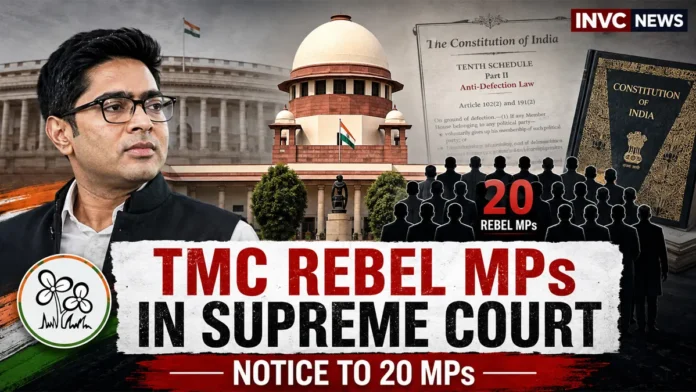
TMC rebel MPs Supreme Court case took a significant turn Tuesday as the Supreme Court issued notices to 20 rebel Trinamool Congress lawmakers on a petition filed by party general secretary and Lok Sabha leader Abhishek Banerjee seeking a time-bound decision on their pending disqualification cases.
The dispute centers on petitions before Lok Sabha Speaker Om Birla seeking the MPs’ disqualification under India’s anti-defection law.
Solicitor General Tushar Mehta informed the Supreme Court that the Speaker had already issued notices to the 20 lawmakers.
The bench, however, indicated that the central question was not simply whether notices had been issued, but whether the disqualification proceedings would be concluded within a reasonable time.
What Abhishek Banerjee Wants From Supreme Court
Banerjee has approached the Supreme Court seeking an expeditious decision by the Lok Sabha Speaker on the pending disqualification petitions.
The matter was heard by a bench headed by Chief Justice of India Surya Kant, along with Justice Joymalya Bagchi and Justice V. Mohana.
The petition does not itself ask the Supreme Court to immediately declare the 20 MPs disqualified.
Instead, the principal issue before the Court concerns the alleged delay in completing the proceedings already pending before the Speaker.
That distinction is important because under the constitutional anti-defection framework, the Speaker normally decides petitions involving defection by members of the House.
Why TMC Wants the 20 MPs Disqualified
The Trinamool Congress alleges that the 20 lawmakers, who were elected on the party’s ticket, subsequently broke with the party and aligned themselves with the Nationalist Citizens Party of India, or NCPI, which has moved closer to the NDA.
TMC argues that their actions amount to voluntarily giving up membership of the party and therefore attract provisions of the Tenth Schedule of the Constitution.
The rebel MPs will have the opportunity to respond to the allegations and present their legal position in the proceedings.
No final finding of disqualification has yet been made.
What India’s Anti-Defection Law Says
The Tenth Schedule of the Constitution, commonly known as the anti-defection law, provides circumstances in which an elected lawmaker can be disqualified.
A member belonging to a political party may face disqualification if the member voluntarily gives up membership of that party or votes or abstains contrary to an authorized party direction, subject to the constitutional conditions and exceptions.
The Constitution also contains provisions relating to mergers of legislature parties.
Readers can access the official Tenth Schedule of the Constitution of India.
Whether the conduct of the 20 MPs satisfies the constitutional test is precisely the type of question that must be determined through the prescribed proceedings rather than assumed in advance.
Supreme Court Focuses on Time Taken by Speaker
The most consequential part of Tuesday’s hearing could be the Court’s focus on delay.
Justice Bagchi observed during the proceedings that the question was not only about issuing notices, but about concluding the proceedings within a time frame.
The Supreme Court has dealt with delays in anti-defection proceedings before.
In the Keisham Meghachandra Singh case, the Court emphasized that disqualification petitions should generally be decided within a reasonable period except in exceptional circumstances.
The current TMC dispute could therefore become another important test of how quickly Speakers are expected to decide politically sensitive anti-defection cases.
Why the Case Matters Politically
The dispute has implications beyond the legal status of 20 individual MPs.
A decision affecting a group of this size could alter parliamentary numbers and intensify the political confrontation within West Bengal’s Trinamool Congress.
INVC NEWS has previously tracked the internal power struggle surrounding the TMC and Mamata Banerjee.
The latest Supreme Court proceedings move that political conflict into an important constitutional forum.
The case also puts renewed attention on the powers and responsibilities of the Lok Sabha Speaker. INVC NEWS recently reported on Speaker Om Birla’s intervention during disruptions in the Lok Sabha.
What Happens Next?
The 20 rebel MPs now have to respond to the Supreme Court notice.
Meanwhile, the Speaker’s disqualification proceedings can continue independently.
The Supreme Court has not disqualified the MPs, nor has it ruled that the TMC’s allegations are proven.
The next important questions are whether the Speaker sets a clear timetable for deciding the petitions and how the rebel lawmakers defend their position under the Tenth Schedule.
For Abhishek Banerjee and the TMC, the immediate objective is clear: a final decision rather than an open-ended disqualification process.
For the 20 MPs, the coming proceedings will determine whether their political realignment is legally protected or attracts disqualification under India’s anti-defection law.