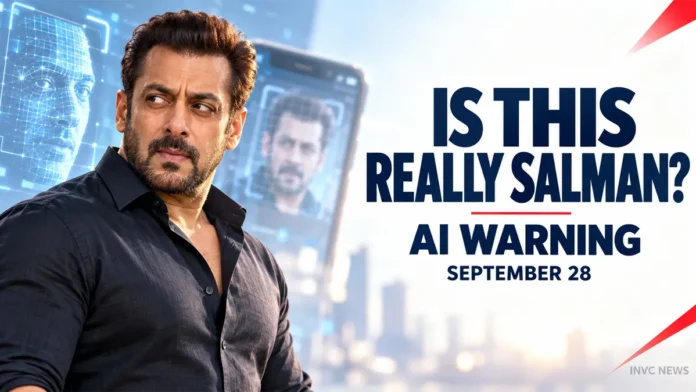
MUMBAI, India | September 28, 2026 —
That Salman Khan video suddenly appearing on your social media feed may look real. His face may look right. His voice may sound familiar. He may even appear to be saying something shocking, endorsing a product or attacking someone.
But there is now one question every viewer needs to ask before believing it:
Did Salman Khan actually say it — or did artificial intelligence create it?
The Bollywood superstar has raised a strong warning over fake AI-generated videos and manipulated voices spreading across social media, revealing that he himself has appeared in such fabricated content.
Salman said people who knowingly create deceptive AI videos should face serious consequences, while also calling for stronger controls to stop manipulated content from spreading online.
His warning is not just about protecting a movie star.
It is about a digital problem that could affect anyone with a face, a voice and a social media presence.
THE 60-SECOND BRIEF
Salman Khan has spoken out against fake AI-generated videos and manipulated voice clips.
The actor revealed that AI-created videos featuring him are already circulating.
He said people who knowingly create deceptive AI content should face strict action.
Salman also expressed concern that ordinary viewers may share such videos without realizing they are fake.
His comments have reopened a much bigger question: Can we still trust everything we see and hear on social media?
‘Even I Am There’: Salman Reveals the Scale of the Problem
Salman Khan made the issue personal when he explained that fake AI content does not involve only unknown victims.
He said AI-generated videos have used several people — including him.
Technology can now take a person’s voice, imitate it and make that person appear to say words they never spoke.
That is what makes the new generation of deepfakes particularly dangerous.
The problem is no longer limited to badly edited photographs or obviously fake videos.
AI-generated content can increasingly look convincing enough for an ordinary viewer to believe it is genuine.
And once the viewer believes it, the content can spread at extraordinary speed.
Salman Khan Wants Tough Action
Salman drew an important distinction between someone who unknowingly shares a fake video and the person who deliberately creates one.
His strongest criticism was directed at people who know the content is fabricated but still manufacture it to mislead others.
The actor argued that serious consequences are needed before such behavior can be brought under control.
He also called for stronger regulation of social media content and said he intended to take the matter seriously.
That makes his intervention more than a casual celebrity complaint.
It puts the spotlight on accountability in the age of artificial intelligence.
The Real Danger: You May Not Know It Is Fake
Imagine seeing a video in which a well-known actor appears to promote an investment scheme.
The face looks real.
The voice sounds real.
The expressions appear natural.
Millions of people may instinctively assume that the celebrity really made the statement.
That is exactly where AI manipulation becomes dangerous.
A fake celebrity endorsement can make an unknown product appear trustworthy.
A fabricated statement can trigger outrage.
A manipulated voice can create a controversy that never actually happened.
And by the time the original person denies it, the fake clip may already have reached millions.
Why Salman Khan’s Warning Matters to You
It would be easy to treat this as another Bollywood controversy.
That would miss the bigger story.
The same technology capable of copying a celebrity can also imitate ordinary people.
A scammer could potentially clone someone’s voice.
A fake clip could be created to embarrass or harass someone.
An edited video could make a person appear to say something damaging.
A fraudulent advertisement could use the face of someone trusted by millions.
The danger comes from the fact that human beings naturally trust their eyes and ears.
Artificial intelligence is challenging that instinct.
Saw Salman Khan in an Ad? Verify Before You Trust It
Celebrity appearances have traditionally made advertisements feel more credible.
AI changes that equation.
Today, simply seeing a famous face beside a product does not automatically prove that the person endorsed it.
The same applies to investment offers, apps, health products, contests and money-making schemes.
Before acting on any unusual celebrity endorsement, users should check whether the same campaign appears on the celebrity’s official channels or through an established company.
Be especially suspicious when an advertisement creates urgency with phrases such as “limited time,” “invest immediately” or “guaranteed returns.”
The more aggressively a video pushes you to act before checking it, the more carefully you should verify it.
Deepfakes Are Changing the Meaning of ‘Proof’
For decades, photographs provided visual evidence.
Video appeared even stronger.
A recording of someone speaking was often treated as proof that the person actually said those words.
AI has disrupted that assumption.
A face can now be replicated.
A voice can be cloned.
Lip movements can be synchronized with words the real person never spoke.
That does not mean every unusual video is fake.
It means viewers can no longer treat a realistic appearance alone as confirmation.
Verification is becoming part of basic digital literacy.
Salman Khan Has Already Fought to Protect His Identity
The actor’s concern also fits into a wider battle over celebrity personality rights.
Salman Khan has previously approached the courts to protect unauthorized commercial use of his name, voice, likeness, photographs and other elements associated with his identity.
The underlying issue has become increasingly important as artificial intelligence makes it easier to imitate recognizable public figures.
A celebrity’s identity is no longer represented only by a photograph.
Their voice, expressions, mannerisms and visual likeness can all potentially be reproduced digitally.
That has created an entirely new battlefield between technology, consent and personal rights.
Before Sharing a Viral Clip, Do This
A few seconds of checking can prevent a fake from spreading further.
Look for the original source.
Check whether the clip appears on an official account.
Watch for unnatural changes in voice, facial movement or synchronization — while remembering that increasingly sophisticated deepfakes may not show obvious flaws.
Most importantly, do not immediately forward sensational content simply because it features a familiar person.
AI misinformation depends on speed.
Verification slows it down.
THE BIGGER PICTURE
Salman Khan’s warning points to one of the biggest changes taking place on the internet.
The question is no longer simply whether information is true.
Users must increasingly ask whether the person appearing to deliver that information is even real.
That transformation could affect celebrities, politicians, businesses, families and ordinary social media users alike.
Artificial intelligence can create extraordinary opportunities.
But when used deceptively, it can also manufacture something the internet has never been able to produce at this scale before:
convincing evidence of an event that never happened.
INVC NEWS Bottom Line
Salman Khan’s message deserves attention even from people who do not follow Bollywood.
He says fake AI videos using his identity already exist and wants tough consequences for those deliberately creating deceptive content.
But the biggest warning is for everyone holding a smartphone.
From now on, seeing a familiar face is not enough.
Hearing a familiar voice is not enough.
Even watching a realistic video may not be enough.
So the next time a shocking Salman Khan clip — or any celebrity video — suddenly goes viral, ask one question before you believe or share it:
Is this really them — or is AI making you believe it is?
What happened. Why it matters. What comes next.