New Delhi, August 18, 2026
Reuven Azar, Israel’s ambassador to India, on Tuesday praised Prime Minister Narendra Modi’s role in transforming India’s economy and global profile, while also delivering a sharp assessment of Iran’s strategy in the Strait of Hormuz and urging caution in judging the long-term impact of the newly formed Saudi Arabia-Türkiye-Pakistan defense pact.
Azar said Prime Minister Modi enjoys considerable respect in Israel and pointed to India’s economic growth, infrastructure expansion, reforms and the empowerment of younger generations as evidence of the country’s transformation.
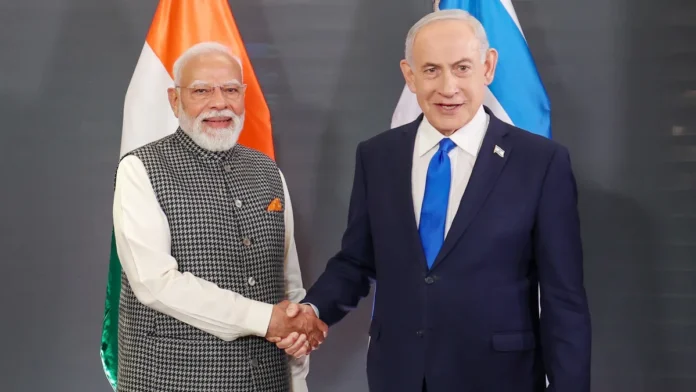
His remarks came months after PM Modi became the first Indian prime minister to address Israel’s parliament, the Knesset, during a special plenary session in Jerusalem on February 25, 2026. PM Modi used that address to emphasize the deepening India-Israel relationship, cooperation in technology and innovation, and a shared commitment to combating terrorism.
Reuven Azar Praises PM Modi’s Role in India’s Development
Azar said there was little doubt that PM Modi had played a transformative role in India’s development.
“When you live here, when you look at India’s development figures, when you see the empowerment of the younger generation, the growth rate of the economy, infrastructure construction and reforms, it is very clear,” Azar said.
He added that India was increasingly opening itself to the world and that the scale of economic and social change was visible to diplomats and investors operating in the country.
The Israeli envoy also said PM Modi was admired in Israel and enjoyed considerable popularity there, reflecting the growing political and strategic relationship between the two countries.
The India-Israel relationship was formally elevated during PM Modi’s February state visit, when both governments agreed to take their strategic partnership to a higher level.
PM Modi’s Knesset Speech Marked a Diplomatic Milestone
PM Modi’s address to the Knesset earlier this year was itself a significant diplomatic moment.
He became the first Indian prime minister to address the Israeli parliament and told lawmakers that India and Israel were connected not only by modern strategic interests but by centuries of historical and civilizational links.
The visit also highlighted cooperation in technology, innovation, defense, security, agriculture, water management and entrepreneurship.
That broader context helps explain why Azar’s latest comments on PM Modi focused not only on bilateral diplomacy but also on India’s domestic transformation.
Iran-US 60-Day Ceasefire Window Reaches Critical Point
Azar’s remarks also came as attention returned to Iran and the United States following the end of the 60-day period associated with their June memorandum of understanding.
The White House says the June arrangement extended a 60-day ceasefire, reopened the Strait of Hormuz to international shipping and created a framework for pursuing a more permanent settlement.
With that period now reaching its end, questions are again growing over whether Washington and Tehran can move toward a durable agreement or whether military and maritime tensions will return.
Azar argued that Iran had been significantly weakened and was attempting to use pressure in the Strait of Hormuz to extract concessions from the international community and the United States.
Azar Calls Iran’s Hormuz Strategy ‘Unwise’
The Israeli ambassador described Iran’s approach in the Strait of Hormuz as strategically shortsighted.
He argued that repeated threats to maritime traffic could accelerate efforts by regional governments to develop pipelines and energy corridors that bypass the strait altogether.
Azar pointed to existing and proposed pipeline routes across the Middle East, including Saudi Arabia’s east-west energy infrastructure and other projects designed to move oil toward alternative export terminals.
His broader argument was that the more Iran uses the Strait of Hormuz as political leverage, the greater the incentive for oil exporters to reduce their dependence on the waterway.
“I think this is a very unwise move by Iran,” Azar said, arguing that pressure in the strait would not reverse what he described as Iran’s military and economic setbacks.
Iran and Oman Are Working on a Safe Shipping Corridor
Iran, however, presents a different account of the maritime situation.
Iranian Foreign Ministry spokesman Esmail Baghaei said Tehran and Muscat have been negotiating for months on a safe navigation corridor through the Strait of Hormuz. Iran says the geographical parameters of the proposed route have already been agreed by the two sides, although a joint statement remains under preparation.
Baghaei said technical, legal, security and environmental aspects had been reviewed, while stressing that an Iran-Oman arrangement alone would not resolve all security concerns in the strait.
Earlier talks between Iran and Oman also focused on operational mechanisms for safe commercial navigation while preserving the sovereign rights of both littoral states.
The contrasting Israeli and Iranian assessments underline how differently the two governments view the causes of instability in one of the world’s most strategically important maritime corridors.
Why the Strait of Hormuz Matters
The Strait of Hormuz is a crucial energy route connecting the Persian Gulf with the Gulf of Oman and the Arabian Sea.
Any prolonged disruption to shipping through the strait can affect global oil markets, shipping costs and energy security well beyond the Middle East.
That makes the diplomatic dispute especially significant for countries such as India, which remain highly exposed to imported crude oil and energy-market volatility.
Azar’s argument is that Iran risks weakening its own strategic leverage if major producers accelerate investments in alternative export routes.
Saudi Arabia, Türkiye and Pakistan Defense Pact Draws Attention
Azar was also asked about the Mecca Joint Defence Agreement, signed by Saudi Arabia, Türkiye and Pakistan on August 7.
The agreement states that an armed attack against one of the three countries would be considered an attack against all, creating a collective-defense mechanism similar in principle to NATO’s Article 5.
Saudi Arabia, Türkiye and Pakistan have described the agreement as a defensive arrangement intended to strengthen deterrence and deepen military coordination rather than as a pact directed at any specific country.
The agreement has nevertheless prompted close scrutiny in India, Israel and across the Middle East because of the strategic weight of its members and the timing of the pact amid regional tensions.
Azar Says It Is Too Early to Judge the Pact
Azar cautioned against drawing sweeping conclusions about the alliance at this stage.
“It is difficult to assess it right now,” he said.
He noted that Saudi Arabia and Türkiye have had significant political differences in the past and argued that the current arrangement appeared to be driven more by immediate security concerns than by the emergence of a fully integrated military alliance.
Azar referenced earlier tensions between Riyadh and Ankara, including disagreements surrounding political Islam and the Jamal Khashoggi case, as examples of the historical divisions that could limit deeper military integration.
He said the region had seen numerous political and security groupings over the decades without necessarily developing into structures comparable with NATO.
“We have to wait and see,” he said.
Türkiye Compares Pact to NATO-Style Collective Defense
Türkiye has been more explicit about the agreement’s collective-defense character.
Turkish Foreign Minister Hakan Fidan described the principle as technically similar to NATO’s Article 5 because an attack on one signatory would be considered an attack on all.
The agreement also envisages greater political and military coordination, joint exercises and cooperation in defense industries.
However, the extent to which members would automatically commit military forces in a future conflict remains less clear.
That uncertainty supports Azar’s argument that the pact’s long-term strategic significance cannot yet be fully measured.
Debate Over Pakistan’s Regional Role
The new defense arrangement has also renewed debate over Pakistan’s role in Middle Eastern security.
Some analysts have argued that Islamabad is seeking to expand its diplomatic influence after years of economic and political difficulties, while others view Pakistan primarily as a security partner offering military experience and deterrence capabilities.
Azar said he did not believe Pakistan had played a major direct military role in the Iran conflict.
He also questioned how effective Islamabad could be as a diplomatic intermediary, arguing that previous attempts to mediate between Iran and the United States had produced limited results.
According to Azar, Iran’s actions after earlier agreements had further complicated confidence-building efforts.
His remarks reflect Israel’s skepticism toward Pakistan’s role in any broader West Asian security architecture, though Pakistan and its partners have presented their new defense cooperation as focused on collective deterrence rather than alignment against Israel or India.
No Evidence Pact Is Formally Directed at India or Israel
The Mecca agreement has triggered speculation about whether it could evolve into a wider Muslim security bloc.
However, the agreement’s publicly available language does not identify India or Israel as targets.
The signatories have framed the pact around collective defense and regional security, while independent analysts have noted that Iran-related instability has been a major driver of closer cooperation.
For that reason, claims that the pact already represents a coordinated front against India or Israel would go beyond what has been publicly established.
The more immediate significance lies in the deepening strategic cooperation among Saudi Arabia, Türkiye and Pakistan.
India and Israel Continue to Deepen Strategic Ties
Azar’s comments on PM Modi also underline how much India-Israel relations have expanded beyond traditional defense cooperation.
During PM Modi’s February visit to Israel, both governments emphasized collaboration in technology, innovation, agriculture, water, security and economic development.
PM Modi’s Knesset speech also stressed the role of people-to-people ties and the Indian Jewish community in strengthening relations between the two countries.
For Israel, India is increasingly viewed as an important strategic, economic and technological partner.
For India, Israel remains an important partner in defense, agriculture, innovation and emerging technologies, even as New Delhi maintains relationships across the wider Middle East.