SINGAPORE | August 21, 2026
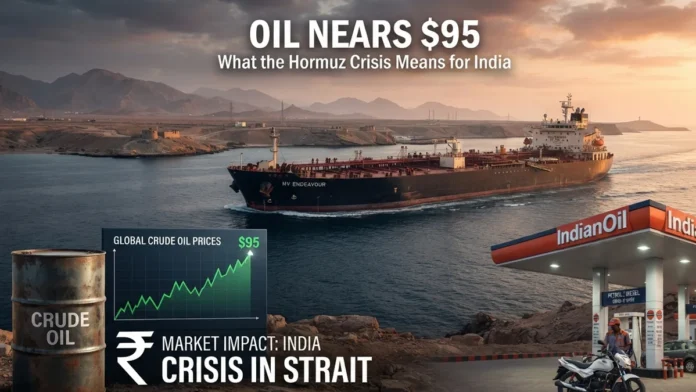
Oil price near $95 a barrel is creating a fresh economic challenge for India as escalating tensions involving Iran and uncertainty around the Strait of Hormuz threaten global energy supplies, potentially putting pressure on inflation, the rupee and domestic fuel costs.
Brent crude climbed sharply as energy traders assessed geopolitical risks in the Gulf and the possibility of tighter restrictions on Iranian oil flows.
The latest rise comes as Washington prepares to intensify economic pressure on Tehran and uncertainty persists over shipping through the Strait of Hormuz, one of the world’s most important energy transit routes.
For India, which depends heavily on imported crude oil, a prolonged period of elevated international prices could have consequences extending far beyond petrol pumps.
Why the Strait of Hormuz Matters So Much
The Strait of Hormuz connects the Persian Gulf with the Gulf of Oman and the Arabian Sea. It is a crucial route for crude oil, petroleum products and liquefied natural gas moving from Gulf producers to international markets.
That makes any threat to shipping through the waterway immediately important for global oil prices.
Even when physical supplies remain available, fears of disruption can increase crude prices, shipping rates and insurance costs.
The impact can be particularly significant for Asian economies because several major oil-importing countries depend on Gulf energy supplies.
Why India Is Particularly Exposed to Higher Crude Prices
India imports the overwhelming majority of the crude oil it consumes.
As a result, a sharp increase in international oil prices can raise the country’s import bill and increase the amount of foreign currency required to purchase energy.
That relationship creates several interconnected risks.
Higher crude prices can put pressure on the rupee, increase costs for companies, affect transportation expenses and eventually feed into consumer inflation.
A sustained oil shock can also complicate the government’s fiscal calculations and the Reserve Bank of India’s monetary-policy outlook.
Will Petrol and Diesel Become More Expensive in India?
A rise in crude oil does not automatically mean petrol and diesel prices at Indian fuel stations will increase immediately.
Domestic retail fuel prices depend on several factors, including international crude and product prices, exchange rates, taxes, refining economics and pricing decisions by oil-marketing companies.
However, the longer international crude remains elevated, the greater the pressure on fuel economics becomes.
If global prices stay near current levels or climb further, investors and consumers are likely to increasingly focus on whether Indian oil companies can absorb the additional cost without changes in retail prices.
Therefore, consumers should distinguish between a temporary geopolitical spike and a sustained period of expensive crude.
Rupee Faces Another Oil Challenge
Crude prices and the Indian rupee are closely watched together because oil imports require substantial dollar payments.
When the cost of imported crude rises, India’s demand for dollars can increase.
That can place downward pressure on the rupee, particularly when global investors are already cautious about emerging-market assets.
A weaker rupee can then make imported oil even more expensive in local-currency terms, creating a potentially difficult feedback loop.
The Reserve Bank of India can intervene in foreign-exchange markets to reduce excessive volatility, but sustained global oil pressure remains an important macroeconomic risk.
Inflation Could Become the Bigger Concern
For households, the effect of an oil shock is not limited to the price displayed at petrol stations.
Diesel and other transportation fuels influence the cost of moving vegetables, grains, manufactured goods and other products across the country.
Aviation fuel affects airline operating costs, while petroleum products are important inputs for chemicals, plastics, paints and several manufacturing industries.
Consequently, a prolonged increase in energy prices can gradually spread through the broader economy.
This is why economists closely monitor crude prices when assessing India’s inflation outlook.
RBI Policy Could Become More Complicated
Persistent oil-driven inflation could also complicate the Reserve Bank of India’s interest-rate decisions.
Central banks generally distinguish between temporary supply shocks and inflation that becomes more widespread or persistent.
If expensive energy significantly pushes up inflation expectations and broader prices, policymakers may have less flexibility to support economic growth through easier monetary policy.
However, the eventual RBI response would depend on the duration of the oil shock, domestic inflation data, economic growth and global financial conditions.
It would therefore be premature to conclude that higher crude prices alone will automatically trigger an interest-rate increase.
US-Iran Economic Confrontation Adds Another Layer of Risk
Energy markets are also watching Washington’s next move against Tehran.
U.S. Treasury Secretary Scott Bessent has said Washington plans to pursue what he described as its toughest sanctions campaign against Iran, with additional details expected Monday.
China’s role is particularly important because of its economic and energy relationship with Iran.
If sanctions enforcement significantly reduces Iranian oil exports or creates greater uncertainty for buyers, traders could price an additional geopolitical risk premium into crude.
What Indian Consumers Should Watch Next
Three developments are particularly important for India: the direction of Brent crude prices, conditions in and around the Strait of Hormuz, and the rupee’s movement against the U.S. dollar.
Consumers should also watch whether elevated crude prices persist rather than reacting to a single day’s market movement.
A rapid diplomatic de-escalation could remove part of the geopolitical premium from oil.
On the other hand, a prolonged confrontation involving sanctions, shipping restrictions or supply disruptions could keep energy prices elevated and increase pressure on India’s economy.
For now, the biggest risk is not simply that oil has approached $95. It is how long the geopolitical uncertainty keeps it there — and whether the Strait of Hormuz remains open to normal energy traffic.