JACKSON HOLE, Wyoming | August 27, 2026 —
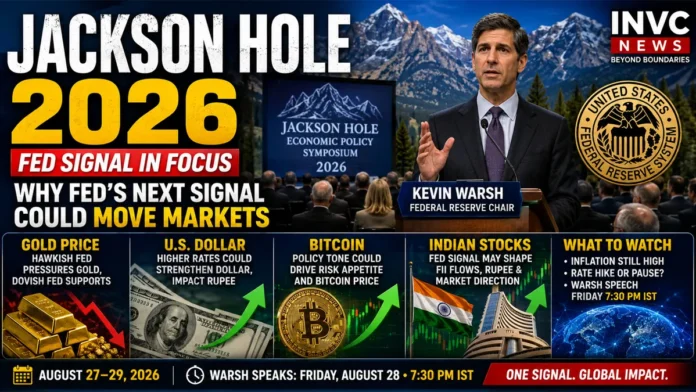
Jackson Hole 2026 begins today with global investors focused on one central question: will Federal Reserve Chair Kevin Warsh signal that U.S. interest rates could remain higher for longer—or even rise again—as inflation stays well above the Fed’s 2% goal?
The Federal Reserve Bank of Kansas City’s annual Economic Policy Symposium runs from August 27 to August 29, bringing together central bankers, economists, financial-market participants and policymakers from around the world. This year’s theme is “Financial Innovation: Implications for Payments and Policy.”
Warsh’s first Jackson Hole keynote as Federal Reserve Chair is scheduled for Friday, August 28 at 10:00 AM ET, which is 7:30 PM IST for Indian viewers.
His remarks could influence the U.S. dollar, Treasury yields, gold, Bitcoin and global equities—and the reaction could quickly spill into Indian markets.
Why Jackson Hole 2026 Matters So Much
Jackson Hole is not a formal Federal Open Market Committee meeting and no interest-rate decision will be announced at the symposium.
But Federal Reserve chairs have historically used the gathering to explain major shifts in monetary-policy thinking.
This year carries additional importance because Warsh is still defining his approach as Fed Chair and markets are searching for clearer guidance on how aggressively the central bank intends to tackle inflation.
At its July 28–29 meeting, the Fed kept the federal funds target range unchanged at 3.50% to 3.75%.
However, the decision was not unanimous.
Three policymakers—Beth Hammack, Neel Kashkari and Lorie Logan—favored a 25-basis-point rate increase, highlighting a more hawkish debate inside the central bank.
That disagreement makes Warsh’s Jackson Hole message even more important.
US Inflation at 3.7% Keeps Fed Under Pressure
The latest inflation data gives the Fed little room for complacency.
The U.S. Bureau of Economic Analysis reported that the Personal Consumption Expenditures Price Index increased 3.7% year over year in July, while core PCE inflation, which excludes food and energy, stood at 3.3%.
On a monthly basis, both headline and core PCE increased 0.2%.
PCE is particularly important because it is the Federal Reserve’s preferred measure of inflation.
There is an important distinction for readers: July’s Consumer Price Index was 3.4% year over year, so the widely discussed 3.7% figure refers to PCE inflation rather than CPI.
With inflation still significantly above the Fed’s 2% objective, traders will listen carefully for any suggestion that Warsh believes monetary policy needs to become more restrictive.
How Jackson Hole Could Affect Gold Prices
Gold could be one of the assets most sensitive to Warsh’s speech.
The relationship is largely driven by interest rates, bond yields and the U.S. dollar.
If Warsh delivers a hawkish message, suggesting that inflation remains too high and further tightening may be required, U.S. Treasury yields and the dollar could rise.
Higher yields can reduce the relative appeal of gold because bullion does not generate interest income.
A stronger dollar can also make dollar-denominated gold more expensive for buyers using other currencies.
On the other hand, a softer-than-expected Fed message could reduce rate expectations, pressure the dollar and provide fresh support to precious metals.
That makes Friday’s speech an important near-term trigger for gold investors in India as well.
Dollar Could React Immediately
The U.S. dollar enters Jackson Hole with investors already reassessing the possibility of tighter monetary policy following the latest inflation data.
A stronger-than-expected hawkish signal could reinforce demand for the dollar, particularly if traders believe U.S. rates will remain elevated for longer.
A more balanced or dovish message could have the opposite effect.
For India, dollar strength matters because it can influence the rupee, foreign portfolio flows, imported inflation and commodity costs.
A persistently strong dollar can make it harder for emerging markets to attract international capital, especially when U.S. bond yields are also elevated.
Why Bitcoin Investors Are Watching Jackson Hole
Bitcoin adds an unusual dimension to this year’s symposium.
The official Jackson Hole 2026 theme focuses on financial innovation, payments and policy, putting subjects linked to digital finance closer to the center of the discussion than at many previous symposiums.
Bitcoin is not directly controlled by Federal Reserve interest rates, but monetary policy can strongly influence investor appetite for risk assets.
If markets anticipate higher rates and tighter financial conditions, speculative assets can face pressure.
If expectations shift toward easier financial conditions, cryptocurrencies can benefit from improved liquidity and stronger risk appetite.
Investors will therefore watch not only Warsh’s comments on inflation but also any broader remarks surrounding payment innovation, digital finance and financial-market infrastructure.
What Jackson Hole Means for Indian Stock Markets
Indian investors should not treat Jackson Hole as a purely American event.
Changes in U.S. rates can influence global capital allocation almost immediately.
A hawkish Fed signal could push U.S. bond yields and the dollar higher, potentially increasing pressure on foreign institutional flows into emerging markets.
That could weigh particularly on high-valuation sectors and companies sensitive to global liquidity conditions.
A less aggressive Fed message could improve global risk appetite and provide support to equities.
For India, four channels matter most: foreign investor flows, the rupee-dollar exchange rate, global bond yields and commodity prices.
Technology stocks could be particularly sensitive because their valuations are linked to global growth expectations and interest rates.
Also Read – : Nvidia’s latest earnings have already put global AI and technology valuations back in focus ahead of Jackson Hole.
Nvidia Earnings: Revenue Hits $96.2 Billion as AI Demand Accelerates
Warsh’s Message May Matter More Than a Rate Prediction
Investors should not focus only on whether Warsh explicitly supports a rate increase.
The language he uses around inflation, Treasury yields and financial conditions could be just as important.
Markets will listen for signals on whether the Fed believes higher long-term bond yields are already tightening financial conditions enough to reduce the need for additional policy-rate increases.
Warsh may also address how new financial technologies affect monetary policy, financial stability and the payments system.
That broader discussion could attract attention from banks, fintech companies, cryptocurrency investors and technology firms.
September Fed Meeting Comes Next
Jackson Hole arrives less than three weeks before the next scheduled FOMC meeting on September 15–16, 2026.
That gives Warsh’s Friday speech added significance.
Any meaningful change in tone could alter expectations before the September decision.
Until then, investors should be prepared for volatility rather than assuming a single directional move in gold, Bitcoin, currencies or stocks.
The key question is whether Warsh convinces markets that the Fed is comfortable holding rates where they are—or signals that persistent inflation could force another move.
For Indian investors, the answer could influence everything from the rupee and gold prices to foreign flows and the direction of the Sensex and Nifty.
Official Sources
Federal Reserve — August 2026 Calendar:
Federal Reserve official schedule
Federal Reserve Bank of Kansas City — Jackson Hole Symposium:
Jackson Hole Economic Policy Symposium official page
U.S. Bureau of Economic Analysis — July 2026 PCE Inflation:
Personal Income and Outlays, July 2026
Federal Reserve — July FOMC Decision:
Federal Reserve July 29, 2026 FOMC statement
Market movements discussed in this article are scenarios, not predictions. This article is for informational purposes only and does not constitute investment advice.