WASHINGTON, United States | August 25, 2026 —
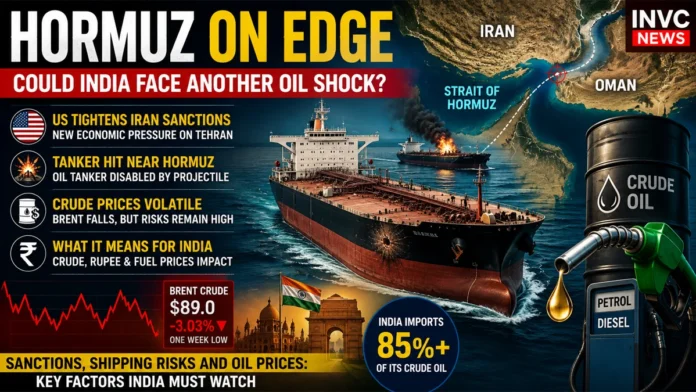
Iran sanctions and Strait of Hormuz tensions have returned to the center of global energy markets after the United States launched a sweeping new economic campaign against Tehran and an oil tanker was struck by an unidentified projectile near Oman, raising fresh questions about what another disruption in the Gulf could mean for India.
The immediate picture, however, is more complicated than a simple oil-price spike.
Global crude prices actually retreated sharply on Tuesday as traders initially viewed economic sanctions as less disruptive to oil supplies than renewed large-scale military action. Brent crude fell to around $89 a barrel during the session.
That means there is currently no basis to say petrol or diesel prices in India are about to rise automatically.
The bigger risk is what happens next in the Strait of Hormuz.
US Launches New Economic Campaign Against Iran
The U.S. Treasury has launched what it calls Operation Economic Outcast, expanding pressure on Iran’s international economic and financial networks.
The measures include nearly 60 individuals, entities and vessels linked to Iran, with additional sanctions exposure covering areas such as shipping, technology, digital assets, aviation and gold.
Washington has also warned businesses and financial institutions facilitating sanctions evasion that they could lose access to the U.S. financial system.
Official U.S. Treasury details:
https://home.treasury.gov/news/press-releases/sb0613
For oil markets, the crucial question is whether the campaign eventually restricts Iranian exports further or triggers a military response that disrupts other Gulf energy flows.
Oil Tanker Hit Near Oman
Maritime risk increased again after an oil tanker was struck by an unidentified projectile about nine nautical miles northeast of Ash Shishah, Oman.
The projectile damaged the vessel’s engine room and disabled the tanker. The crew was reported safe, while authorities were investigating the incident.
The attack occurred on the Omani side of the strategically important Strait of Hormuz corridor.
The wider maritime environment was already considered extremely dangerous. A recent Joint Maritime Information Center assessment maintained a SEVERE threat level for the Strait of Hormuz and said commercial traffic remained sharply reduced.
UK Maritime Trade Operations:
https://www.ukmto.org/
Why the Strait of Hormuz Matters So Much
Hormuz is not simply another shipping route.
Before the current conflict disrupted traffic, approximately 20% of global petroleum liquids consumption moved through the waterway. India, China, Japan and South Korea were among the largest destinations for crude and condensate passing through the strait.
The U.S. Energy Information Administration estimates that flows fell dramatically during 2026 as conflict disrupted shipping.
Alternative pipelines exist, but they cannot fully replace normal Strait of Hormuz capacity.
That is why even a relatively small maritime incident can quickly influence crude prices, tanker insurance, freight rates and energy-market sentiment.
Could Petrol and Diesel Become Costlier in India?
They could — but a price increase is not automatic.
India imports most of the crude oil it consumes, which means a sustained rise in international oil prices can increase the country’s energy import bill.
However, retail petrol and diesel prices depend on several factors:
- International crude and refined-product prices
- Rupee-dollar exchange rate
- Refining and transportation costs
- Oil-marketing company margins
- Central taxes
- State VAT and other local taxes
A short-lived crude spike therefore does not necessarily produce an immediate change at fuel pumps.
INVC NEWS recently examined this question in detail when Brent moved above $91 in its report on whether the Iran-America conflict could raise petrol and diesel prices in India.
Rupee Could Become the Second Pressure Point
Oil is only one side of India’s risk.
Because crude imports are largely paid for in U.S. dollars, the impact becomes more serious if the rupee weakens at the same time that crude prices rise.
That combination increases the landed cost of oil even before domestic taxes and retail pricing are considered.
INVC NEWS has already analyzed how a sustained oil shock could increase pressure on the Indian rupee and its medium-term outlook.
The sequence investors need to watch is simple:
Hormuz disruption → higher crude → stronger dollar pressure → weaker rupee → higher imported energy cost.
LNG Is Already Showing India’s Vulnerability
India has already seen how disruption around Hormuz can affect another major energy import.
Indian companies have recently paid some of their highest spot LNG prices since 2022 as supply disruption and shipping risks tightened the market.
Read the INVC NEWS report on India’s LNG prices and the Strait of Hormuz supply disruption.
That makes developments around Hormuz relevant not only for motorists but also for industries dependent on natural gas, fertilizers, electricity, transportation and petrochemicals.
What India Should Watch Next
For Indian consumers and investors, four developments matter most now:
First, tanker traffic through Hormuz. A sustained recovery in shipping would ease supply fears.
Second, Brent crude. A brief move above or below $90 matters less than whether prices remain elevated for weeks.
Third, the rupee. A weaker currency can amplify India’s oil-import costs.
Fourth, U.S.-Iran retaliation. Economic sanctions alone may have a limited immediate effect on crude, but direct attacks on tankers, ports or energy infrastructure could change market sentiment very quickly.
For now, another petrol or diesel price shock in India is a risk, not a certainty.
But with U.S. sanctions tightening and another tanker disabled near one of the world’s most important energy chokepoints, the Strait of Hormuz remains the single development that could change that equation fastest.