By Team INVC | INVC NEWS
NEW DELHI, India | September 17, 2026 —
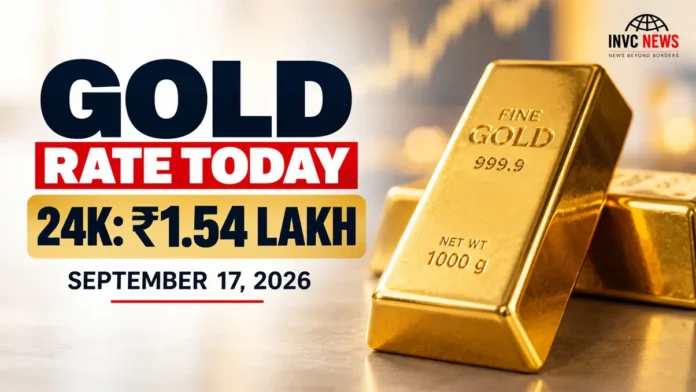
Gold Rate Today September 17, 2026 remains in sharp focus after the US Federal Reserve raised interest rates by 25 basis points, keeping global bullion markets volatile and Indian buyers watching prices closely.
In the broader Indian retail market, 24-karat gold was around ₹1,53,600 per 10 grams, while 22-karat gold stood near ₹1,40,800 per 10 grams during Thursday morning trade.
Silver 999 fine was around ₹2,35,140 per kilogram.
Actual jewellery prices can be higher after GST, making charges and other applicable costs are added.
Gold Price Today in Delhi
Delhi recorded some of the lowest prices among major metros on Thursday morning.
24K Gold: ₹1,53,060 per 10 grams
22K Gold: ₹1,40,305 per 10 grams
Silver 999: ₹2,34,310 per kg
Jewellery buyers should remember that these are indicative bullion-market rates and not necessarily the final showroom price.
Gold Price Today in Mumbai
Mumbai bullion rates remained slightly above Delhi.
24K Gold: ₹1,53,320 per 10 grams
22K Gold: ₹1,40,543 per 10 grams
Silver 999: ₹2,34,710 per kg
Final rates can differ across jewellers depending on local premiums and making charges.
Gold Price Today in Chennai
Chennai recorded the highest gold and silver prices among the major cities tracked Thursday morning.
24K Gold: ₹1,53,770 per 10 grams
22K Gold: ₹1,40,956 per 10 grams
Silver 999: ₹2,35,390 per kg
Regional demand and local market conditions can create price differences between cities.
Gold Price Today in Kolkata
24K Gold: ₹1,53,120 per 10 grams
22K Gold: ₹1,40,360 per 10 grams
Silver 999: ₹2,34,400 per kg
Gold Price Today in Bengaluru
24K Gold: ₹1,53,440 per 10 grams
22K Gold: ₹1,40,653 per 10 grams
Silver 999: ₹2,34,890 per kg
Gold Price Today in Hyderabad
24K Gold: ₹1,53,560 per 10 grams
22K Gold: ₹1,40,763 per 10 grams
Silver 999: ₹2,35,080 per kg
Why Gold Prices Are Volatile Today
The immediate global trigger is the US Federal Reserve’s latest interest-rate decision.
The Federal Open Market Committee raised its target range by 25 basis points to 3.75%–4.00%.
The Fed said inflation remained elevated and that the policy move was intended to support a return toward its 2% inflation objective.
Gold is particularly sensitive to US interest rates because the metal does not pay interest.
Higher interest rates can increase the appeal of interest-bearing assets and strengthen the US dollar, both of which can create pressure on bullion.
However, geopolitical uncertainty, inflation concerns and safe-haven demand can support gold at the same time.
That combination explains why prices can move sharply in both directions even within a single trading session.
Gold Trades Near $4,300 Internationally
International gold remained near the $4,300-per-ounce region after the Fed decision.
Investors are now tracking the US dollar, Treasury yields, inflation data and geopolitical developments for clues about the next major move.
The Fed’s future interest-rate path will remain particularly important.
Any indication that rates could rise further may influence precious-metal prices globally, including Indian gold and silver.
Why Indian Gold Prices Can Move Differently
International gold is only one factor determining what Indian consumers ultimately pay.
Domestic rates are also influenced by:
The rupee-dollar exchange rate.
Import-related costs.
Local demand.
Taxes.
Jeweller premiums.
Making charges.
That means international gold can fall while Indian retail prices remain relatively firm if the rupee weakens or local demand rises.
24K vs 22K Gold: What Buyers Should Know
24-karat gold is close to pure gold and is commonly used for investment products such as coins and bars.
22-karat gold contains other metals that make it stronger and is therefore widely used in jewellery.
The distinction matters because the price difference can be substantial when purchasing larger quantities.
Buyers should always check purity and hallmarking before purchasing jewellery.
Jewellery Price Will Be Higher Than the Gold Rate
A headline gold rate is not the final amount a jewellery buyer pays.
The final bill can include:
Gold value based on weight and purity.
Making charges.
GST.
Stone or design costs, where applicable.
Other jeweller-specific charges.
Therefore, comparing only the headline per-gram gold rate can be misleading when choosing between jewellery stores.
Buyers should compare the final payable price, not only the bullion rate.
Silver Remains Exceptionally Expensive
Silver has also experienced a major rally.
The national benchmark retail indication Thursday morning was around ₹2.35 lakh per kilogram.
Silver prices can be even more volatile than gold because demand comes from both investors and industry.
The metal is widely used in electronics, solar equipment and other industrial applications.
Changes in industrial demand can therefore influence silver alongside the usual precious-metal investment factors.
Gold Has Delivered Strong One-Year Returns
Gold prices remain substantially above where they stood one year earlier.
Market data cited in current retail-rate tracking shows 24K gold up roughly 39% over the past year, while silver has recorded an even sharper rise.
Those historical gains do not guarantee future returns.
Precious metals can experience significant corrections after strong rallies, particularly when interest rates, currencies or geopolitical conditions change.
Should You Buy Gold Today?
There is no single answer that fits every buyer.
Someone purchasing jewellery for a wedding may have a very different objective from someone considering gold as a long-term investment.
Consumers buying jewellery should focus on purity, hallmarking, making charges and the total invoice.
Investors should consider how much gold already forms part of their overall financial assets rather than reacting only to daily price movements.
Buying solely because prices have recently risen can expose an investor to short-term volatility.
What Could Move Gold Prices Next?
Four factors deserve close attention.
US interest rates: Further tightening could influence gold through yields and the dollar.
Inflation: Persistent inflation can maintain demand for precious metals as a store of value.
Geopolitical tensions: Escalation can increase safe-haven demand.
Rupee movement: A weaker rupee can make imported gold more expensive in India even if international prices remain unchanged.
For Indian buyers, the rupee and global gold therefore need to be watched together.
Bottom Line
Gold remains historically expensive as Indian consumers enter another period of festive and wedding-related demand.
At around ₹1.54 lakh per 10 grams for 24K gold and more than ₹2.35 lakh per kilogram for silver, even relatively small price changes can make a noticeable difference to the final purchase cost.
Buyers planning a purchase should check the latest local rate, confirm purity and hallmarking, and ask for the full price including taxes and making charges before paying.
Gold and silver rates can change during the day. Prices quoted here are indicative morning retail rates and may vary by city, jeweller and market conditions.