By Team INVC | INVC NEWS
Published: August 29, 2026 | 12 : 51 PM IST
BENGALURU, INDIA | August 29, 2026 —
Ford India hiring is moving in the opposite direction from the job-cut headlines sweeping parts of the global auto industry.
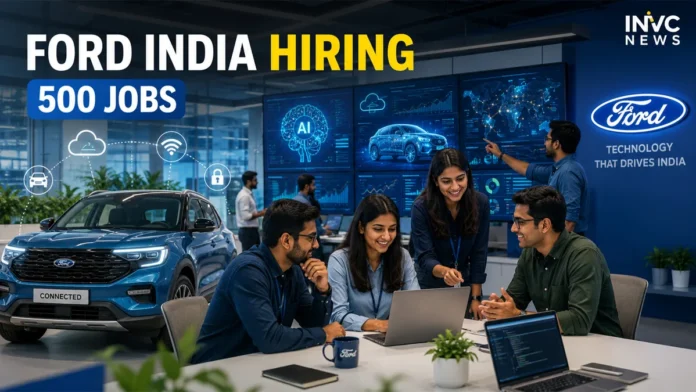
Ford Business Solutions, the automaker’s Global Capability Centre in India, plans to recruit around 500 employees in 2027, with much of the hiring expected in technology, data, artificial intelligence and connected-vehicle capabilities.
The planned expansion offers an important signal for India’s technology workforce: companies may be becoming more cautious about overall headcount, but they are still competing aggressively for professionals with specialized digital skills.
Ford Business Solutions currently employs more than 12,000 people in India, making the country one of the most important technology and business-services bases within Ford’s global operations.
Ford Wants AI, Data and Technology Specialists
The upcoming hiring is expected to concentrate mainly on experienced professionals with specialized capabilities rather than broad-based mass recruitment.
Key areas include:
- Artificial intelligence
- Data and analytics
- Enterprise technology
- Digital transformation
- Connected vehicles
- Finance technology
- Supply-chain technology
- Software engineering
Ford is increasingly looking for professionals who can combine technology expertise with an understanding of how major business functions operate.
That is becoming especially valuable as automakers turn vehicles into increasingly software-driven products.
The message for job seekers is clear: hiring is becoming more specialized.
Companies may employ fewer people for repetitive or legacy tasks while paying greater attention to workers who can build, automate and manage advanced digital systems.
Also Read – : Volkswagen Layoff Showdown: 50,000 Job Cuts Already Agreed as CEO Pushes Deeper Overhaul
AI Is Changing Ford’s Hiring Strategy Too
Ford’s decision to add hundreds of specialist employees does not mean artificial intelligence will lead to unlimited workforce expansion.
Quite the opposite.
The company is also examining how AI and productivity tools can allow existing employees to perform more work efficiently.
That means the future hiring model could increasingly become:
fewer generic roles + more specialized AI, data and software roles.
Ford Business Solutions has developed an internal large language model called Mach1ML, giving employees a controlled environment in which to experiment with generative AI technologies.
AI is therefore not being treated only as a product feature.
It is increasingly becoming part of how Ford employees work, analyse information and develop technology.
Connected Vehicles Become a Major India Opportunity
One particularly important growth area is connected-vehicle technology.
Ford’s Connected Vehicle System organization in India includes roughly 200 professionals working on software linking Ford vehicles with cloud-based systems.
Their work includes:
- Connectivity platforms
- Over-the-air software updates
- Vehicle-health insights
- Vehicle software intelligence
- Digital product delivery
- Cloud-connected vehicle services
Modern vehicles are becoming more like computers on wheels.
Software can increasingly determine how a car receives new features, detects problems, communicates with cloud infrastructure and generates useful data.
That shift is creating demand for professionals who may previously have considered traditional IT companies rather than automakers as potential employers.
India Is Becoming More Important to Ford’s Global Technology Strategy
Ford Business Solutions has operated in India for more than two decades and supports multiple areas of the company’s global business.
Its capabilities span software engineering, analytics, data science, AI and machine learning, product engineering, financial technology, accounting, supply-chain management and manufacturing engineering.
Ford has also been bringing more core software and coding work in-house while shifting some lower-value and legacy work to external service providers.
That is important for India.
It means global corporations are not using their Indian centres only for traditional back-office support.
Increasingly, India-based teams are participating directly in technology development and global product operations.
Also Read – : Ford Returns to India With $370 Million EV Investment in Tamil Nadu
Volkswagen Cuts, Ford Hires: What Is Really Happening to Auto Jobs?
The contrast with Volkswagen is striking.
Volkswagen has already agreed to reduce tens of thousands of positions in Germany as it tries to lower costs and restructure its operations.
Ford, meanwhile, is preparing to add specialized technology workers in India.
These developments are not necessarily contradictory.
They demonstrate where global employment is moving.
Traditional automotive groups are facing pressure to reduce:
legacy costs, excess capacity, repetitive work and complicated management structures.
At the same time, they need more talent in:
AI, software, data, cybersecurity, connected vehicles and digital engineering.
That makes the global auto employment story much more complicated than simply saying companies are either “hiring” or “laying off.”
Jobs are being redistributed across skills, functions and countries.
Are All 500 Ford Jobs Open Right Now?
No.
Ford has disclosed a 2027 hiring projection of around 500 positions, but that should not be interpreted as 500 vacancies simultaneously open for applications today.
Recruitment is expected to happen progressively as teams identify requirements.
Candidates interested in Ford should therefore rely on the company’s official careers channels for individual openings, locations, eligibility requirements and application deadlines.
The bigger signal is the direction of demand.
Ford wants more capability in advanced technology and data while using AI itself to improve productivity.
What Skills Could Give Candidates an Edge?
The Ford hiring plan reinforces a pattern becoming visible across India’s GCC ecosystem.
Professionals with combinations of technical and domain expertise may have an advantage.
For example:
AI + manufacturing
Data + supply chain
Software + automotive engineering
Cloud + connected vehicles
Analytics + finance
The ability to use AI tools productively may also become increasingly important even in jobs that are not formally labelled “AI roles.”
For students and experienced IT professionals, that creates a critical career lesson:
The safest response to AI-driven workforce disruption may not be avoiding AI—it may be learning how to work with it.
Ford Hiring Shows Where Jobs May Be Moving Next
The Ford announcement gives INVC’s new Jobs & Careers coverage an important second side.
Layoff numbers tell readers where jobs are disappearing.
Hiring plans tell them where the opportunities are moving.
In Ford’s case, India is gaining importance as a hub for AI, data, software and connected-vehicle capabilities even while the global automotive industry goes through one of its biggest technological restructurings in decades.
For job seekers, the headline is therefore bigger than 500 positions.
The real story is the skill shift behind them.