New Delhi | August 6, 2026
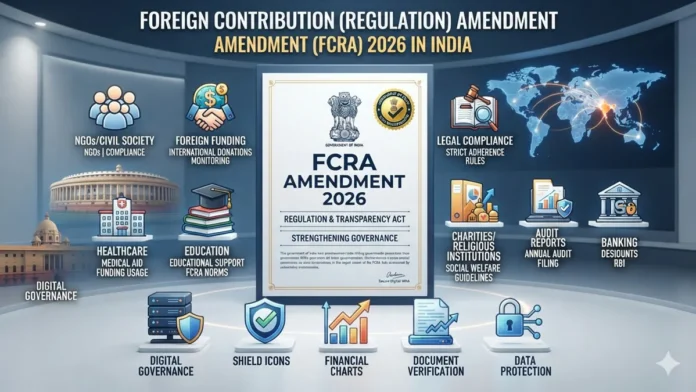
The Foreign Contribution (Regulation) Amendment Bill, 2026 (FCRA Amendment) has triggered debate both in India and abroad. The controversy intensified after comments from a U.S. lawmaker, bringing the proposed legislation into the international spotlight.
The Central Government says the proposed amendments are aimed at improving transparency, accountability, and regulatory oversight in the use of foreign donations. However, opposition parties argue that the changes could expand the Centre’s powers and adversely affect certain religious and minority institutions.
While the FCRA Amendment Bill, 2026 is still under consideration in Parliament, the FCRA Rules, 2026 have already been notified and are now in force.
Here’s a detailed look at what the law is, what is changing, and why it has become controversial.
Why Is FCRA in the News?
The issue gained international attention after U.S. Republican Congressman Riley Moore of West Virginia expressed concerns over the proposed amendments.
Moore claimed the legislation could allow the Indian government greater authority over the management of churches and religious institutions. He described the proposal as potentially harmful to Christian organizations and suggested that its passage in the current form could affect India-U.S. relations.
Meanwhile, CPI(M) MP John Brittas rejected the American lawmaker’s remarks, calling FCRA an internal matter of India, while reiterating his party’s longstanding opposition to certain stringent provisions of the law.
Why Is the Opposition Opposing the Bill?
Several opposition leaders have raised concerns about the proposed amendments.
Kerala
Leader of the Opposition V.D. Satheesan argued that the amendments could allow the Centre to:
- Refuse renewal of an organization’s FCRA registration.
- Take control of assets created using foreign funds if the registration lapses.
He claimed that churches, Christian educational institutions, and other minority organizations could be adversely affected.
Tamil Nadu
Former Chief Minister M.K. Stalin also criticized the proposal, alleging that:
- Minor procedural lapses could lead to cancellation of FCRA registration.
- Schools, colleges, hospitals, orphanages, and other charitable institutions receiving foreign funds could face uncertainty over their assets.
What Is FCRA?
The Foreign Contribution (Regulation) Act (FCRA) regulates how foreign donations are received and utilized in India.
It applies to:
- NGOs
- Trusts
- Educational institutions
- Religious organizations
- Companies
- Individuals eligible under the law
Its primary objectives are to:
- Ensure transparency in foreign funding.
- Monitor the use of overseas contributions.
- Prevent foreign funds from being used in activities that could affect India’s sovereignty, national security, democratic institutions, or public order.
The law is administered by the Ministry of Home Affairs (MHA).
Evolution of the FCRA Law
| Year | Development |
|---|---|
| 1976 | Original FCRA enacted |
| 2010 | New comprehensive FCRA law introduced |
| 2016 | Amendment |
| 2018 | Amendment |
| 2020 | Major amendment tightening compliance |
| 2026 | New amendment bill and revised rules introduced |
What Has Been Proposed in the FCRA Amendment Bill 2026?
The bill was introduced in the Lok Sabha on March 25, 2026 and is currently awaiting parliamentary approval.
According to the government, the amendments are designed to address administrative gaps observed during implementation while retaining the core framework of the 2010 law.
1. Management of Assets Created Through Foreign Funds
If an organization’s:
- Registration is cancelled,
- Expires, or
- Is voluntarily surrendered,
a designated authority will temporarily manage assets created using foreign contributions.
If registration is restored later, the assets will be returned to the organization.
Permanent government control would arise only if the registration is not restored through the prescribed legal process.
2. Protection of Religious Institutions
The government states that:
- Churches
- Temples
- Mosques
- Other religious institutions
will retain their religious character.
The amendments, according to the government, do not permit alteration of the religious identity of any place of worship.
3. Right to Appeal
Organizations dissatisfied with decisions made by the designated authority will have the right to:
- Seek administrative review.
- Appeal before the District Court.
4. Automatic Expiry of Registration
Organizations failing to renew their FCRA registration within the prescribed period will have their registration automatically treated as expired.
5. Reduced Criminal Penalty
The proposed amendment seeks to reduce the maximum punishment for certain FCRA violations from:
- Five years imprisonment
to - One year imprisonment
6. Central Approval for Investigations
State governments and their agencies would require prior approval from the Central Government before initiating investigations related to FCRA violations.
What Changes Have Already Come into Force?
The FCRA Rules, 2026, notified on June 22, 2026, are already operational.
Purpose-Based Registration
Organizations must now clearly specify:
- The purpose for which foreign funds will be received.
- The states or Union Territories where activities will be undertaken.
Existing FCRA-registered organizations must also update this information within one year.
Clearer Rules for Religious Activities
For the first time, the Rules explicitly specify which religious activities may receive foreign funding.
The government says this provides greater legal clarity for organizations across all faiths.
Minimum Utilization Requirement
Organizations seeking renewal must demonstrate that they have utilized at least:
₹10 lakh in foreign contributions during the previous two years.
The government says this requirement helps distinguish active organizations from inactive ones.
Stricter Reporting Requirements
Organizations must now disclose:
- Project-wise expenditure.
- Activity-wise utilization.
- Official website.
- Social media accounts.
- Details of the ultimate foreign donor, even if funds are routed through intermediary organizations.
According to the government, these measures strengthen transparency and accountability.
Current FCRA Rules
Under the existing framework:
- Organizations must obtain FCRA registration or prior approval.
- Foreign funds are first received in the designated SBI New Delhi branch account.
- Funds may then be transferred to approved utilization accounts.
- Annual audited returns must be submitted.
- Registration remains valid for five years.
- Renewal is mandatory.
Certain categories—including election candidates, MPs, MLAs, judges, government servants, and specified public officials—are prohibited from receiving foreign contributions.
Key FCRA Statistics
Foreign Funding
- Around 16,200 active FCRA-registered organizations received approximately ₹22,963 crore in foreign contributions during FY 2024–25.
Registration Cancellations
- Around 22,000 registrations have been cancelled over the past decade.
Registration Expiry
- Approximately 15,000 registrations have expired during the same period, including cases where organizations failed to renew on time.
Registration Validity
- FCRA registration is valid for five years.
Administrative Expense Limit
Organizations may spend:
- Up to 20% of foreign contributions on administrative expenses.
- At least 80% must be utilized for approved projects and declared objectives.
Share Among Indian NGOs
According to the Ministry of Home Affairs, FCRA-registered organizations account for less than 1% of all NGOs operating in India.
Government’s Position
The Centre maintains that the amendments:
- Do not fundamentally alter the FCRA framework.
- Improve governance and transparency.
- Close procedural loopholes.
- Strengthen monitoring of foreign funding.
- Protect national interests while allowing legitimate charitable activities to continue.
Why the Debate Matters
The controversy over the FCRA Amendment 2026 reflects a broader debate about balancing national security and financial transparency with the operational autonomy of NGOs and religious institutions.
Supporters argue the changes modernize oversight and improve accountability, while critics fear they could increase executive powers and create additional regulatory uncertainty for organizations dependent on foreign funding.
Since the bill remains pending before Parliament, its final provisions may still evolve during the legislative process.
Reference Links
Official Government Sources
- Foreign Contribution (Regulation) Act (FCRA) Portal – Ministry of Home Affairs
https://fcraonline.nic.in - Ministry of Home Affairs (MHA) – Foreigners Division
https://www.mha.gov.in/en/divisionofmha/foreigners-division - India Code – Foreign Contribution (Regulation) Act, 2010
https://www.indiacode.nic.in - The Gazette of India – Official Notifications
https://egazette.nic.in - Lok Sabha – Bills, Legislative Business & Debates
https://sansad.in/ls - Rajya Sabha – Legislative Business
https://sansad.in/rs - Press Information Bureau (PIB)
https://pib.gov.in - Ministry of Law and Justice – Legislative Department
https://legislative.gov.in
Parliamentary & Legal Resources
- PRS Legislative Research – FCRA and Related Bills
https://prsindia.org - Supreme Court of India
https://www.sci.gov.in
International References (For U.S. Reaction)
- U.S. House of Representatives
https://www.house.gov - Congressman Riley Moore – Official Website
https://rileymoore.house.gov - U.S. Congress
https://www.congress.gov
Government Documents
- Ministry of Home Affairs – Annual Reports
https://www.mha.gov.in/en/documents/annual-reports - FCRA Frequently Asked Questions (Official)
https://fcraonline.nic.in/home/PDF_Doc/fc_faq.pdf
Sources: Ministry of Home Affairs (MHA), FCRA Online Portal, India Code, Gazette of India, Press Information Bureau (PIB), Lok Sabha Secretariat, Rajya Sabha Secretariat, PRS Legislative Research, Ministry of Law & Justice, U.S. House of Representatives.
References: Ministry of Home Affairs (MHA), FCRA Online Portal, India Code, Gazette of India, Press Information Bureau (PIB), Lok Sabha Secretariat, Rajya Sabha Secretariat, PRS Legislative Research, Ministry of Law & Justice, U.S. House of Representatives, U.S. Congress.