New Delhi | August 4, 2026
India continues to balance rapid economic growth with mounting environmental challenges, including climate change, air pollution, water scarcity, and biodiversity loss. The latest Environmental Performance Index (EPI) 2026 has placed India at 176th out of 177 countries, renewing discussions about the country’s environmental performance and sustainability efforts.
While the report highlights several areas of concern, the Government of India maintains that significant progress has been made in renewable energy, afforestation, pollution control, wildlife conservation, and climate commitments.
Here is everything you need to know about the Environmental Performance Index 2026, India’s ranking, the methodology behind the index, and the government’s environmental initiatives.
What Is the Environmental Performance Index (EPI)?
The Environmental Performance Index (EPI) is a global assessment developed by researchers from Yale University and Columbia University. It measures how effectively countries protect the environment, address climate change, and safeguard public health.
The 2026 edition evaluated 177 countries using 47 environmental indicators grouped into 12 categories and three major policy objectives.
How Does the EPI Measure Environmental Performance?
The EPI assigns different weights to three broad policy objectives:
1. Ecosystem Vitality (45%)
This carries the highest weight and evaluates:
- Forest conservation
- Grasslands
- Biodiversity
- Agriculture
- Fisheries
- Water resources
- Natural habitat protection
2. Climate Change (30%)
Countries are assessed on:
- Greenhouse gas emissions
- Climate mitigation efforts
- Progress toward net-zero commitments
- Clean energy transition
3. Environmental Health (25%)
Indicators include:
- Air quality
- Safe drinking water
- Sanitation
- Heavy metal pollution
- Waste management
India’s Ranking in EPI 2026
India ranked 176th among 177 countries, receiving an overall score of 22.46.
According to the report, India has shown gradual improvement over the past decade, but challenges remain across nearly every major environmental category.
The report notes weaknesses in:
- Environmental health
- Climate change mitigation
- Ecosystem conservation
What Does the Report Say About Climate Change?
The EPI notes that the world remains significantly behind the targets set under the Paris Climate Agreement.
Although renewable energy deployment continues to grow, global greenhouse gas emissions are still increasing.
According to previous EPI assessments:
- India remains the third-largest greenhouse gas emitter after China and the United States.
- India’s total emissions have increased by approximately 32% over the past decade, driven by rapid industrialization, economic expansion, and rising energy demand.
However, the report also acknowledges India’s growing investment in:
- Renewable energy
- Forest expansion
- Climate adaptation initiatives
It adds that substantially greater investment will be required to achieve India’s 2030 climate targets and Net Zero by 2070.
How Has the EPI Changed Since 2024?
The methodology was revised for the 2026 report.
| EPI 2024 | EPI 2026 |
|---|---|
| 180 countries | 177 countries |
| 58 indicators | 47 indicators |
| 11 categories | 12 categories |
| India ranked 176th (Score: 27.6) | India ranked 176th (Score: 22.46) |
The latest edition introduced grasslands as a separate assessment category and revised several environmental indicators.
Government’s Response: India’s Climate Commitments
The Government of India says it continues to implement large-scale environmental and climate initiatives.
Updated Nationally Determined Contributions (NDCs)
Approved in August 2022, India’s climate commitments include:
- Reducing emissions intensity of GDP by 45% by 2030 (compared to 2005 levels)
- Achieving approximately 50% installed electricity capacity from non-fossil fuel sources
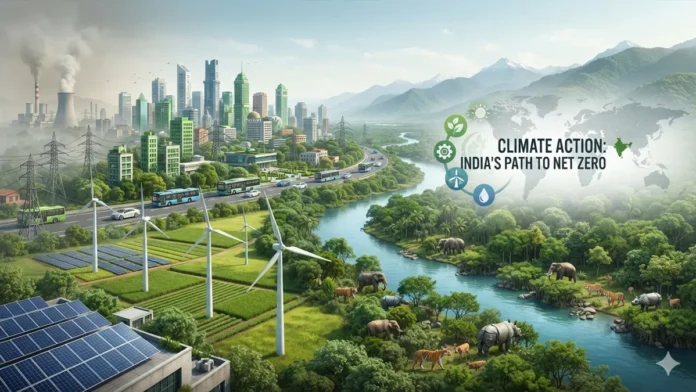
- Reaching Net Zero emissions by 2070
Key Environmental Achievements Highlighted by the Government
1. Massive Tree Plantation Drive
Under the “Ek Ped Maa Ke Naam” campaign:
- 262.4 crore saplings had been planted by December 24, 2025.
2. Forest Cover Expansion
According to government data:
- Forest and tree cover now accounts for 25.17% of India’s geographical area.
- This represents a 4.83% increase since 2013.
The Food and Agriculture Organization (FAO) ranked India:
- 9th globally in forest area.
- 3rd worldwide in annual net forest gain.
3. Wildlife Conservation
The government says India now has:
- 58 Tiger Reserves
- 33 Elephant Reserves
- 1,134 Protected Areas
Under Project Cheetah, India’s cheetah population has increased to 30, including 19 cubs born in India.
India also leads the International Big Cat Alliance, which includes 18 participating countries.
Progress on Climate Goals
According to official data:
- India reduced GDP emissions intensity by 36% between 2005 and 2020.
- More than 50% of installed power capacity now comes from non-fossil fuel sources.
- An additional 2.29 billion tonnes of carbon sink was created between 2005 and 2021.
- India has also introduced a Carbon Credit Trading Scheme.
National Clean Air Programme (NCAP)
To tackle urban air pollution:
- 130 cities are covered under the National Clean Air Programme.
- Government funding has crossed ₹13,415 crore.
According to official figures:
- 103 cities recorded lower PM10 levels.
- 64 cities achieved reductions exceeding 20%.
- 25 cities reduced PM10 by over 40%.
- 22 cities now meet National Ambient Air Quality Standards (NAAQS).
Renewable Energy Progress
India has achieved several clean energy milestones:
- Target of 20% ethanol blending in petrol (E20) achieved ahead of schedule.
- Ranked 3rd globally in installed solar power capacity.
- Ranked 4th worldwide in total renewable energy capacity.
Biodiversity and Wetland Conservation
The government says:
- 22,560 hectares of degraded mangrove forests have been restored under the MISHTI Programme.
- India now has 96 Ramsar Sites, the highest number in Asia.
- Udaipur and Indore have become India’s first Ramsar Wetland Cities.
Circular Economy and Waste Management
India has strengthened Extended Producer Responsibility (EPR) regulations covering:
- Plastic waste
- E-waste
- Batteries
- Tyres
- Seven additional waste categories
Government data indicates:
- More than 71,000 producers
- Over 4,400 recyclers
are now registered under the EPR framework.
Environmental Reforms Introduced
Recent reforms include:
- Green Credit Programme
- Amendments to Forest Conservation Rules
- Construction and demolition waste regulations
- End-of-life vehicle regulations
- Improved environmental clearance procedures
- Polluted site management rules
The government says these reforms aim to strengthen environmental protection while improving transparency and administrative efficiency.
Measures Against Pollution
According to the Ministry of Environment, Forest and Climate Change:
- Pollution control continues under the Water Act, 1974, Air Act, 1981, and Environment Protection Act, 1986.
- Industries are monitored through Online Continuous Emission Monitoring Systems (OCEMS).
- River restoration programmes continue under the National Water Quality Monitoring Programme.
Conclusion
India’s 176th ranking in the Environmental Performance Index 2026 underscores the country’s significant environmental challenges, particularly in air quality, emissions, and ecosystem protection. However, the government argues that substantial progress has been made through renewable energy expansion, afforestation, wildlife conservation, pollution control, and climate policy reforms.
The coming years will be critical as India seeks to balance rapid economic growth with its ambitious environmental commitments, including achieving Net Zero emissions by 2070.
References
1. Environmental Performance Index (EPI) 2026 Report (Official)
https://epi.yale.edu/
2. Yale Center for Environmental Law & Policy (Official)
https://environment.yale.edu/
3. Ministry of Environment, Forest and Climate Change (MoEFCC), Government of India
https://moef.gov.in/
4. Press Information Bureau (PIB), Government of India
https://pib.gov.in/
5. Nationally Determined Contributions (India’s Climate Targets)
https://moef.gov.in/en/division/climate-change/
6. National Clean Air Programme (NCAP)
https://moef.gov.in/en/division/national-clean-air-programme/
7. Forest Survey of India (Official)
https://fsi.nic.in/
8. International Renewable Energy Agency (IRENA)
https://www.irena.org/
9. Food and Agriculture Organization of the United Nations (FAO)
https://www.fao.org/
10. Ramsar Convention on Wetlands
https://www.ramsar.org/
11. UN Framework Convention on Climate Change (UNFCCC)
https://unfccc.int/
12. Intergovernmental Panel on Climate Change (IPCC)
https://www.ipcc.ch/
13. Central Pollution Control Board (CPCB)
https://cpcb.nic.in/
Sources: Environmental Performance Index (EPI) 2026 (Yale University & Columbia University); Ministry of Environment, Forest and Climate Change (Government of India); Press Information Bureau (PIB); National Clean Air Programme (NCAP); Forest Survey of India (FSI); Food and Agriculture Organization (FAO); International Renewable Energy Agency (IRENA); Ramsar Convention; UNFCCC; IPCC; Central Pollution Control Board (CPCB).