New Delhi, August 18, 2026
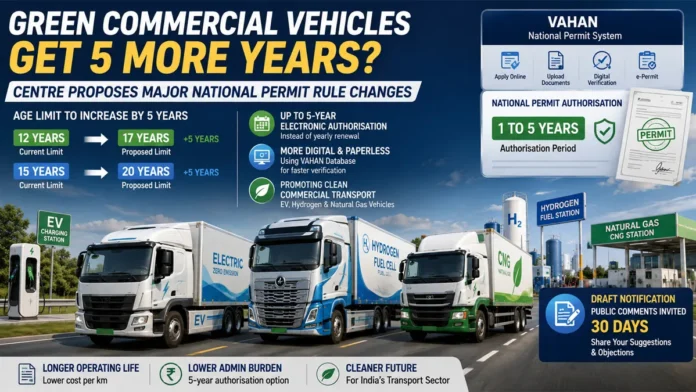
Commercial Vehicle Age Limit India rules could change significantly for certain cleaner commercial vehicles under a new draft proposal from the Ministry of Road Transport and Highways. Battery-powered, hydrogen fuel-based and natural gas-powered vehicles covered by the national permit framework could receive an additional five years of operating eligibility if the proposed amendments are finalized.
The draft amendments to the Central Motor Vehicles Rules, 1989, are aimed at simplifying the national permit system, expanding digital processing and encouraging cleaner commercial transport.
However, the proposal is not yet a final rule. The ministry has invited objections and suggestions from the public and stakeholders for 30 days, and the provisions can still be modified before final notification.
Which Commercial Vehicles Could Get a Higher Age Limit?
The proposed change focuses on eligible vehicles operating under the national permit system that run on:
- Battery-electric power
- Hydrogen fuel
- Natural gas, including eligible CNG-powered vehicles
Under the existing national permit framework, Rule 88 places age-related limits on certain goods vehicles.
For a multiaxle goods carriage, a national permit generally becomes invalid after 15 years, while the limit is 12 years for other goods carriages unless the vehicle is replaced.
Under the proposed clean-fuel relaxation, those limits could effectively increase by five years to:
- 17 years instead of 12 years
- 20 years instead of 15 years
Importantly, the proposal does not extend the age of every commercial vehicle in India.
It is limited to specified battery-operated, hydrogen fuel-based and natural gas-driven vehicles falling under the relevant national permit provisions.
Why Is the Government Proposing a Five-Year Extension?
The proposal appears designed to make cleaner commercial vehicles more economically attractive to fleet operators.
Electric, hydrogen and other alternative-fuel commercial vehicles can involve higher upfront investment than conventional diesel models. A longer permitted operating period could give operators more time to recover those costs while also encouraging investment in cleaner transport technologies.
The measure also aligns with the government’s broader push toward lower-emission road transport and increased adoption of alternative fuels.
National Permit Holders Could Choose Up to Five Years of Authorisation
Another major proposal concerns the period for which a national permit authorisation can be issued.
At present, the national permit authorisation system requires periodic processing, with the official Form 46 listing a consolidated national permit fee of ₹16,500.
Under the draft proposal, an applicant could choose electronic authorisation for a period ranging from one year to five years.
The proposed fee would remain:
₹16,500 for each year of authorisation
That means a vehicle operator selecting the maximum five-year period would pay:
₹16,500 × 5 = ₹82,500
The change could reduce the administrative burden of going through a separate authorisation process every year.
National Permit Process Could Become More Digital
The government also wants a larger part of the national permit system to operate electronically.
The national permit platform is already part of the Ministry of Road Transport and Highways’ e-governance framework, with the official VAHAN portal offering online payment of national permit composite fees.
Under the draft changes:
Form 46 applications could be filed electronically, while Form 47 authorisations could also be issued electronically.
The existing Form 47 is the official authorisation document for tourist or national permits.
If finalized, the proposed changes could further reduce physical paperwork and manual processing at transport offices.
VAHAN Database Could Automatically Fill Vehicle Details
The draft also proposes wider use of the VAHAN database.
Instead of repeatedly entering information already held in government records, details could be automatically retrieved using a vehicle registration number or relevant dealership authorisation.
This could make permit and registration applications faster while reducing duplicate paperwork.
The proposed system could also improve consistency between vehicle registration records and permit information.
Form 48 Could Carry More Compliance Information
The revised national permit framework could also require more detailed vehicle compliance data.
Under the proposal, Form 48 could include information relating to:
- Valid registration certificate
- Insurance status
- Pollution Under Control certificate
- Fitness certificate
- Pending traffic challans
- Details of any previous national permit
This could allow authorities to verify whether a commercial vehicle meets key legal and safety requirements before granting or renewing national permit authorisation.
Temporary Registration for Chassis Could Remain Valid for Six Months
The draft also proposes changes to temporary registration rules.
For a chassis without a body, temporary registration could remain valid for six months from the date of issue.
This provision is particularly relevant for commercial vehicles that are sold as chassis and later sent to body builders for fabrication.
What If Body Building Takes More Than Six Months?
If a chassis remains at a workshop beyond six months because body fitting has not been completed, or because of circumstances beyond the owner’s control, the registering authority could extend the temporary registration.
The proposed extension could be granted in periods of:
Up to 30 days at a time
The owner would need to submit an application and pay the prescribed fee.
This could help operators whose vehicles are delayed during body fabrication for reasons outside their control.
45-Day Temporary Registration Proposed in Certain Cases
The draft also provides for a 45-day temporary registration period in two specific situations.
This could apply when:
- A fully built motor vehicle is being converted into an adapted vehicle
- A vehicle is intended to be registered in a state different from the state where the dealer is located
The additional time could give vehicle owners a limited window to transport the vehicle and complete registration or modification requirements.
More Technical Details Could Be Added to Registration Forms
The proposed amendments also seek to improve digital tracking and record accuracy by collecting additional technical and ownership information.
Dealer-related applications could include details such as:
- GST registration number
- PAN
- Udyam registration details
- Corporate Identification Number, where applicable
Vehicle-owner forms could also be expanded to include additional digital identification and financing-related information.
Aadhaar-Linked Mobile Number Could Be Added to Form 20
Another proposed change concerns Form 20, the application used for vehicle registration.
The draft seeks to include an Aadhaar-linked mobile number in the form.
The existing official Form 20 is used for motor vehicle registration and contains ownership, insurance, financing and vehicle-related information.
If the amendment is finalized, the additional mobile-number requirement could support digital verification and communication between vehicle owners and transport authorities.
Hire-Purchase and Loan Details Could Also Be Recorded
For vehicles purchased under:
- Hire-purchase agreements
- Lease agreements
- Hypothecation arrangements
the proposed rules could require the relevant agreement number or loan account number to be recorded.
The change could make financing records easier to match with vehicle registration information.
Does the Proposal Apply to All CNG Vehicles?
No.
This is one of the most important points for vehicle owners.
The proposed five-year benefit is not a blanket age extension for every CNG, electric or hydrogen vehicle in India.
The change is tied specifically to vehicles covered by the relevant national permit age-limit provisions.
Private cars, ordinary local commercial vehicles and vehicles governed by other state-specific rules should not automatically be assumed to receive the same extension.
Are the New Commercial Vehicle Age Limits Already in Force?
No.
These are draft rules only.
The proposal cannot be treated as a final change to the law until the government completes the consultation process and publishes the finalized amendments.
Stakeholders have been given 30 days to submit objections or suggestions.
The government can review that feedback, modify the proposal and then issue final rules through the Official Gazette.
What Could the Changes Mean for Fleet Operators?
If finalized in their current form, the amendments could bring several benefits for operators of cleaner commercial vehicles.
A longer eligible operating life could allow fleet owners to use expensive alternative-fuel vehicles for more years.
At the same time, five-year national permit authorisation could reduce repeated paperwork, while VAHAN-linked verification could make applications faster.
The combined effect could be particularly useful for logistics operators, interstate goods carriers and fleet businesses investing in battery-electric, CNG or hydrogen technologies.
Could the Rules Lower the Cost of Running Green Fleets?
The proposal would not directly reduce fuel prices or vehicle purchase costs.
However, allowing an eligible cleaner commercial vehicle to remain under the national permit framework for five additional years could potentially improve the economics of ownership.
For a fleet operator, spreading the initial cost of an electric, hydrogen or natural gas commercial vehicle over a longer operating period may make investment easier to justify.
That is one of the most important practical implications of the proposed change.
Official National Permit Portal
Vehicle operators can access the government’s National Permit online payment service through the official VAHAN portal, which is operated under the Ministry of Road Transport and Highways.
The official Parivahan platform also provides Form 46 for national permit authorisation applications and the relevant transport documentation.
Bottom Line
The proposed Commercial Vehicle Age Limit India changes could give eligible battery, hydrogen and natural gas commercial vehicles an additional five years under the national permit framework.
For qualifying vehicles, existing 12-year and 15-year limits could effectively extend to 17 and 20 years, while operators could also gain the option of national permit authorisation for up to five years at ₹16,500 per year.
At the same time, the government wants more applications and vehicle data to move online through VAHAN, reducing paperwork and improving digital verification.
For now, however, fleet operators should treat these provisions as proposals, not final law, until the government issues the final notification.