By Team INVC | INVC NEWS
AICHI-NAGOYA, Japan | September 16, 2026 —
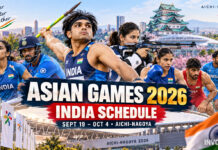
Asian Games 2026 is almost here, and India enters the continental showpiece carrying the weight of its greatest performance in Games history.
A 503-member Indian contingent will compete across 35 sports in Japan as the country attempts to build on its record-breaking 107-medal campaign at Hangzhou.
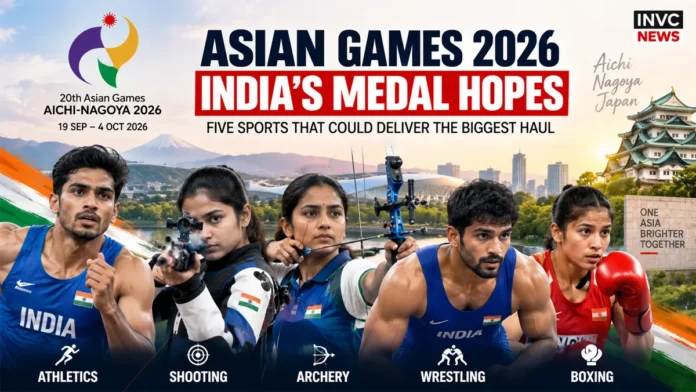
India will have medal opportunities across cricket, hockey, kabaddi, badminton, weightlifting and several other disciplines. However, when it comes to producing medals in volume, five sports could have an especially important influence on the final tally: athletics, shooting, archery, wrestling and boxing.
Athletics remains the biggest pillar despite the absence of Neeraj Chopra, while India’s deep shooting squad could again deliver multiple podium finishes.
Here are the five sports that could shape India’s Asian Games 2026 campaign.
1. Athletics: Can India Rebuild Its 29-Medal Powerhouse Without Neeraj Chopra?
No sport contributed more to India’s historic Hangzhou campaign than athletics.
Indian track and field athletes won 29 medals at the previous Asian Games — six gold, 14 silver and nine bronze — making athletics the country’s single biggest source of medals.
That immediately makes the discipline central to India’s attempt to cross the 100-medal mark again.
However, the challenge is different this time.
Two-time Asian Games javelin champion Neeraj Chopra will miss Aichi-Nagoya because of injury, removing one of India’s most dependable gold-medal contenders.
Yet India still has substantial depth.
Avinash Sable will defend his 3000m steeplechase title, while shot put star Tajinderpal Singh Toor is chasing another Asian Games triumph.
Distance runner Gulveer Singh, hurdler Jyothi Yarraji, long jumper M Sreeshankar, triple jumper Praveen Chithravel, heptathlon and combined-event talent, relay squads and race walkers give India several additional opportunities.
Parul Chaudhary, who delivered one of Hangzhou’s memorable performances, will also carry significant expectations.
India may not have Neeraj, but the breadth of its athletics squad means the sport can still decide whether the country gets anywhere close to its 2023 medal record.
2. Shooting: Manu Bhaker and Esha Singh Lead a Deep Medal Challenge
If one discipline can challenge athletics for India’s biggest medal contribution, it is shooting.
Indian shooters produced an extraordinary 22 medals at Hangzhou, including seven golds.
The 2026 squad again features several athletes capable of competing for individual and team medals.
Manu Bhaker, already established among India’s biggest shooting stars, will be one of the most closely watched names.
However, Esha Singh may enter Japan in even more intimidating form.
The 21-year-old has climbed to world No. 1 in the women’s 25m pistol and world No. 2 in the 10m air pistol. She already owns two individual Asian Games silver medals and a team gold from Hangzhou.
Recent World Cup success and a world-record performance have strengthened expectations around her.
India also has depth across rifle, pistol and shotgun events.
That matters because shooting offers numerous individual and team medal opportunities.
A strong first week at the range could quickly push India up the overall medal table.
3. Archery: Jyothi Surekha Vennam Gives India Another Golden Opportunity
Archery produced nine medals for India at Hangzhou and remains one of the country’s strongest technical sports.
Compound archery has been particularly productive for India in recent years.
Jyothi Surekha Vennam will again be central to the campaign. Her consistency at major international events gives India a serious chance across individual and team competitions.
India’s compound archers have increasingly challenged South Korea and other established Asian powers, turning what was once considered an outside medal possibility into a genuine strength.
Recurve events remain tougher because Asian archery includes some of the deepest fields in the world.
Nevertheless, the combination of individual, team and mixed-team competitions creates several routes to the podium.
If India reproduces anything close to its Hangzhou archery performance, this discipline could again make a major contribution to the overall tally.
4. Wrestling: Aman Sehrawat and Sujeet Kalkal Carry Major Hopes
Wrestling has historically been one of India’s most reliable Asian Games sports.
The 2026 campaign will again feature several medal contenders, even though the build-up has not been completely smooth.
Aman Sehrawat, an Olympic bronze medalist, is expected to lead India’s challenge in the men’s 57kg freestyle category.
Sujeet Kalkal is another important contender at 65kg.
India has traditionally produced Asian-level strength across freestyle wrestling, while women’s wrestling has also added greater depth over the past decade.
Competition will be fierce.
Japan, Iran, Uzbekistan, Kazakhstan, Mongolia and several other Asian countries possess world-class wrestlers across multiple weight divisions.
Still, India does not need to dominate the competition for wrestling to make a meaningful difference.
Even four or five podium finishes could become extremely valuable in a tight overall medal race.
5. Boxing: India Has Multiple Routes to the Podium
Boxing completes the five-sport group with significant medal-volume potential.
India’s team includes experienced international campaigners as well as younger contenders.
Lovlina Borgohain, an Olympic medalist, remains one of India’s most recognizable boxing names.
Heavyweight Narendar Berwal and Jadumani Singh are among the other boxers entering the Games with international experience.
Asian boxing is exceptionally difficult because Uzbekistan, Kazakhstan, China, Japan and several Central Asian nations consistently produce elite fighters.
However, boxing’s weight-category structure creates multiple independent medal opportunities.
That makes it different from a team sport such as hockey or cricket, where even winning the entire competition contributes only one medal to the official medal table.
A strong Indian boxing campaign could therefore quietly add several podium finishes to the national tally.
What About Cricket, Hockey and Kabaddi?
These sports may not produce the largest number of medals, but they could become extremely important for India’s gold count.
India will enter with high expectations in men’s and women’s cricket, men’s and women’s hockey, and kabaddi.
Several Indian teams are defending Asian Games champions.
Cricket, in particular, offers India two clear gold-medal opportunities — one in the men’s event and one in the women’s event.
The hockey teams also enter with serious ambitions, while kabaddi traditionally remains one of India’s strongest Asian Games disciplines.
Therefore, these sports could determine the quality of India’s medal haul even if they cannot match athletics or shooting in medal volume.
Badminton Could Produce Several Big Moments
Badminton deserves special attention as well.
India has PV Sindhu, Lakshya Sen and the Satwiksairaj Rankireddy-Chirag Shetty combination among its major contenders.
Satwik and Chirag will attempt to defend the men’s doubles Asian Games title.
Asian badminton contains the deepest talent pool in the world, with China, Japan, South Korea, Indonesia and Malaysia all capable of challenging for medals.
That makes every podium finish difficult — but also highly significant.
Mirabai Chanu Still Searching for Her First Asian Games Medal
Weightlifting may not produce a large number of Indian medals, but one name will command enormous attention.
Mirabai Chanu enters Aichi-Nagoya still seeking the first Asian Games medal of her decorated career.
The Olympic silver medalist has already achieved success at the Olympics, World Championships and Commonwealth Games.
An Asian Games podium would fill one of the few major gaps in her résumé.
The competition, however, will be extremely demanding because Asian weightlifting includes many of the world’s strongest lifters.
India Chasing Hangzhou’s Historic 107-Medal Benchmark
India produced its best Asian Games performance in Hangzhou with:
28 gold medals
38 silver medals
41 bronze medals
107 medals overall
It was the first time India crossed the 100-medal barrier at an Asian Games.
Repeating that feat will not be easy.
China, Japan and South Korea remain continental sporting giants, while countries including Iran, Uzbekistan and Kazakhstan are formidable across combat and strength sports.
India also enters without Neeraj Chopra, one of its highest-profile champions.
Yet the overall depth of the squad remains considerably stronger than it was a decade ago.
The Five Sports India Needs Most
If India is to challenge its Hangzhou benchmark, these five disciplines could provide the foundation:
Athletics — biggest potential medal volume.
Shooting — multiple individual and team events with world-class Indian contenders.
Archery — compound events offer particularly strong opportunities.
Wrestling — historically one of India’s most reliable medal sports.
Boxing — numerous weight categories provide several paths to the podium.
The equation is simple.
If athletics and shooting deliver close to their previous Games numbers and archery, wrestling and boxing convert their opportunities, India could build a strong base before its team sports enter the decisive stages.
Asian Games 2026 will ultimately be decided athlete by athlete and event by event.
But India’s road toward another historic medal tally is likely to run through the track, shooting range, archery field, wrestling mat and boxing ring.