By Team INVC | INVC NEWS
MUMBAI, India | September 9, 2026 —
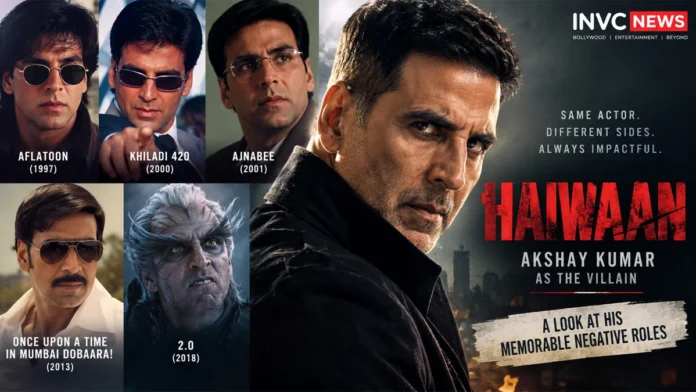
Akshay Kumar Haiwaan villain role is putting one of Bollywood’s most familiar leading men on the other side of the battle. After decades of playing action heroes, comic leads and men fighting for justice, Akshay Kumar is preparing to unleash one of the darkest characters of his career in Priyadarshan’s crime thriller Haiwaan.
The film places Saif Ali Khan at the center of the fight, while Akshay steps into the role of a dangerous antagonist. More importantly, the actor is not presenting his character as a misunderstood antihero with redeeming qualities. Haiwaan instead gives him the opportunity to play a ruthless and psychologically disturbing villain.
The film arrives in theaters on September 11, 2026.
However, Haiwaan is not the first time Akshay Kumar has abandoned his heroic screen image.
Throughout his long career, the actor has occasionally experimented with negative, morally corrupt and outright villainous characters. Some became cult favorites, while one even earned him his first Filmfare Award.
Here are five films that proved Akshay Kumar could be just as compelling as the bad guy.
Aflatoon (1997): Raja vs His Ruthless Lookalike Rocky
Long before audiences became accustomed to Akshay Kumar as a comedy superstar, Aflatoon gave him the chance to play two completely contrasting characters.
Akshay appeared in a dual role as Raja and Rocky.
Raja is a street-smart man looking for quick ways to make money. His life changes after he falls in love with Pooja, played by Urmila Matondkar.
Rocky, however, is an entirely different personality.
Cold, violent and manipulative, he becomes a dangerous criminal whose physical resemblance to Raja creates chaos. Rocky uses that similarity to his advantage and eventually turns Raja’s life upside down.
The double role allowed Akshay to shift between lighter comic energy and an intimidating villainous persona within the same film.
For audiences who primarily knew him through his Khiladi-era action image, Rocky showed that the actor could also create menace on screen.
Khiladi 420 (2000): Dev Became One of His Darkest Early Characters
Khiladi 420 pushed Akshay deeper into negative territory.
Once again, he played two characters — Dev Kumar Malhotra and Anand Kumar Malhotra.
Dev presents himself as a sophisticated and successful man, but behind that appearance lies a calculating conman burdened by debt and driven by greed.
He enters the life of wealthy businessman Shyam Prasad Bhardwaj and becomes romantically involved with his daughter Ritu, played by Mahima Chaudhry.
Soon, Dev’s true intentions emerge.
He wants access to the family fortune and is prepared to commit murder to protect his scheme.
The movie eventually introduces Anand, Dev’s identical twin, whose personality is completely different.
By playing both brothers, Akshay got another opportunity to contrast innocence with corruption. Dev remains among the actor’s more striking negative characters from the early phase of his career.
Ajnabee (2001): The Villain Role That Won Akshay Kumar a Filmfare Award
If one film established Akshay Kumar’s credentials as a screen villain, it was Ajnabee.
The suspense thriller cast him as Vikram Bajaj, commonly called Vicky.
At first, the character appears charming and friendly. As the story develops, however, his manipulative personality and carefully constructed plans begin to emerge.
The performance became one of the defining villain roles of Akshay’s career.
It also brought him major awards recognition.
Akshay Kumar won the Filmfare Award for Best Performance in a Negative Role for Ajnabee, marking his first Filmfare win.
The role remains particularly memorable because Vicky did not depend on conventional physical intimidation. Instead, deception, confidence and manipulation made him dangerous.
Even decades later, Ajnabee remains an important entry whenever audiences discuss Akshay Kumar’s negative characters.
Once Upon a Time in Mumbai Dobaara! (2013): Akshay Becomes Underworld Don Shoaib Khan
Akshay returned to a darker character with Once Upon a Time in Mumbai Dobaara!
The film cast him as powerful underworld figure Shoaib Khan.
Emraan Hashmi had played the younger version of Shoaib in the preceding film, Once Upon a Time in Mumbaai. The sequel presented Akshay as an older and much more powerful version of the gangster.
By this stage, Shoaib has risen to the top of Mumbai’s criminal world.
Akshay approached the character with swagger, controlled aggression and larger-than-life dialogue delivery.
The film itself received a mixed response, and Shoaib did not become as universally celebrated as some of Akshay’s other performances.
Still, the role remains significant because the actor completely stepped away from his conventional heroic image and played the central antagonist without attempting to soften the character.
2.0 (2018): Pakshi Rajan Gave Akshay His Most Dramatic Transformation
Akshay Kumar’s transformation in 2.0 was impossible to ignore.
Shankar’s science-fiction spectacle, led by Rajinikanth, featured Akshay as Pakshi Rajan, an antagonist closely associated with birds and increasingly destructive forces.
The role required one of the most elaborate physical transformations of Akshay’s career.
Heavy prosthetics changed his face, skin texture and overall appearance, creating an almost creature-like screen presence.
Akshay said the process required around four hours of prosthetic makeup before filming and approximately another hour and a half to remove it.
The transformation helped create one of the most visually distinctive villains he had ever played.
At the same time, Pakshi Rajan was not written merely as an evil figure. His motivations gave the character an emotional and ideological dimension, making him considerably more complicated than a conventional movie villain.
Haiwaan Could Take Akshay Kumar Even Further Into Darkness
Now comes Haiwaan.
Directed by Priyadarshan, the psychological crime thriller reunites Akshay Kumar with Saif Ali Khan years after their previous collaborations.
However, their equation is dramatically different this time.
Saif plays the central heroic character, while Akshay creates the danger around him.
Akshay has made it clear that his Haiwaan character should not be viewed as a conventional grey-shaded antihero. The role is designed as a far darker antagonist.
That distinction makes the project particularly interesting.
Hindi cinema has increasingly allowed established stars to move beyond rigid hero and villain categories. Actors who once carefully protected a heroic screen image can now take darker roles without necessarily damaging their commercial identity.
Akshay appears ready to embrace that freedom.
After Aflatoon, Khiladi 420, Ajnabee, Once Upon a Time in Mumbai Dobaara! and 2.0, Haiwaan could become the next major addition to his villain filmography.
The biggest question now is whether Akshay Kumar’s new antagonist will simply surprise audiences — or become one of the most memorable negative characters of his career.
Haiwaan releases in theaters on September 11, 2026.