New Delhi, November 2, 2026: Delhi’s air quality has come under renewed pressure, with several monitoring stations recording very poor pollution levels early Monday. The deterioration comes after a brief spell of relatively cleaner air following rainfall, raising fresh concerns about the return of hazardous winter pollution across the national capital.
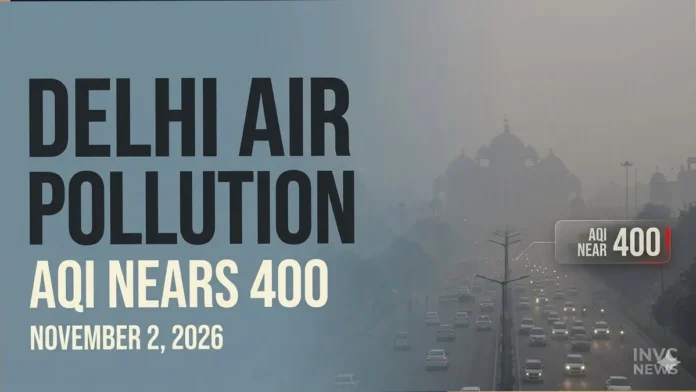
The supplied report puts the Air Quality Index (AQI) around Akshardham at nearly 400. However, the available monitoring data does not independently confirm an AQI reading of 400 at an Akshardham station. The Indian Institute of Tropical Meteorology’s Delhi air-quality dashboard recorded 351 at Patparganj at 4 a.m. on November 2, while Jahangirpuri registered 411, Rohini 392 and Punjabi Bagh 390. These readings show that pollution levels varied considerably across the city.
Several Delhi Monitoring Stations Record Very Poor Air
The early-morning data points to widespread pollution across Delhi. At 4 a.m., monitoring stations reported AQI readings of 375 at Alipur, 357 at Bawana, 347 at Dwarka Sector 8, 346 at ITO, 365 at R.K. Puram and 368 at Vivek Vihar.
Jahangirpuri crossed the 400 mark with an AQI of 411, placing it in the severe category. Rohini and Punjabi Bagh also recorded readings close to that threshold.
These figures underline an important distinction: a reading from one monitoring station represents local air quality and should not automatically be described as the average AQI for the entire capital.
What Does an AQI Near 400 Mean?
Under India’s National Air Quality Index classification, an AQI between 301 and 400 falls in the Very Poor category. A reading between 401 and 500 is classified as Severe.
The Central Pollution Control Board warns that prolonged exposure to very poor air can increase the risk of respiratory illness. In the severe category, even healthy people may experience respiratory effects, while those with existing lung or heart conditions face greater risks.
Who Needs to Be Extra Careful?
Children, older adults, pregnant women and people with asthma, chronic respiratory conditions or cardiovascular disease should take particular care during periods of elevated pollution.
Residents can reduce exposure by:
Avoiding prolonged or strenuous outdoor exercise when pollution levels are high.
Keeping windows closed when outdoor air quality is poor, while maintaining appropriate indoor ventilation and filtration.
Using a well-fitting N95 or equivalent particulate respirator when outdoor exposure is unavoidable.
Following official air-quality advisories and seeking medical attention if they experience persistent breathing difficulty, chest discomfort or worsening respiratory symptoms.
Why the Latest Readings Matter
The return of high pollution readings after a period of cleaner air is a reminder that Delhi’s air quality can change quickly. Local readings may differ from one neighbourhood to another, and the pollution situation should be assessed using updated station-level data rather than a single location’s figure.
The Bottom Line: Delhi is facing renewed air-quality concerns this Monday, with several monitoring stations reporting very poor conditions and Jahangirpuri crossing into the severe category in the early-morning data. The reported figure of nearly 400 around Akshardham needs station-specific confirmation. Residents should monitor official updates and limit unnecessary exposure while pollution remains elevated.