
New Delhi, October 25, 2026: Delhi’s fight against air pollution is facing a familiar challenge: official measures are expanding, but dust-covered roads, broken footpaths and construction debris remain visible across several neighbourhoods. Despite the implementation of Stage I of the Graded Response Action Plan (GRAP), conditions reported in parts of the capital raise questions about the enforcement of dust-control rules on the ground.
The Delhi government has cited the deployment of 103 mechanical road sweepers, 608 anti-smog guns at 283 construction sites and anti-smog equipment at 200 high-rise buildings as part of its pollution-control efforts. Yet stretches of Uttam Nagar, Najafgarh, Mandawali, Chander Vihar, Laxmi Nagar, ITO and Mandi House continue to face complaints about dust, roadside debris and construction-related disruption.
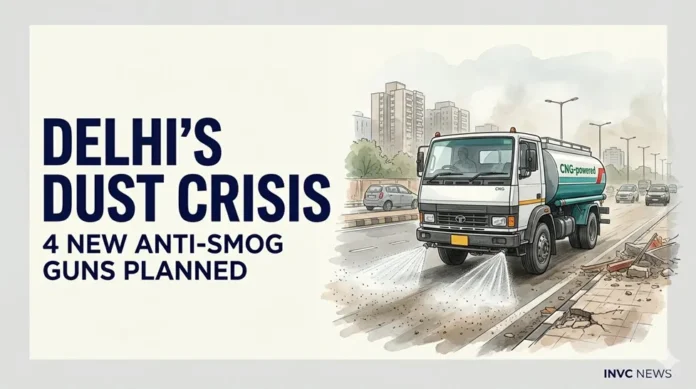
In a new measure targeting eastern Delhi, the Public Works Department’s East Road Division plans to deploy four additional water-sprinkler anti-smog guns. The machines will be hired and operated across the division’s four sub-divisions, with CNG-powered trucks, water tanks holding at least 7,000 litres and digital tracking systems planned for monitoring their operations.
The initiative could strengthen dust suppression on busy roads. However, its effectiveness will depend on regular deployment, adequate maintenance, proper cleaning and enforcement of construction-site regulations.
GRAP-I Is in Force, but Dust Remains a Concern
Stage I of GRAP calls for measures to control road dust, improve mechanical sweeping, increase water sprinkling where necessary, ensure the proper handling of construction debris and prevent open waste burning.
These measures are particularly important in Delhi, where road dust and construction activity can add to the burden of particulate pollution. When vehicles pass over dusty roads or move through areas with loose soil and debris, particles can become airborne and affect pedestrians, commuters and nearby residents.
However, the reported conditions in several neighbourhoods suggest that implementing a pollution-control plan on paper is not enough. The effectiveness of GRAP depends on whether agencies inspect vulnerable locations, remove accumulated debris and ensure that contractors follow the required precautions.
Mandawali, Laxmi Nagar and ITO: Ground-Level Problems
In Mandawali and Chander Vihar, debris associated with work by the Delhi State Industrial and Infrastructure Development Corporation (DSIIDC) has reportedly remained in several lanes. Along Vikas Marg, excavation and barricading linked to Delhi Jal Board work have affected the stretch between Karkari More and Laxmi Nagar.
Dust stirred up by buses and other vehicles adds to the discomfort of pedestrians. Between Nirman Vihar and Laxmi Nagar, roadside debris and damaged footpaths also raise questions about how quickly roads and public spaces are restored after utility work.
Similar concerns have been reported around ITO, Mandi House and Pandit Pant Marg, where road, footpath, sewerage and water-pipeline works can leave soil and sand on public routes.
Anand Vihar, already recognised as a major pollution hotspot, highlights the importance of tackling dust not only at monitoring locations but also on the surrounding roads and neighbourhood streets that contribute to the wider pollution burden.
More Machines, but Is the Impact Visible?
The government’s reported deployment figures indicate a substantial investment in dust-control infrastructure. Nevertheless, the number of machines alone cannot establish how much pollution has been reduced.
Mechanical sweepers need to operate on suitable roads at appropriate intervals. Water sprinklers must cover the areas where dust is generated, while construction debris must be removed instead of being left beside roads for extended periods.
The Commission for Air Quality Management (CAQM) has emphasised mechanical road cleaning, with equipment selected according to road width and the available space. It has also called for effective implementation of dust-control measures.
Water sprinklers installed along the central stretch of ITO have reportedly provided relief. The experience underscores the importance of consistent operations, although visible dust suppression does not by itself establish a measurable reduction in overall air pollution.
Four New CNG-Based Anti-Smog Guns Planned for Eastern Delhi
The PWD’s East Road Division plans to hire four additional modern water-sprinkler anti-smog guns for deployment across its four sub-divisions.
Unlike conventional diesel-powered vehicles, the proposed units will be mounted on compressed natural gas (CNG)-powered trucks. Each vehicle is expected to carry a water tanker with a capacity of at least 7,000 litres.
The department also plans to equip the vehicles with Global Positioning System (GPS) tracking and a web-based dashboard. These systems are intended to support live tracking and digital monitoring, helping officials check where the vehicles operate and how they are deployed.
The arrangements could improve transparency and accountability if the tracking information is regularly reviewed and the machines are used according to an effective schedule. Their actual contribution to air quality, however, will need to be assessed through operational records and pollution-monitoring data.
Construction Agencies Face Pressure to Improve Compliance
Delhi’s pollution-control effort involves several agencies, including the Delhi Jal Board, the Public Works Department, DSIIDC, the Municipal Corporation of Delhi and the New Delhi Municipal Council.
After excavation, roads must be restored, loose material cleared and dust controlled. Construction contractors are expected to cover building materials and manage debris responsibly. Open burning of waste and leaves is prohibited under applicable restrictions, while vehicles must comply with valid Pollution Under Control (PUC) requirements.
Authorities have also encouraged people to use public transport or carpool for short journeys where practical. These steps can contribute to reducing emissions, but they cannot replace the responsibility of public agencies and contractors to maintain roads and control construction dust.
Diesel generator sets emitting visible smoke, poorly maintained municipal vehicles and delays in clearing construction material can further undermine pollution-control efforts. Inspections and enforcement are therefore as important as purchasing or hiring additional equipment.
What Needs to Happen Next?
The immediate priority is to turn announced measures into consistent action. This requires regular mechanical sweeping, timely removal of debris, appropriate water sprinkling and inspections of construction sites and public works.
The four planned anti-smog guns could provide additional support in eastern Delhi, but residents will need to see whether they operate regularly and whether the dirtiest stretches receive sustained attention.
Authorities should also publish clear operational information wherever possible, including deployment schedules, road coverage and performance indicators. Such information would help residents distinguish between equipment being available and equipment being used effectively.
The Bottom Line
Delhi’s pollution challenge cannot be solved by anti-smog guns alone. The reported condition of roads and construction sites shows why dust control, waste removal, road restoration and enforcement must work alongside broader efforts to reduce emissions.
The planned deployment of four additional CNG-powered anti-smog guns in eastern Delhi is a useful operational step. Its success, however, will depend on sustained use and stronger accountability across the agencies responsible for keeping the capital’s roads clean.