
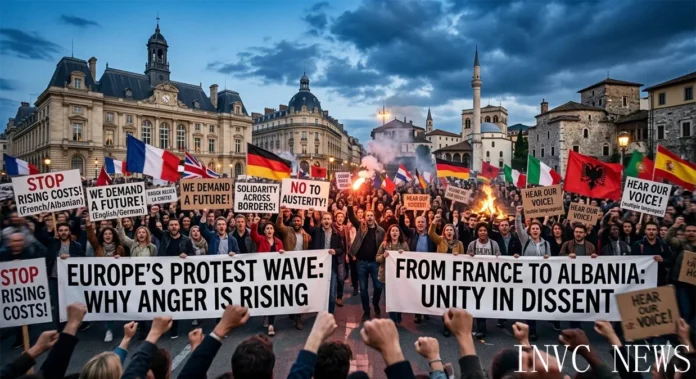
Paris, October 20, 2026: Rising living costs, expensive housing, concerns about public services and frustration over education are fueling a wave of protests across parts of Europe. Demonstrations in France, Italy and Albania have been accompanied by violent clashes, arrests and property damage, while housing activists in Spain and Portugal have taken to the streets to demand more affordable homes.
The unrest reflects a range of national grievances rather than a single, coordinated European movement. In some countries, students and public-sector workers are demanding better services and working conditions. Elsewhere, tenants and young workers are protesting rents they say have become unaffordable.
The developments are also unfolding against a tense political backdrop, with debates over immigration, government spending, corruption and national elections adding to the pressure on European governments.
Why Are Protests Spreading Across Europe?
The grievances vary from country to country, but several common themes run through the demonstrations: the rising cost of everyday essentials, housing affordability, pressure on public services and a growing sense among younger people that economic opportunities are becoming harder to secure.
María Silvestre, a sociology professor at Spain’s University of Deusto, described young people as increasingly disappointed with the social model and uncertain about their future. Her assessment highlights the frustration experienced by people who feel they have limited control over their economic prospects.
However, the protests should not be treated as one unified movement. The demands of French students, Spanish tenants, Italian workers and Albanian anti-government demonstrators reflect different domestic circumstances.
France: School Conditions and Living Costs Fuel Unrest
France has experienced some of the most serious violence in the current wave of demonstrations. Protests initially driven by concerns about school funding and staffing expanded to include broader grievances over living costs and public services.
High school students have demanded more resources for educational institutions, arguing that staff shortages and deteriorating buildings are affecting learning, particularly in lower-income areas.
Labor unions and other activists subsequently joined the demonstrations, widening the demands to include wages, fuel costs and the quality of public services.
The demonstrations turned violent in several cities, including Paris, Marseille, Lyon and Bordeaux. Authorities reported around 2,400 arrests following clashes, looting and fires. Limoges’ historic 19th-century city hall was severely damaged by fire.
French President Emmanuel Macron condemned the violence and said those responsible for looting and property damage should be held accountable. He also accused radical left-wing activists of attempting to destabilize public order.
The unrest has sharpened political tensions ahead of France’s 2027 presidential election. Yet the scale of the demonstrations also reflects economic and social concerns that extend beyond any single political faction.
Spain: Housing Costs Become a Flashpoint
In Spain, the housing crisis has emerged as a major source of public anger. Rising rents and property prices have made it increasingly difficult for many young workers to establish independent households.
Protesters have established encampments in central Madrid, including around Puerta del Sol, to draw attention to the cost of housing and the risk of eviction.
The movement gained attention following the eviction of 87-year-old Maricarmen, whose case became a symbol of housing insecurity. Her subsequent death while hospitalized further intensified public concern, although the circumstances should not be interpreted as proof of a direct causal link without additional evidence.
Housing protests have also taken place in Barcelona and other cities, where residents have raised concerns about rental affordability and the pressure associated with tourism.
Teachers have separately demanded better pay and working conditions, with industrial action adding to the broader debate over public services.
The political dispute over housing measures has increased pressure on the government. Spanish unions have also called a general strike for November 11 over the housing crisis, ahead of the early general election scheduled for November 29.
Portugal: Lisbon and Porto Face Housing Pressure
Portugal is experiencing similar concerns, particularly in Lisbon and Porto, where housing affordability has become a major public issue.
Protesters are demanding measures to improve access to homes and address rising rental costs. The debate has implications for younger residents, lower-income households and workers whose wages have not kept pace with housing expenses.
Although housing concerns connect Portugal’s demonstrations with those in Spain, the protests have their own national context. Local policy choices, rental markets and the supply of affordable homes remain central to the debate.
Italy: Workers Demand Better Wages and Services
In Italy, demonstrations under the banner “Italia in Piazza,” or “Italy in the Square,” have brought together people demanding better access to employment, health care, education and housing.
Protesters have also called for higher wages to offset rising living expenses.
The demonstrations have included peaceful marches as well as clashes with police in cities such as Milan, Turin and Bologna. Looting and damage to property were reported during some incidents.
The unrest has increased pressure on the government to address economic concerns while maintaining public order.
A new group calling itself the “October 17 Movement” has also announced plans for continued demonstrations, calling on supporters to gather in Italian cities on Saturdays.
The extent to which these mobilizations translate into sustained political or policy changes remains uncertain.
Albania: Anti-Government Protests and Corruption Concerns
In Albania, demonstrations in the capital, Tirana, have focused on government accountability and demands for Prime Minister Edi Rama to resign.
Students from secondary schools and universities have joined the broader anti-government movement, known as the “Flamingo” movement in the supplied reporting.
The protests have included clashes between demonstrators and police, raising concerns about public order.
Unlike the housing-focused protests in Spain and Portugal, Albania’s demonstrations are more directly tied to domestic political grievances, including corruption concerns and dissatisfaction with government performance.
The participation of students has widened the movement and highlighted the role of younger citizens in challenging established political leadership.
Serbia: Student Protests Keep Corruption in Focus
Serbia has experienced a separate, prolonged wave of student-led demonstrations over corruption and government accountability.
University students have organized protests over an extended period, challenging the political establishment associated with Aleksandar Vučić.
The movement reflects broader concerns about transparency, accountability and the relationship between political power and public institutions.
Serbia’s political situation differs from those of European Union member states such as France, Italy, Spain and Portugal. Its protests should therefore be understood within the country’s own political and electoral context.
Are Political Divisions Adding to the Tension?
The demonstrations are taking place as European political parties debate immigration, public spending, economic policy and national security.
In France, immigration has become part of the political argument surrounding the unrest. US President Donald Trump blamed migrants for the situation in a social media post and called for tighter border controls.
French authorities, however, have not attributed the protests as a whole to migrants. The distinction matters: peaceful demonstrators, people committing criminal acts and groups pursuing political objectives should not be treated as interchangeable.
The unrest also comes at a time of uncertainty over European security and continued support for Ukraine. Those international issues form part of the wider political backdrop, but they do not by themselves explain the domestic grievances driving the protests.
Why Young Europeans Are Particularly Frustrated
For many young people, the issues overlap. Housing costs affect their ability to live independently, employment insecurity complicates long-term planning, and concerns about schools and public services raise questions about future opportunities.
When these pressures coincide, an individual event can become a focal point for wider dissatisfaction. A school protest may expand into a debate about government spending, while a housing dispute can develop into a broader campaign over inequality and public policy.
That does not mean all young people share the same political views or support the same demands. Rather, the demonstrations reveal different responses to economic insecurity and concerns about whether existing institutions are meeting public expectations.
What Happens Next?
Governments across Europe face the challenge of responding to public grievances while preventing violence and protecting the right to peaceful protest.
Potential pressure points include affordable housing, school funding, wages, access to health care and the delivery of public services. In countries facing elections, these issues are also likely to remain part of the political debate.
The protests do not guarantee a common political outcome across Europe. Their longer-term impact will depend on how governments respond, whether demonstrators maintain public support and whether demands are translated into concrete policy measures.
The bottom line: Europe’s current protest wave reflects several overlapping but distinct crises. Housing affordability dominates parts of the debate in Spain and Portugal, while education, living costs and public services have helped fuel unrest in France and Italy. In Albania and Serbia, government accountability and corruption concerns are central. Together, these movements show the political pressure created when citizens believe the cost of living is rising faster than their ability to secure a stable future.