The move marks a major shift in Colombia’s foreign policy under President Abelardo de la Espriella, with both countries seeking to revive trade and expand security cooperation.
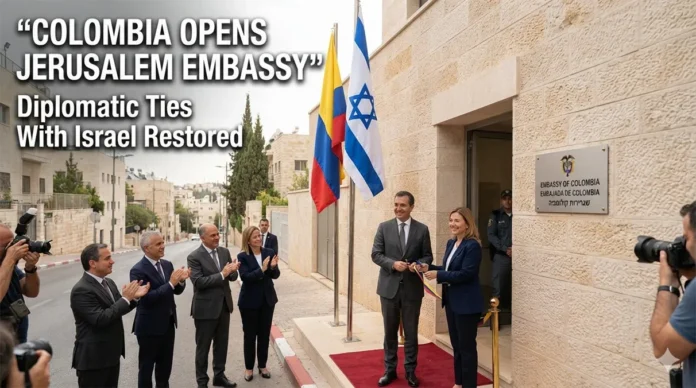
JERUSALEM | October 15, 2026 – Colombia has opened its embassy in Jerusalem after restoring diplomatic relations with Israel, marking a significant change in the South American country’s foreign policy following a two-year rupture over the war in Gaza. The inauguration on Wednesday, October 14, represents a renewed commitment by President Abelardo de la Espriella’s administration to rebuild diplomatic, economic and security ties with Israel.
The opening ceremony was attended by Colombian Foreign Minister Omar Bula Escobar and Israeli Foreign Minister Gideon Sa’ar. Colombia’s Foreign Ministry described the move as a diplomatic milestone, while Sa’ar welcomed it as a landmark moment for bilateral relations and Jerusalem.
The decision reverses the policy of former Colombian President Gustavo Petro, who severed diplomatic relations with Israel in May 2024 over its military operations in the Gaza Strip. The latest development also places Colombia among a small group of countries that maintain their embassies to Israel in Jerusalem rather than Tel Aviv.
Colombia and Israel Move to Rebuild Relations
Colombia and Israel established diplomatic relations in 1957 and developed close cooperation over the following decades, particularly in security and defence. Colombia’s military has used Israeli-made rifles and fighter-bomber aircraft, reflecting the longstanding defence relationship between the two countries.
That relationship deteriorated sharply under Petro, who accused Israel of genocide over its military campaign in Gaza. He also compared Israeli actions to Nazi concentration camps. Israel rejected the allegations and criticised Colombia’s decision to break diplomatic ties.
Following the rupture, Petro announced plans to establish a Colombian embassy in Ramallah, in the occupied West Bank. The proposed diplomatic mission, however, never became operational.
The election of de la Espriella, who took office in August 2026, brought a significant shift in Colombia’s approach to Israel. Restoring relations became a priority for the new administration, which has emphasised renewed engagement and expanded bilateral cooperation.
Colombian Foreign Minister Omar Bula Escobar said the embassy would serve as a visible expression of the government’s determination to restore dialogue, strengthen mutual trust and develop an agenda that delivers practical benefits to citizens of both countries.
Embassy Opening Marks a Diplomatic Shift
The Jerusalem embassy is more than a symbolic step in the restoration of diplomatic ties. It reflects Colombia’s decision to establish its formal diplomatic presence in a city whose status remains one of the most sensitive issues in the Israeli-Palestinian conflict.
Israel considers Jerusalem its capital, while Palestinians claim East Jerusalem, captured by Israel in the 1967 Middle East war, as the capital of a future independent Palestinian state. The city’s final status remains disputed, and most countries continue to maintain their embassies to Israel in Tel Aviv.
Colombia’s decision makes it the 10th country to establish an embassy in Jerusalem, according to reports on the inauguration. The move follows the United States’ recognition of Jerusalem as Israel’s capital in 2017 and the subsequent relocation of several other countries’ diplomatic missions.
Israeli Foreign Minister Gideon Sa’ar welcomed Colombia’s decision, describing the inauguration as a celebration for relations between the two countries and for Jerusalem. The ceremony underscored the two governments’ intention to move beyond the diplomatic breakdown of 2024.
Trade and Security Cooperation Back on the Agenda
The renewed relationship extends beyond diplomatic representation. Colombia and Israel have also taken steps to revive their economic partnership, including the restoration of a free trade agreement that had been terminated during Petro’s presidency.
The agreement could provide a framework for renewed commercial engagement as both governments seek to strengthen economic ties. Security cooperation, intelligence sharing and cybersecurity have also been identified as areas for closer collaboration.
In early October, Colombia appointed Tania Gilinski Bacal as its ambassador to Israel. Her responsibilities include strengthening cooperation in trade, security, intelligence, cybersecurity and information sharing.
These priorities suggest that the renewed partnership is intended to cover several areas of government activity rather than focus solely on diplomatic symbolism. However, the practical impact will depend on how quickly the two countries translate their commitments into concrete agreements and sustained cooperation.
Gaza Remains Central to the Diplomatic Divide
The restoration of relations comes against the backdrop of the continuing international debate over Israel’s military campaign in Gaza and the wider Israeli-Palestinian conflict.
Petro’s decision to sever ties in 2024 was explicitly linked to Israel’s actions in Gaza and his government’s objections to the military campaign. Israel rejected the accusations that prompted the break, leaving the two countries with sharply different positions during the diplomatic crisis.
The embassy opening signals that Colombia’s new administration has chosen a different approach to its relationship with Israel. It does not, by itself, resolve the broader disagreements surrounding Gaza or the status of Jerusalem.
The move has also drawn criticism from Palestinian officials, highlighting the political sensitivity of establishing an embassy in a city claimed by both Israelis and Palestinians. For countries that maintain their missions in Tel Aviv, the unresolved status of Jerusalem remains a key reason for avoiding a similar step.
What the Development Means for Colombia-Israel Ties
The reopening of diplomatic channels and the establishment of the Jerusalem embassy mark a clear break with the previous administration’s policy. The restored trade agreement and plans for wider cooperation provide a basis for the two governments to pursue a more extensive partnership.
For Israel, Colombia’s decision represents renewed diplomatic engagement with a country that had maintained close security ties before the 2024 rupture. For Colombia, the move reflects a new administration’s effort to reset relations and reopen avenues for economic and strategic cooperation.
The long-term significance of the decision will depend on whether the two countries can sustain their renewed engagement, expand trade and deliver measurable results in security and other areas.
For now, the embassy’s inauguration marks a notable turning point in bilateral relations. It restores Colombia’s formal diplomatic presence in Israel while placing Jerusalem—and the continuing dispute over the city’s status—at the centre of a significant foreign-policy decision.