
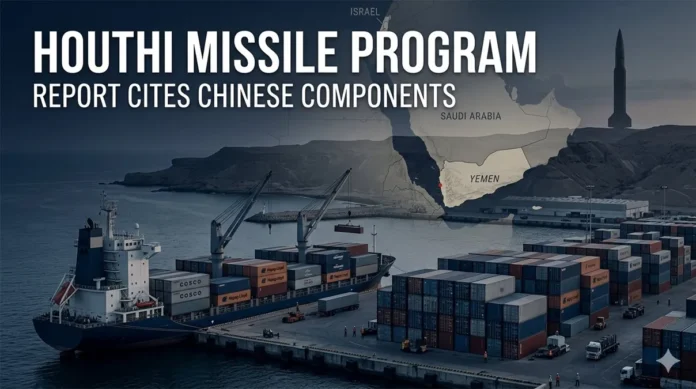
SANA’A, Yemen | October 15, 2026 – Yemen’s Iran-aligned Houthi movement is seeking to expand its ballistic missile capabilities by acquiring specialized components from Chinese suppliers, according to a new report that raises questions about the group’s weapons ambitions and increasingly complex international supply networks.
The assessment, released Wednesday by the UK-based organization Conflict Armament Research, says components linked to advanced missile systems were among equipment intercepted by Yemeni government authorities. The findings suggest that the Houthis may be pursuing greater capacity to assemble weapons locally rather than relying exclusively on established external suppliers.
The report says the group sought components that could be used in the production of a version of Iran’s Kheibar Shekan ballistic missile, whose reported range is approximately 2,000 kilometers (1,240 miles). If successfully developed and deployed, a system of this class could significantly affect regional threat assessments, including calculations involving Saudi Arabia and Israel.
However, the reported procurement attempts do not, by themselves, establish that the Houthis have successfully built, tested or deployed such a missile. The extent of any transfer of technical knowledge, the completeness of the intercepted equipment and the group’s current production capabilities remain important questions.
Specialized Components Raise Questions About Local Missile Production
According to Conflict Armament Research, the equipment included components associated with missile stabilization, rocket motor systems and ignition mechanisms. The reported items included fin cores, hardware for the rear section of a rocket motor, and igniters.
The shipments also contained phenolic resin, a material used in applications requiring resistance to high temperatures, including certain heat-protective structures.
The significance of the components lies not only in their individual functions but also in what their procurement may indicate about the Houthis’ ambitions. Specialized missile parts can point to a more sophisticated production effort, particularly when they are linked to systems that require precise engineering and knowledge of the underlying design.
Fabian Hinz, a senior analyst associated with the report, said the Houthis’ ambitions for domestic weapons production appeared to be greater than previously estimated. He also indicated that some of the recovered components were specialized enough to suggest that knowledge of the relevant missile design could be necessary to manufacture or integrate them.
The report does not establish that every component was intended for a single completed missile system. Nor does the presence of specialized parts alone prove that the group has mastered the full process of missile manufacture, assembly, testing and operational deployment.
China’s embassy did not respond to a request for comment, according to the supplied account of the report.
Shipments Bound for Yemen Were Intercepted
The findings draw on information provided by Yemeni government officials after two shipments were intercepted in July. The consignments had reportedly departed from China and were destined for the port of Hodeidah in Yemen.
Authorities identified equipment considered suspicious, including parts that the report associated with missile functions. The shipment details have drawn attention to the commercial routes and intermediaries that can potentially connect overseas suppliers with armed groups operating in conflict zones.
The reported interceptions also raise a broader question: how are non-state armed groups obtaining specialized equipment that may have both industrial and military applications?
Components used in machinery, chemical processing or other industrial activities can sometimes have more than one potential use. Determining whether a particular shipment is intended for civilian industry or a weapons program requires examining the equipment, its specifications, the buyer, the destination and other available evidence.
In this case, the report links the intercepted equipment to the Houthis’ broader missile ambitions. The information provided does not, however, establish that every item originated directly from a Chinese state institution or that the Chinese government authorized any alleged transfer to the group.
Are the Houthis Trying to Reduce Their Dependence on Iran?
Iran has long been identified as a key source of weapons-related assistance, designs and components for the Houthis. The group’s reported efforts to acquire equipment through additional channels could indicate a push to diversify its supply network.
Behnam Ben Taleblu, senior director of the Iran program at the Foundation for Defense of Democracies, has emphasized the strategic value of maintaining alternative procurement routes. The assessment cited in the supplied material suggests that pressure on Iran’s ability to move equipment could give the Houthis an incentive to seek supplies from other sources.
Diversification would not necessarily mean that the group is abandoning its relationship with Tehran. Instead, it could allow the Houthis to reduce the risk that disruption along one route would halt their access to important components.
For an armed movement operating under sanctions, maritime scrutiny and other restrictions, access to multiple suppliers and intermediaries can be strategically valuable. A more varied procurement network may also make it harder for authorities to identify and disrupt every part of a weapons supply chain.
The key question is whether these reported purchases represent isolated procurement attempts or part of a sustained effort to develop a more independent domestic production capability. The available account does not settle that question.
International Supply Networks Complicate Weapons Monitoring
A separate assessment by the Washington-based Century Foundation, as described in the supplied material, points to the growing role of international commercial networks in the Houthis’ weapons program. These networks reportedly include smugglers operating in Yemen and businesses connected to export hubs in eastern China.
Such arrangements can complicate efforts to trace the movement of sensitive equipment. Procurement may involve several stages, including intermediaries, commercial exporters, shipping companies and local networks. The involvement of multiple parties can make it difficult to determine who ultimately controls a shipment or how its contents will be used.
For investigators, the distinction between the place from which goods are shipped, the commercial supplier and the party directing or authorizing a transaction is essential. Evidence of a component’s origin does not automatically establish state involvement in its onward transfer or intended military use.
The reported interceptions underscore the importance of tracing equipment through the entire supply chain, rather than relying solely on the country of dispatch.
What Could This Mean for Saudi Arabia and Israel?
The possibility that the Houthis are seeking components for an advanced medium-range ballistic missile is strategically significant because of the potential reach associated with such systems. A missile with a reported range of approximately 2,000 kilometers could place a broad area within theoretical reach, depending on its launch location, trajectory and actual performance.
Saudi Arabia has faced missile and drone threats from the Houthis during the Yemen conflict. Israel has also had to account for threats from Iran-aligned armed groups operating across the region. Any credible improvement in the Houthis’ missile capabilities could therefore affect military planning, air and missile defense requirements, and regional security calculations.
Yet the distinction between theoretical range and demonstrated operational capability is critical. A missile’s performance depends on factors such as its design, payload, guidance system, reliability, production quality and the ability to launch it successfully.
The reported acquisition of components does not confirm that the Houthis possess an operational missile matching the Kheibar Shekan’s reported specifications. Further evidence would be needed to establish whether the group has assembled a complete system, conducted successful tests or reached a deployable stage.
The Bigger Picture: From Imported Weapons to Local Assembly
The report points to a potentially important development in the evolution of the Houthi weapons program: a greater emphasis on obtaining components and assembling systems locally.
Local production, if achieved, could provide an armed group with greater flexibility and reduce its dependence on the delivery of complete weapons. It could also create new challenges for monitoring and interdiction, particularly when components are sourced through international commercial channels.
At the same time, acquiring individual parts is only one step in a much more demanding process. Producing a reliable ballistic missile requires engineering expertise, compatible components, quality control, testing facilities and the ability to integrate multiple systems safely and consistently.
The available findings therefore raise serious questions about the Houthis’ intentions and procurement capabilities, but they do not establish that a fully operational advanced missile has been produced.
What Happens Next?
The reported interceptions are likely to intensify scrutiny of commercial shipments, intermediaries and procurement networks suspected of supplying military equipment to armed groups in Yemen. Investigators will need to determine the precise origin of the components, their intended end users and whether the shipments were part of a broader procurement effort.
For regional governments, the central concern is not simply where individual components were manufactured, but whether the Houthis can translate access to specialized equipment into a meaningful improvement in their operational capabilities.
The bottom line: The Conflict Armament Research findings suggest that the Houthis may be pursuing a more sophisticated and diversified approach to missile procurement. But the reported components and shipments should not be treated as proof that the group has successfully built or deployed an advanced ballistic missile. The security implications will depend on what the evidence ultimately establishes about the scale, technical progress and operational readiness of the program.