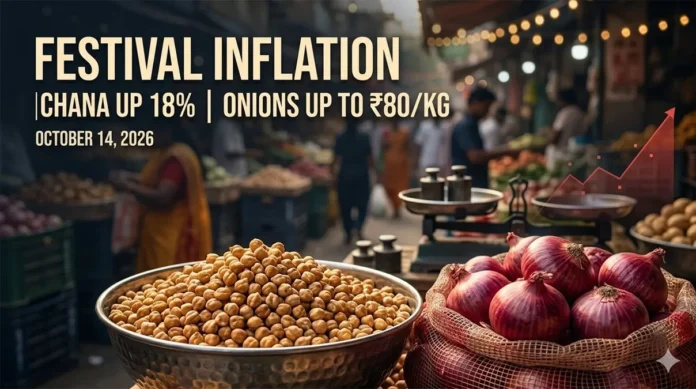
NEW DELHI, October 14, 2026 : Indian households are facing renewed pressure on grocery budgets ahead of the festive season, with chickpea prices reportedly climbing by around 18% in a month and good-quality onions selling for as much as ₹80 per kilogram in parts of Delhi-NCR.
The price increases come as demand for chickpeas and gram flour strengthens ahead of Diwali and the subsequent wedding season. At the same time, onion prices remain elevated despite government efforts to supply subsidized onions through selected retail outlets.
The Department of Consumer Affairs reported an all-India average retail onion price of ₹53.15 per kilogram on October 13, 2026. Its price-monitoring system also listed gram dal at ₹91.14 per kilogram and besan at ₹97.91 per kilogram on the same date. These official national averages provide a broader benchmark, although prices can vary by location, product quality and retailer.
Why are chickpea prices rising?
Chickpea, commonly known as chana, has become more expensive as seasonal demand combines with concerns about domestic supplies and the next crop.
According to the market commentary attributed to Ankit Kapoor, founder of Commodity Samachar, demand for chana and besan has strengthened following the Shraddh period, with Navratri, Diwali and the wedding season expected to support buying.
Chickpeas are widely used in Indian kitchens, whether as whole pulses, roasted snacks, chana dal or gram flour. Besan is also an important ingredient in festive snacks, sweets and everyday dishes. Stronger demand across these uses can place additional pressure on wholesale markets and eventually influence retail prices.
Market conditions are not uniform across producing regions. The supplied report says arrivals have remained relatively steady in major mandis in Maharashtra and Madhya Pradesh, while arrivals in Rajasthan have declined. Reduced availability in some markets can support prices even when supplies remain available elsewhere.
Recent market reporting has also pointed to rising pulse prices amid concerns about crop conditions, tighter arrivals and more expensive imports. The Economic Times reported in late September that wholesale prices of major pulses had increased by as much as 11% over a month, citing industry data and market participants.
Imports and international prices add pressure
India relies on imports to supplement domestic pulse supplies. When imported chickpeas become more expensive, the additional cost can feed into the domestic market, depending on exchange rates, freight, availability and the price at which importers sell their stocks.
The supplied report says chickpea imports have risen by approximately 155% compared with the previous year. It also cites Australian chickpea prices of around $800 per quintal, equivalent to approximately ₹8,600 at the conversion used in the report.
Those specific figures should be treated as reported market claims rather than independently confirmed trade statistics. International quotations can refer to different grades, delivery terms and units, so comparisons require care.
Weather conditions are another concern. Uneven rainfall and low soil moisture in some chickpea-growing areas could affect sowing and crop prospects for the coming season. A report published by CMB News in September highlighted rainfall deficits in parts of India’s chickpea belt and the uncertainty surrounding the 2026–27 rabi crop.
However, the precise effect on the final harvest will depend on subsequent rainfall, planting progress and crop development. Current concerns do not, by themselves, establish how much production will ultimately change.
Could chana reach ₹9,000–₹9,500 per quintal?
Kapoor is quoted in the supplied report as saying chickpea prices may remain above ₹6,000 per quintal and could potentially reach ₹9,000–₹9,500 if weather and international-market pressures persist.
This is a market forecast, not a confirmed future price. Actual rates will depend on domestic arrivals, import costs, demand from mills and consumers, and the progress of the next crop. Prices may also differ significantly across mandis and grades.
For households, the impact can extend beyond whole chana. If raw chickpea prices remain elevated, manufacturers and retailers may face higher input costs for besan and other chickpea-based products. Whether those costs are fully passed on to consumers will depend on competition, inventories and local demand.
Onion prices remain high in Delhi-NCR
Onions are adding to the pressure on household budgets. According to the supplied report, good-quality onions are selling for up to ₹80 per kilogram in Delhi and Noida.
That local retail price is substantially higher than the Department of Consumer Affairs’ all-India average of ₹53.15 per kilogram on October 13. The difference highlights why national averages do not necessarily reflect what consumers pay in a particular neighborhood or for a particular grade of produce.
The department’s data also show how sharply onion prices have risen over the past year. On October 10, the average retail price was reported at ₹51.71 per kilogram, compared with ₹26.73 a year earlier, according to the figures cited in the supplied report.
Higher prices have persisted despite the government’s sale of onions from buffer stocks. The government announced in August that onions would be sold at ₹35 per kilogram through outlets and mobile vans operated by agencies including NAFED and NCCF, as part of efforts to moderate seasonal price pressures.
These subsidized sales operate through designated channels and do not mean that every neighborhood shop must charge ₹35 per kilogram. Availability, location, quality and distribution arrangements can affect whether consumers can access the lower price.
Will cheaper onions become more widely available?
The supplied report says the government is preparing to end subsidized onion sales around Diwali. That timeline should be confirmed with the relevant agencies before it is treated as an official decision.
NAFED and NCCF have reportedly indicated that fresh onion arrivals have begun and that larger volumes of the new crop may reach markets over the coming month. If supplies increase sufficiently, wholesale prices could ease and retail prices may eventually respond.
The timing and scale of any reduction remain uncertain. Strong festive demand, transportation costs, storage conditions and differences in the quality of available onions can all influence the prices paid by consumers.
What should consumers expect before Diwali?
The near-term outlook for household grocery bills will depend on both demand and supply. Chickpea prices could remain firm if festival buying coincides with limited arrivals or more expensive imports. Onion prices could ease if fresh supplies increase, but local retail prices may not fall immediately or uniformly.
Consumers comparing prices should check both neighborhood retailers and government-supported onion outlets where available. For chickpeas and besan, comparing pack sizes, grades and unit prices can help households identify better-value options.
For now, the reported increase in chickpea prices and the high cost of onions in parts of Delhi-NCR underline a wider concern about food affordability during a period when many families face additional spending on celebrations, gifts and gatherings.
INVC NEWS will continue tracking official price data, market arrivals and government announcements as the festive season progresses.