By Team INVC | INVC NEWS
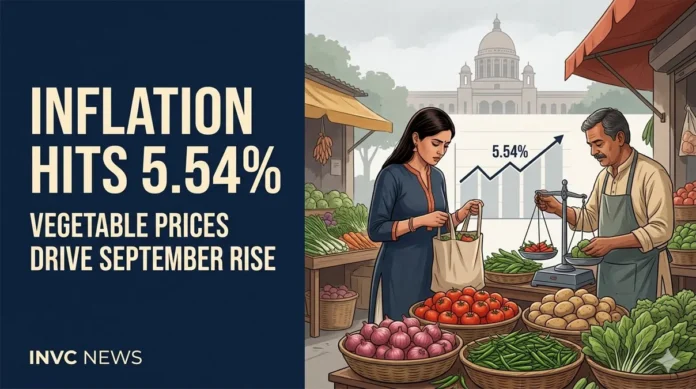
NEW DELHI, India — India’s retail inflation accelerated to 5.54% in September 2026, up from 4.83% in August, as rising food prices, particularly vegetables, placed renewed pressure on household budgets. The latest government figures released Monday mark the fourth consecutive month that consumer price inflation has remained above the Reserve Bank of India’s (RBI) 4% medium-term target.
The increase also brings inflation closer to the upper end of the RBI’s 2%–6% tolerance band, complicating the outlook for consumers, businesses, and monetary policymakers.
Food inflation climbed to 7.74% in September, while rural inflation rose to 6.08%, significantly exceeding the 4.88% recorded in urban areas. The figures suggest that rising prices are placing a particularly heavy burden on rural households, where food and essential goods account for a substantial share of spending.
Why Did Retail Inflation Rise in September?
Higher food prices were the principal driver of September’s inflation increase. Vegetables, including onions and other essential kitchen staples, contributed to the renewed pressure on consumers.
Several additional factors have complicated the price outlook. Elevated international crude oil prices can increase transportation, production, and distribution expenses. A weaker rupee can also make imported commodities more expensive, while uneven rainfall and El Niño-related weather risks may affect agricultural output and food supplies.
The combination of these pressures raises the possibility that price increases could extend beyond a limited number of food products. The RBI has already expressed concern about inflation spreading across a wider range of consumer goods and services.
September’s reading also exceeded the 5.40% median forecast in a Reuters poll of economists, underscoring how quickly the inflation outlook has deteriorated.
Rural Inflation Outpaces Urban Price Growth
The gap between rural and urban inflation was one of the most significant features of the September data.
Rural inflation increased to 6.08% from 5.24% in August, moving above the RBI’s 6% upper tolerance threshold on a year-over-year basis. Urban inflation rose to 4.88%, compared with 4.31% a month earlier.
The divergence matters because higher food and fuel expenses can absorb a larger proportion of household budgets, leaving less money for discretionary purchases, savings, and other essential expenses.
For rural consumers, persistent food inflation can be especially difficult to manage when the cost of basic goods rises faster than household income. Urban households may also face pressure from higher grocery bills, transportation costs, and other living expenses.
RBI Raises Repo Rate to 5.50%
The inflation increase follows the RBI’s October 7 monetary policy decision to raise the benchmark repo rate by 25 basis points to 5.50%. It was the central bank’s first rate increase since February 2023. The Monetary Policy Committee also shifted its policy stance to calibrated tightening, signaling a stronger emphasis on containing inflation risks.
A higher repo rate can increase banks’ funding costs and may eventually translate into more expensive loans for households and businesses. Borrowers with floating-rate loans could face higher repayments if lenders pass on the increase, although the timing and size of any change depend on individual loan terms and bank policies.
Higher rates are intended to restrain inflation by moderating demand and preventing temporary price shocks from becoming entrenched. However, monetary policy cannot immediately resolve supply-side problems such as poor harvests, disrupted supply chains, or higher international oil prices.
RBI Raises Its FY27 Inflation Forecast to 5.2%
The RBI has increased its consumer price inflation forecast for fiscal year 2026–27 to 5.2%, from 5.0% previously.
Its quarterly projections point to continued price pressures. The central bank expects inflation at 4.9% in the second quarter of FY27, 6.0% in the third quarter, and 5.7% in the fourth quarter. The projection for the first quarter of FY28 stands at 5.6%.
The RBI has identified deficient monsoon rainfall, El Niño conditions, elevated energy prices, and broader commodity-cost pressures as important risks. At the same time, adequate food-grain buffer stocks and timely government measures could help limit the effects of weather-related supply disruptions.
The revised forecast indicates that the central bank expects inflation to remain a significant policy challenge even as economic growth stays relatively strong.
What the Inflation Increase Means for Consumers and Markets
For households, higher retail inflation means that the same amount of money may buy fewer groceries and other essentials. If food and fuel prices remain elevated, families may have to reduce discretionary spending or draw more heavily on savings.
Businesses could also face higher transportation, raw-material, and operating expenses. Companies that cannot pass these increases on to customers may experience pressure on profit margins, while those that raise prices risk weakening consumer demand.
Financial markets will closely watch future inflation readings and RBI policy signals. Persistent price pressure could increase expectations of further monetary tightening, potentially affecting borrowing costs, bond yields, and equity valuations.
Outlook: Inflation Remains a Key Economic Risk
September’s 5.54% retail inflation rate highlights the challenge facing India’s policymakers as food prices, energy costs, and weather-related uncertainties converge.
The RBI’s recent rate hike and higher FY27 inflation projection reflect growing concern that price pressures could remain persistent. Future inflation readings will depend on food supply conditions, global oil prices, currency movements, and the extent to which higher costs spread across the economy.
For consumers, the immediate concern is the rising cost of everyday essentials. For policymakers, the challenge is to bring inflation closer to the 4% target without unnecessarily undermining economic growth.