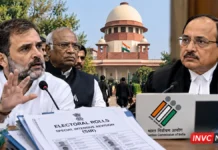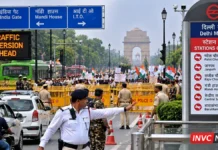
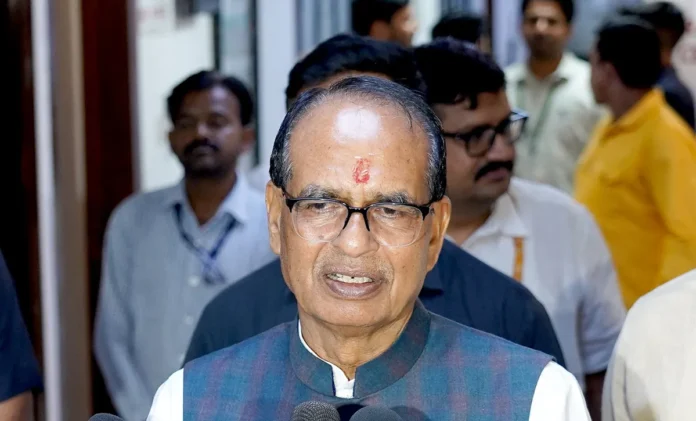
New Delhi, October 12, 2026 — Union Minister Shivraj Singh Chouhan launched a sharp attack on Congress leader Rahul Gandhi and the Congress party on Monday, October 12, ahead of the INDIA bloc’s planned march to the Supreme Court. Chouhan criticized Gandhi’s description of the opposition’s protest as “Shivji ki baraat,” questioned the Congress leadership’s response to electoral defeats, and accused the party of undermining constitutional institutions.
The remarks came amid escalating political tensions over the Election Commission of India, electoral-roll revisions, and opposition demands for Chief Election Commissioner Gyanesh Kumar’s resignation. Gandhi has described the protest movement as an effort to defend constitutional rights, while the BJP has challenged the opposition’s allegations and its approach to the demonstrations.
Chouhan Criticizes Rahul Gandhi’s ‘Shivji Ki Baraat’ Remark
Responding to Gandhi’s comparison of the opposition movement with “Shivji ki baraat,” Chouhan questioned the Congress leader’s invocation of Hindu religious imagery. He claimed that a party he accused of opposing Lord Ram was now referring to Lord Shiva while describing its political campaign.
Chouhan also dismissed the opposition march, using sharply critical language to characterize the demonstrators. His comments reflected the widening political dispute over Gandhi’s description of the protests as an evolving movement rather than a tightly structured political campaign.
Gandhi, meanwhile, has said that people from different backgrounds can join the demonstrations and that the movement will continue in different forms.
Congress Leadership, Not the Election Commission, Is Responsible, Chouhan Says
Chouhan argued that the Congress party should examine its leadership and internal problems rather than blame the Election Commission for its electoral setbacks.
He accused the party of questioning constitutional institutions after unfavorable political outcomes and invoked the Hindi proverb “Naach na jaane, aangan tedha,” which suggests that people sometimes blame their circumstances instead of acknowledging their own shortcomings.
The minister also referred to reported internal disagreements within Congress, including political tensions in Uttar Pradesh and organizational changes in Punjab. He argued that internal divisions had weakened the party’s position in several states.
These comments represent Chouhan’s political assessment of Congress’s performance, rather than an independently established explanation for the party’s electoral results.
Chouhan Cites Congress’s Long Absence From Power in Several States
The Union minister also highlighted the Congress party’s extended periods outside government in several states, including Tamil Nadu, West Bengal, Sikkim, Uttar Pradesh, and Bihar.
He argued that Congress has increasingly relied on regional allies to remain politically relevant in parts of the country, citing its relationships with the Dravida Munnetra Kazhagam (DMK) in Tamil Nadu, the Rashtriya Janata Dal (RJD) in Bihar, and regional parties in Uttar Pradesh.
His remarks formed part of a broader argument that Congress needs to address organizational weaknesses and strengthen its political base rather than focus primarily on its disputes with national institutions.
Allegations Against Constitutional Institutions and Foreign Influence
Chouhan further accused Congress of damaging public confidence in constitutional institutions. He alleged that the party criticizes the judiciary when court decisions do not go its way, questions the Election Commission after electoral defeats, and raises objections to security operations against terrorists.
He also alleged that Congress and its allies were benefiting from support linked to foreign interests, including references to billionaire George Soros and non-governmental organizations. Chouhan did not present evidence for those specific allegations in the remarks described here; they should therefore be understood as political accusations, not established facts.
The dispute comes as opposition parties challenge aspects of electoral-roll revisions and demand accountability from the Election Commission. The commission and the ruling BJP have faced criticism from opposition leaders, while the BJP has rejected claims that the electoral process is politically biased.
A Wider Political Confrontation
The exchange over “Shivji ki baraat” has become another flashpoint in the confrontation between the BJP and Congress. Beyond the religious reference, the dispute highlights a deeper disagreement over electoral integrity, the conduct of constitutional institutions, and the opposition’s right to protest.
While Chouhan has urged Congress to take responsibility for its political difficulties, Gandhi and INDIA bloc leaders have maintained that their campaign is intended to raise concerns about electoral processes and defend constitutional rights.
The competing claims underscore the continuing political tensions in New Delhi as the opposition presses its demands and the ruling party challenges its allegations.