By Team INVC | INVC NEWS
Published: October 10, 2026 | 10 : 25 AM IST
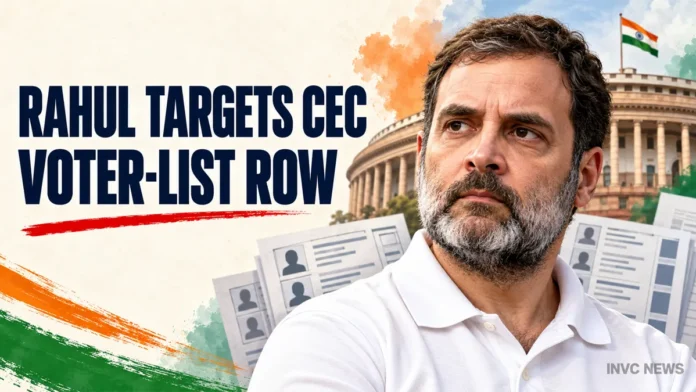
NEW DELHI, India | October 10, 2026 — Rahul Gandhi’s Gyanesh Kumar remarks have sharpened the confrontation over India’s voter lists, with the opposition leader predicting the departure of both the chief election commissioner and the central government. His latest message comes a day after INDIA bloc leaders took their electoral-manipulation allegations to President Droupadi Murmu.
“Gyanesh Kumar will go. This government will go. Then the repair of democracy will begin,” Gandhi wrote on X on Saturday, in a message translated from Hindi.
The statement sets out a political prediction. It does not announce Kumar’s resignation or any decision to remove him. However, it raises the stakes of an opposition campaign that now combines street protests, demands for changes to election procedures and appeals to constitutional authorities.
A three-line post with a wider political target
Gandhi, the leader of the opposition in the Lok Sabha, directed his message at both Kumar and the government. By linking their departure, he framed the voter-list dispute as a broader challenge to the administration rather than a disagreement with the Election Commission alone.
His post follows sustained opposition criticism of the Special Intensive Revision, or SIR, of electoral rolls. Opposition parties allege that the exercise has removed eligible voters and weakened confidence in the electoral process.
Those allegations remain contested. The available reporting does not establish Gandhi’s accusations against individual officials as findings of wrongdoing.
Opposition takes its demands to Rashtrapati Bhavan
On Friday, October 9, Congress president Mallikarjun Kharge, Gandhi, Trinamool Congress chief Mamata Banerjee and other INDIA bloc leaders met President Murmu.
Their memorandum sought Kumar’s resignation and the immediate suspension of SIR. It also demanded the restoration of voters whom the alliance claims authorities wrongly deleted from electoral rolls.
In addition, the opposition called for a return to paper ballots and sought the reversal of Assembly elections held over the past two years where, it argued, evidence of electoral manipulation had emerged.
These proposals go beyond the removal of one official. They challenge voter-registration decisions, voting methods and the legitimacy of election results that the alliance disputes.
President’s response becomes another point of contention
After the meeting, Gandhi alleged that PM Modi, Union Home Minister Amit Shah and Kumar had conspired to undermine Indian democracy. He also said President Murmu had sought evidence of alleged “vote theft” and interpreted her response as acceptance of the opposition’s account.
However, the President’s office disputed that characterization. According to reporting on its response, Rashtrapati Bhavan said Gandhi’s claims were incorrect and objected to drawing the President into the controversy.
That distinction matters: receiving a memorandum or requesting evidence does not, by itself, establish the allegations contained in it.
Kharge separately said the opposition would prepare and submit supporting material. Consequently, the evidence behind the alliance’s accusations remains central to the dispute.
Election Commission defends its decision-making
The Election Commission has also defended its institutional processes amid controversy over reported differences among its members.
In its response to reports of internal objections, the commission said differing views form a normal part of institutional deliberations. It maintained that its orders carry legal sanction and follow established statutory procedures.
Meanwhile, BJP president Nitin Nabin criticized the opposition campaign on Saturday, accusing its participants of trying to destabilize the country. His response underscored the competing political narratives surrounding the protests.
October 12 is the next announced step
Gandhi said opposition leaders planned to submit a memorandum to Chief Justice of India Surya Kant on Monday, October 12.
That remains an announced plan. It does not establish that the Chief Justice has agreed to a meeting, that the Supreme Court has accepted a case arising from the memorandum, or that any judicial decision will follow.
Before Friday’s presidential meeting, opposition MPs marched from Parliament House toward Vijay Chowk carrying a “Save Democracy” banner. Police stopped them at barricades, while the designated delegation proceeded to Rashtrapati Bhavan.
Why the dispute matters beyond the political slogans
For voters, the central issue concerns the accuracy of electoral rolls and the handling of disputed exclusions. For political parties, it concerns whether election authorities can maintain public confidence while responding to allegations of unfairness.
Gandhi’s post supplies the confrontation’s sharpest new slogan. The next substantive developments will depend on the evidence the opposition submits, the responses from the authorities it has approached and any formal proceedings that follow.
Until then, readers should distinguish demands from decisions: the opposition has called for Kumar’s exit, a halt to SIR and changes to voting procedures. Those demands do not themselves change an electoral roll, reverse an election result or remove an official.