By Team INVC | INVC NEWS
Published: October 9, 2026 | 12 : 13 PM IST
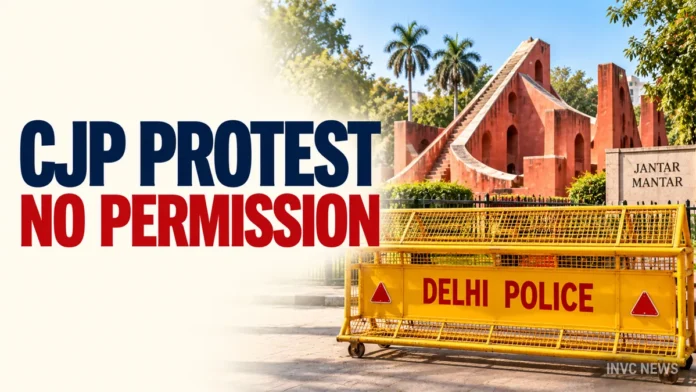
NEW DELHI, India | October 9, 2026 — The CJP protest planned for October 10 at Jantar Mantar faces a permission dispute before demonstrators reach the venue. Delhi Police say organizers failed to follow the prescribed procedure and submitted their notice too late. Police have also warned of action if the gathering proceeds without permission.
The Cockroach Janta Party, or CJP, announced the demonstration to demand the resignation of the Chief Election Commissioner. However, Joint Commissioner of Police Nupur Prasad said at a press briefing that authorities had not approved the proposed gathering.
According to Prasad, police received CJP’s letter on October 7. She cited procedural noncompliance and delayed notification as the reasons for withholding permission.
The announcement places the immediate focus on whether organizers will proceed, seek a revised arrangement or announce another course of action.
Police Explain Why Permission Was Not Granted
Prasad’s account centers on the process organizers followed before the proposed demonstration.
She said submitting the letter on October 7 did not satisfy the prescribed requirements for the October 10 event. Consequently, police had not granted permission for the gathering at Jantar Mantar.
The distinction matters for anyone considering attending: an organizer’s announcement and police authorization represent separate developments. A widely circulated protest invitation does not establish that authorities have approved the event.
At the same time, the police explanation concerns the permission process. It does not determine the merits of CJP’s political demand.
October 7 Letter Becomes Central to the Dispute
The date of the organizers’ communication now sits at the center of the disagreement.
Earlier reporting identified CJP co-convenor Saurav Das as the person who submitted formal notice of the October 10 demonstration at Parliament Street police station. Das maintained that the organization had informed police and questioned the requirement for permission to protest at a designated demonstration site.
He also said CJP would cooperate with police and expected cooperation in return.
Therefore, the disagreement extends beyond whether a letter reached the authorities. Police say the organizers did not comply with the required procedure. CJP’s earlier position questions the permission framework itself.
Neither position should disappear from the account. Readers need both to understand why the planned gathering has become a dispute before its scheduled start.
Police Warn of Action if the Gathering Goes Ahead
Prasad said police would take action under Section 163 of the Bharatiya Nagarik Suraksha Sanhita, or BNSS, if CJP proceeded with the demonstration despite the lack of permission.
That statement constitutes a warning about a possible next step. It does not establish that the October 10 gathering has already taken place or that police have taken action against its participants.
Similarly, the briefing does not supply a final account of how events will unfold on Saturday. Any subsequent police action, revised permission or change in the organizers’ plans would require a separate update.
For now, the confirmed position in the police briefing remains clear: the proposed Jantar Mantar demonstration does not have permission.
What Prospective Attendees Should Check
Anyone planning to travel for the event should check the latest communication from both organizers and authorities before leaving.
First, confirm whether CJP has changed the venue, timing or format. Next, look for any revised police statement concerning permission or access to the area.
Moreover, treat an old poster or forwarded message as an announcement rather than a current status report. A message can continue circulating after circumstances change.
The information in the police briefing does not, by itself, confirm specific road closures, Metro suspensions or restrictions elsewhere in Delhi. Readers should check separate official advisories for those details.
The Next Development to Watch
CJP’s demand for the Chief Election Commissioner’s resignation provides the political purpose of the protest. However, the immediate question concerns what happens after the police refusal.
Will organizers maintain the October 10 plan? Will they submit further communication or seek an alternative arrangement? Will authorities revise their position?
The available briefing does not answer those questions. Until a fresh announcement provides clarity, the story rests on three points: CJP has announced a protest, police have withheld permission, and Prasad has warned of action if it proceeds.
For readers, keeping those developments separate helps distinguish a planned demonstration from an authorized gathering—and a police warning from an action that has already occurred.