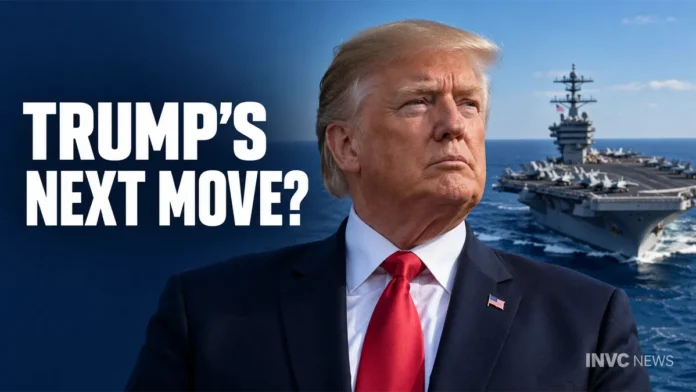
A reported Camp David meeting and military reinforcements raise questions about Washington’s next move. However, the available evidence does not establish a decision to attack Iran before the November election.
By Team INVC | INVC NEWS
Published: October 7, 2026 | 07 : 58 AM IST
WASHINGTON, United States | October 7, 2026 —
The U.S. military buildup in the Middle East has put President Donald Trump’s next Iran decision under renewed scrutiny ahead of November’s midterm elections. Additional ships and personnel could expand Washington’s options as diplomacy struggles. However, the distinction between preparing military capacity and ordering an operation remains critical. Reports of reinforcements and high-level discussions do not establish that Trump has approved an attack—or that three American aircraft carriers already operate inside the Strait of Hormuz.
INVC NEWS | BEYOND THE HEADLINE
THE 60-SECOND BRIEF
- The United States is sending additional naval forces to the Middle East.
- Reports describe approximately 200 U.S. personnel providing support in Saudi Arabia.
- Trump’s advisers reportedly discussed Iran and Yemen at Camp David.
- The November 3 election adds political context, but it does not establish a military timetable.
What the carrier deployment actually shows
The Associated Press reported that roughly 9,000 sailors and Marines were heading to the Middle East aboard naval formations that include the USS Theodore Roosevelt carrier strike group and USS Makin Island amphibious group.
An official said the deployment could produce a three-carrier presence by late October. AP placed the prospective naval personnel total above 20,000.
Separately, the Financial Times reported a later expected arrival for the Roosevelt, by the end of November. It said the carrier could replace an existing vessel or join the force.
Consequently, the reporting does not establish three carriers simultaneously stationed in Hormuz. Arrival schedules and rotations affect the eventual deployment.
Why the “60,000 troops in Hormuz” claim needs qualification
Regional troop strength and personnel aboard naval formations describe different things.
The Financial Times reported an existing American military presence exceeding 50,000 across the Middle East, alongside the planned reinforcements. That broader regional figure should not become a claim that approximately 60,000 personnel have assembled at Hormuz.
Moreover, adding deployment figures mechanically can mislead when incoming forces replace existing units.
The practical distinction matters: a regional military presence includes forces operating across multiple locations and roles. It does not identify where every service member is stationed.
What the Saudi deployment means
Times of India, citing Axios, reported that approximately 200 American military personnel were providing intelligence, targeting and other support in Saudi Arabia.
The report described Washington’s role as non-combat assistance and said the administration had declined Saudi requests for direct American strikes against the Houthis at that stage.
Supporting another country’s campaign can still carry strategic consequences. Nevertheless, assistance with intelligence or planning differs from American forces conducting airstrikes.
The Saudi-Houthi conflict also involves the Red Sea and Bab al-Mandeb. Those developments should not automatically become evidence of an American attack plan for Hormuz.
Camp David discussions raise questions, not certainty
Axios reported that Trump’s senior advisers met at Camp David to discuss Iran and the Saudi-Houthi conflict.
A high-level meeting can address diplomacy, military readiness and contingency planning. Its occurrence alone cannot establish which option the president has selected.
Therefore, describing the gathering as proof of an imminent operation would go beyond the available evidence.
Why the midterms matter
Americans will vote on November 3 in elections that determine control of Congress. Voters do not directly elect or remove the president in a midterm election.
However, congressional control can influence legislation, spending, oversight and the administration’s ability to advance its agenda. The outcome therefore carries consequences for Trump’s remaining term.
That political context makes Iran policy an important campaign issue. It does not prove that election calculations determine the timing of military action.
In fact, AP reported that Trump had described increased bombing after the election as a possibility. That statement leaves a pre-election escalation unconfirmed.
What readers should watch next
The strongest indicators would be an official operational announcement, confirmation of arrivals and rotations, or a substantive diplomatic agreement.
Until then, distinguish three developments: forces moving toward a region, forces arriving there and forces receiving orders to conduct an operation.
For readers concerned about regional security and energy supplies, those distinctions make this story worth following. The military buildup expands Washington’s potential options; the evidence available so far does not settle which option Trump will choose.