By Team INVC | INVC NEWS
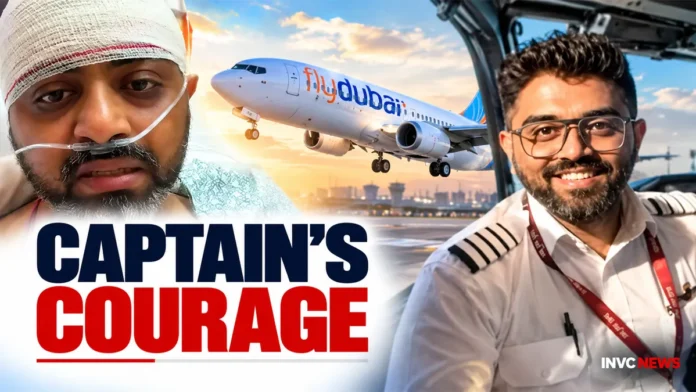
ABU DHABI, United Arab Emirates | October 4, 2026 — An injured captain’s effort to reach the cockpit door helped others intervene during the Flydubai cockpit attack, according to his account of the emergency. Indian Captain Smit Machchhar described opening the door despite repeated blows and impaired vision. Meanwhile, the UAE Attorney-General said investigators found that the co-pilot used a crash axe and attempted a terrorist act. A separate report that the suspect previously lost flying duties at Oman Air now raises an urgent question: what information followed him when he joined another airline?
THE 60-SECOND BRIEF
- The incident occurred aboard flight FZ1073 on September 30.
- The aircraft diverted from its Dubai–Tel Aviv journey to Tabuk, Saudi Arabia.
- UAE investigators say the co-pilot attacked the captain and tried to seize control.
- Machchhar described how he reopened the cockpit door after the attacker closed it.
- Others then entered and helped overpower the suspect.
- Reports about a previous flying restriction rely on unnamed sources.
- Investigators continue examining motives, possible links and technical evidence.
What Happened
The UAE Attorney-General, Hamad Saif Al Shamsi, announced the investigation’s preliminary findings on October 3.
According to his statement, the co-pilot began executing a plan during the flight, attacked the captain inside the flight deck with a crash axe and attempted to take control of the aircraft.
The official statement identifies the incident as an attempted terrorist act. However, it also makes clear that investigators have further work to complete.
Authorities continue examining physical and digital evidence. They will announce final findings after the necessary procedures conclude.
Consequently, the official classification does not settle every question about motive, planning or outside involvement.
How the Captain Helped Others Reach the Cockpit
Machchhar recounted the attack during an October 3 video call with Israeli Prime Minister Benjamin Netanyahu.
According to Indian Express’s account of that conversation, the captain initially struggled to understand the first blow. Further strikes impaired his vision as he felt the aircraft descending.
Despite his injuries, he reached the cockpit door and opened it. He said the attacker closed it again and that he fell to the floor.
Then he made another effort to open the door.
People waiting outside entered, overpowered the co-pilot and helped restore control of the cockpit, according to the captain’s account.
His actions formed a critical part of the intervention. Nevertheless, the account also credits those who entered and assisted; it does not establish that he handled every stage of the recovery alone.
Why the Earlier Flying Restriction Matters
Associated Press identified the suspect as Omani national Hamam al-Hammami, citing people familiar with the matter.
AP also reported that concerns about extremist views had led to a flying restriction at Oman Air and a move to an administrative role. A source said Flydubai subsequently hired him.
Those details raise questions about recruitment and information sharing. However, they remain source-based reporting rather than findings established in the UAE statement.
The available accounts do not prove that Flydubai knowingly disregarded a formal warning. They also do not establish a worldwide license revocation.
Investigators will need to determine the restriction’s precise scope, the records available to the hiring airline and the checks it performed.
What Each Side Says
The UAE’s official position concerns the attack and the continuing investigation.
Machchhar’s account explains his experience inside the cockpit and his efforts to let others enter.
The reports about the suspect’s employment history address a separate issue: whether earlier concerns should have influenced later hiring or flight assignments.
These accounts should remain distinct. A survivor’s recollection, an investigative statement and confidential-source reporting provide different kinds of evidence.
Numbers That Matter
FZ1073: The flight identifier.
September 30: The incident date.
October 3: The date of the UAE statement and the captain’s reported conversation with Netanyahu.
October 4: The publication date of this update.
The chronology matters because the latest investigation details emerged several days after the emergency. They do not describe a new attack today.
The Bigger Picture
INVC NEWS’s assessment is that the employment-history question deserves scrutiny alongside the cockpit investigation.
An airline’s screening process may involve information from several institutions. Establishing responsibility requires identifying what each institution knew, when it knew it and what it communicated.
Likewise, a restriction imposed by one employer can differ from a regulator’s licensing decision. Treating them as identical would obscure the question investigators need to answer.
The case therefore demands specific records rather than assumptions based on nationality or background.
What Happens Next
The UAE says investigators will complete technical examinations and analyze the evidence before releasing final results.
Further findings may clarify the planning, the sequence of events and whether anyone else had a connection to the incident.
Separately, verified employment and regulatory records could establish the earlier restriction’s scope and how the suspect later obtained flying duties.
INVC NEWS Bottom Line
Machchhar’s account describes a determined effort to open the cockpit door despite serious injury, allowing others to intervene. The UAE has classified the incident as an attempted terrorist act. The remaining questions concern the full chain of events, possible links and what airlines knew about the suspect before the flight.