By Team INVC | INVC NEWS
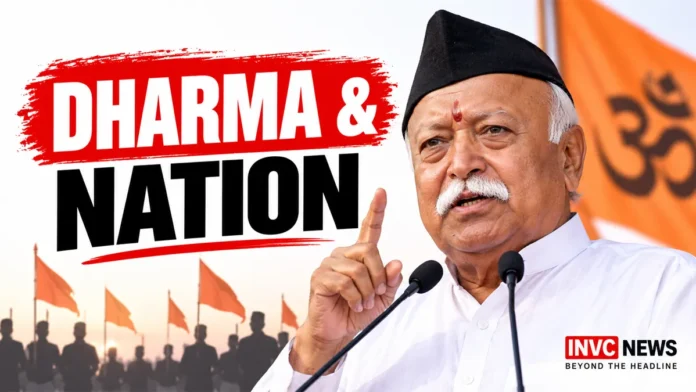
MUMBAI, India | October 2, 2026 — Can a country’s spiritual inheritance help it address problems that economic growth alone cannot solve? RSS chief Mohan Bhagwat’s Mumbai speech placed that question at the center of his argument about India’s future. Speaking on the relationship between dharma and national life, he said India’s knowledge traditions could help a world struggling to balance development with environmental protection, individual freedom with family life, and religious belief with peaceful coexistence.
His central assertion: India’s national strength and its spiritual foundations depend on each other.
INVC NEWS | BEYOND THE HEADLINE
THE 60-SECOND BRIEF
- Bhagwat said India cannot view dharma and the nation as separate from each other.
- He addressed the 14th conference of the Akhil Bharatiya Vihar Seva Samuh in Mumbai.
- He drew on Hindu, Jain, Buddhist and Sikh texts to describe India’s knowledge inheritance.
- He presented the preservation of spiritual traditions and their custodians as a service to humanity.
What Happened: Bhagwat Connects National Strength With Dharma
Rashtriya Swayamsevak Sangh chief Mohan Bhagwat argued that dharma supports the nation, while national strength helps sustain dharma.
In his account, the relationship works in both directions. A weakened nation affects its spiritual traditions; therefore, nurturing both represents a shared responsibility.
His remarks offered a view of national identity rooted in India’s spiritual and intellectual inheritance. He connected that inheritance with a wider question: how India should contribute to the world.
For readers, the distinction matters. Bhagwat was presenting his understanding of the nation’s purpose and cultural foundations. The speech itself does not establish a government policy or announce a change in law.
Why It Matters: The Everyday Choices Behind the Global Argument
Bhagwat identified tensions that reach beyond diplomatic meetings or philosophical discussions.
Development and environmental protection, for example, involve decisions about how societies pursue prosperity. Similarly, individual freedom and family life raise questions about autonomy, relationships and responsibility.
He also pointed to the challenge of reconciling religious faith with conflict.
According to Bhagwat, the world often struggles to maintain balance, with attempts to address one problem creating another.
The significance of his argument lies in the standard it sets for progress. As a reading of the speech, his message asks whether material advancement can endure without ethical responsibility and social balance.
That question gives the remarks relevance beyond the conference audience. It concerns the relationship between personal choices, community life and national ambition.
From the Vedas to the Guru Granth Sahib
Bhagwat referred to the Vedas, Upanishads, Ramayana, Mahabharata and Bhagavad Gita. He also cited Jain Agamas, the Buddhist Tripitaka, the Guru Granth Sahib and the teachings of saints.
The range of references formed an important part of his presentation. He drew from several Indian spiritual traditions when describing the knowledge he believes the world needs.
Furthermore, he linked devotion and surrender with a person’s approach to the divine.
For readers assessing the speech, the full list supplies useful context. Reducing the address to a single phrase about religion and nation would leave out the breadth of the traditions he invoked.
India’s Global Role: A Claim About Knowledge and Influence
Bhagwat said India had historically shared its knowledge without occupying other countries or converting their populations.
That broad historical characterization represents his assertion. Likewise, his statement that the world looks toward India for solutions expresses his assessment of the country’s potential role.
The practical question that follows is how spiritual ideas translate into outcomes.
A claim about global contribution becomes more meaningful when people can connect it with cooperation, responsible conduct and solutions that improve lives. This is the broader issue raised by his argument, rather than a specific program announced at the conference.
Protecting the People Who Carry Traditions Forward
Bhagwat also emphasized the people who preserve and transmit spiritual knowledge.
He described protecting their lives and traditions as more than a religious responsibility. In his view, that work serves humanity by safeguarding knowledge that could benefit future generations.
Consequently, his message connected cultural preservation with the future, rather than treating inheritance solely as a matter of remembering the past.
INVC NEWS Bottom Line
Bhagwat’s Mumbai address tied India’s national purpose to its spiritual inheritance and argued that both require care. Its central question extends beyond the headline: how can a society turn inherited wisdom into responsible action? That is where his vision of India’s global role will ultimately invite scrutiny—through the contribution it makes to people’s lives.