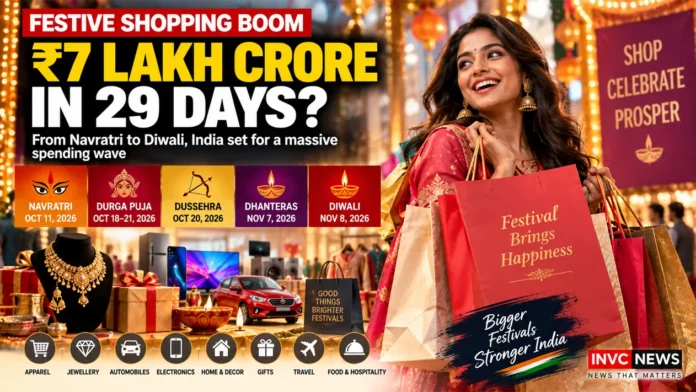
NEW DELHI, India | September 23, 2026 — India’s biggest shopping season is approaching, and retailers are preparing for a massive consumer-spending wave stretching from Navratri to Diwali.
Industry estimates indicate that festive trade across goods and services could approach ₹7 lakh crore as households spend on jewellery, automobiles, electronics, apparel, home improvement, gifts, sweets, travel and religious purchases.
The key 29-day festive window begins with Shardiya Navratri on October 11 and runs through Diwali on November 8, 2026.
Inside that window will come Durga Puja, Dussehra, Karwa Chauth, Dhanteras and several regional festivals — creating repeated buying occasions instead of a single shopping weekend.
For India’s retailers, this could become one of the most important commercial periods of 2026.
Why the 29 Days Matter So Much
Festive shopping in India rarely begins on Diwali itself.
Households start purchasing during Navratri, while demand accelerates around Durga Puja and Dussehra before reaching another peak during Dhanteras and Diwali.
This year:
Navratri begins: October 11
Durga Puja main celebrations: October 18-21
Dussehra: October 20
Diwali: November 8
That creates nearly a month of continuous festival-led consumption.
For retailers, the advantage is simple: consumers do not spend on just one category or one occasion.
A family may buy clothes during Navratri, electronics around Dussehra, gold on Dhanteras and gifts or home products before Diwali.
That multiplies the number of purchase occasions.
Can Festive Trade Really Reach ₹7 Lakh Crore?
The ₹7 lakh crore figure should be treated as an industry projection, not guaranteed sales.
However, recent festive-season data explains why traders are optimistic.
India’s Diwali trade in 2025 was estimated at around ₹6.05 lakh crore, including approximately ₹5.40 lakh crore in goods and ₹65,000 crore in services.
That already established a very high base.
If consumer demand continues growing across physical retail, ecommerce, automobiles, jewellery and services, overall festive activity around the ₹7 lakh crore level becomes a significant market benchmark rather than an impossible number.
Online Festive Sales Could Cross ₹1.5 Lakh Crore
Digital commerce will take a major share of the spending boom.
Current industry projections place India’s festive online sales at roughly ₹1.5-1.55 lakh crore in 2026, representing estimated growth of around 25-29% over last year.
Quick-commerce companies are also becoming increasingly important.
Instead of using apps only for groceries, consumers now order gifts, sweets, decorations, beauty products, small electronics and puja supplies for same-day delivery.
This means the festive battle will happen simultaneously across malls, traditional markets, ecommerce platforms and quick-commerce apps.
Jewellery Could Be One of the Biggest Winners
Gold and jewellery traditionally receive a major boost during the festive season.
Dhanteras provides the strongest trigger, but jewellery buying often begins earlier during Navratri and Durga Puja.
Consumers also purchase:
Gold coins
Silver coins
Jewellery
Wedding jewellery
Religious silver articles
Investment-oriented precious metals
However, high gold prices can change the mix of purchases.
Instead of abandoning buying altogether, customers may shift toward lighter jewellery, smaller coins or lower-ticket products.
Automobile Dealers Prepare for Festive Deliveries
Cars and two-wheelers represent another major spending category.
Automobile dealerships typically build inventory before the festival rush because many buyers prefer to take delivery on auspicious dates.
Industry data already showed passenger-vehicle dealers entering the season with inventory of around 33-35 days, substantially healthier than the unusually high inventory levels seen a year earlier.
Navratri and Dussehra could therefore become crucial sales checkpoints for manufacturers.
Discounts, exchange bonuses and financing schemes may further influence demand.
Smartphones, TVs and Appliances Enter Peak Season
Electronics companies also depend heavily on festive demand.
Some of the most aggressively promoted categories are likely to include:
Smartphones
Smart TVs
Laptops and tablets
Refrigerators
Washing machines
Air conditioners
Kitchen appliances
Wearables
Large ecommerce sales and retailer discounts can bring forward purchases that consumers may otherwise have postponed.
Banks and payment companies typically add another layer of discounts through card offers, EMIs and cashback programmes.
Durga Puja Creates a Powerful Regional Economy
Durga Puja is especially important for West Bengal and eastern India.
Spending extends far beyond religious purchases.
Apparel, jewellery, restaurants, travel, transport, entertainment, temporary employment, advertising and pandal-related services all benefit.
The 2026 Durga Puja calendar places the principal celebrations in the second half of October, directly inside the Navratri-to-Diwali commercial window.
That makes eastern India one of the major regional consumption centres before the national Diwali peak arrives.
Small Traders Could Capture a Large Share
The festive economy is not limited to large corporations.
Traditional neighbourhood businesses remain central to Indian festive shopping.
Demand spreads across:
Clothing shops
Sweet shops
Dry-fruit sellers
Decorative-light vendors
Florists
Gift shops
Utensil sellers
Jewellers
Furniture stores
Local markets
Street vendors
Puja-material sellers
This widespread spending means festive consumption moves money through thousands of local economies simultaneously.
For small traders and MSMEs, the weeks ahead can determine a significant share of annual revenue.
‘Made in India’ Could Remain a Major Consumer Theme
Recent festive seasons have also shown stronger consumer interest in domestically manufactured products.
In 2025, trade estimates suggested that a large majority of festive shoppers preferred Indian-made goods.
That trend could benefit local manufacturers of decorative items, lighting, handicrafts, clothing, gifts and traditional products.
It also reduces reliance on imported festive merchandise in some categories.
Services Will Earn Alongside Retail
The festive boom will not stop at physical products.
Restaurants, hotels, travel companies, salons, event organisers, decorators, photographers and delivery services also experience higher demand.
Consumers increasingly spend on experiences as well as products.
That helps explain why measuring the festive economy only through retail merchandise can underestimate its total commercial impact.
What Could Slow the Shopping Boom?
The optimistic forecast still faces risks.
High gold prices could constrain jewellery volumes.
Fuel and energy costs can put pressure on household budgets.
Global uncertainty may also affect consumer confidence.
Meanwhile, aggressive discounting can raise sales volumes without necessarily producing equally strong retailer profits.
Therefore, ₹7 lakh crore should be viewed as a measure of potential market activity rather than guaranteed economic gain.
Diwali Remains the Biggest Commercial Moment
Despite weeks of celebrations, Diwali remains the peak.
Dhanteras traditionally triggers purchases of gold, silver, vehicles, utensils and appliances.
Diwali then drives spending across gifts, sweets, clothing, decorations, electronics and household goods.
For many businesses, the final week before November 8 could produce the highest sales volumes of the entire festive season.
A ₹7 Lakh Crore Test of Indian Consumer Confidence
India’s 2026 festive season will therefore be more than a celebration.
It will also provide a major real-time test of consumer confidence.
The 29 days from Navratri to Diwali will show whether households are prepared to increase discretionary spending despite global economic uncertainty.
If current industry expectations hold, nearly every major retail category — from gold and cars to smartphones, sweets and clothing — could participate in the surge.
And after a record-setting festive market last year, India’s traders are preparing for an even bigger prize in 2026.